
24 | Nonlocal Consciousness: What The Secret of Secrets Reveals About the Nature of Mind
~17 MINS READ
NONLOCAL CONSCIOUSNESS AND THE BRAIN-AS-RECEIVER MODEL. WHY DAN BROWN NAMED PSYCHEDELICS ONE OF THREE DOORWAYS TO PROVING CONSCIOUSNESS SURVIVES DEATH. THE PSYCHEDELIC PARADOX AND WHY LESS BRAIN ACTIVITY PRODUCES MORE EXPERIENCE. THE CONSCIOUSNESS SPECTRUM: FROM INTUITION AND REMOTE VIEWING TO PRECOGNITION AND FULL-SPECTRUM AWARENESS AT DEATH. WILLIAM JAMES’ TRANSMISSION THEORY, HUXLEY'S REDUCING VALVE, AMANDA FEILDING, AND THE BECKLEY FOUNDATION. PRESENTIMENT RESEARCH, THE GLOBAL CONSCIOUSNESS PROJECT, AND THE GOOD FRIDAY PSILOCYBIN EXPERIMENT. MKULTRA, PROJECT STARGATE, AND WHAT HAPPENS WHEN GOVERNMENTS WEAPONIZE CONSCIOUSNESS. TERROR MANAGEMENT THEORY, TWO PATHS THROUGH CEREMONY, AND WHY UNDERSTANDING THE NATURE OF MIND MAY BE THE MOST IMPORTANT WORK OF OUR TIME.
What if consciousness doesn't need a brain?
Iraq, 2004. A rocket landed within the kill radius. In that fraction of a second, time did not behave the way it is supposed to. It widened. My life appeared, not as metaphor, but as a compressed review of everything I had been and done. I could observe myself reacting automatically for survival while simultaneously wondering, from somewhere outside the reaction, whether I was going to make it.
Watching the body respond while something else watched the watching.
I did not understand what had happened. I only knew that whatever was doing the watching did not feel like it lived inside my skull. Researchers call it tachypsychia: the brain processes information so rapidly under extreme threat that subjective time expands. Bruce Greyson's research (see footnotes) found that 60 to 70 percent of near-death experiencers report time stopping or losing meaning entirely. But tachypsychia names the phenomenon. It does not explain who is watching.
That question has driven my every choice since: biomimicry at Arizona State, the Fourth Way, the hidden dimension I explored in Hyparxis, the hundreds of ceremonies, the work I do now as a guide. It is all one question. What are we, underneath everything we have been told we are?
The foundational assumption of Western science is that consciousness resides in our skull. That our brain manufactures us. That when it stops firing, we stop existing.
There is a growing body of peer-reviewed evidence that this model is not wrong but incomplete. That the brain does not produce consciousness at all, but receives it, the way a radio receives a signal it did not generate. And that psychedelics, meditation, and near-death experiences may be the most direct ways we have of demonstrating it.
That is also the premise of Dan Brown's The Secret of Secrets. Brown has spent his career turning Robert Langdon loose on the questions institutions prefer you never ask, from the secrets the Church tried to erase to the mysteries encoded in Washington, D.C.’s monuments. Each novel is a puzzle box wrapped around real science and real history. This time, Brown turns Langdon's attention to the nature of consciousness itself, dedicating multiple chapters to arguing that psychedelics are a primary portal for expanded awareness. Brown told NPR he started the book as a skeptic and came out the other end no longer fearing death at all. I would encourage anyone drawn to these ideas to read it. The surprises Brown builds into the plot deserve to be discovered on their own terms.
The drop does not create the ocean. The ocean was there first.

“My brain is only a receiver, in the Universe there is a core from which we obtain knowledge, strength and inspiration. I have not penetrated into the secrets of this core, but I know that it exists.”
Why Less Brain Produces More Mind
The central scientific puzzle is this: if the brain produces consciousness, then reducing brain activity should reduce experience. Less brain, less mind.
The opposite happens.
In 2012, Robin Carhart-Harris and his team at Imperial College London gave psilocybin to volunteers inside fMRI scanners. They found decreases only in activity, especially in the Default Mode Network, the part of the brain that maintains the ongoing story of who we are, the narrator I explored in Self-Remembering.
The volunteers came out of the scanner describing the most expansive experiences of their lives. Their brains had been doing less, not more. This has been confirmed across multiple imaging studies, including with LSD and ayahuasca.
In cardiac arrest wards, the Dutch cardiologist Pim van Lommel documented rich conscious experience during zero measurable brain activity. Carhart-Harris formalized these findings as the entropic brain hypothesis.
This paradox is fatal to the model of brain producing consciousness. If the brain is a filter constraining a pre-existing field of consciousness, then reducing brain activity is like lifting a veil. Like a desert after monsoon rain: when the hard-packed surface softens, what was dormant beneath finally breaks through. The brain was never the source. It is the bottleneck.
A man I will call M. came to ceremony as a committed atheist carrying a depression that had flattened his life for years. He was not looking for God. He was looking for relief. At five grams, time dissolved. He described falling through the floor of his own identity into something with no edges. No body, no name, no story. Just presence. When he came back, he was weeping. Not from sadness. From recognition. He said, "I have been arguing with something that was holding me the whole time." Less brain. More mind. The paradox lived.
The sacrament does not add anything to you. It removes what is in the way.
The Theory Your Doctor Was Never Taught
If the brain is not the source, then what is? In The Secret of Secrets, Brown pairs Langdon with Katherine Solomon, a brain scientist whose research into consciousness becomes the novel's central argument. The model she articulates draws on a 130-year scientific lineage. William James proposed a transmission-reception theory at Harvard in 1898. Henri Bergson argued the brain filters reality for survival. Aldous Huxley synthesized both into his reducing valve explanation in 1954.
Katherine Solomon identifies three doorways through the filter: death, psychedelics, and sudden moments of clarity. In those moments, the filter falls away, and we see more of reality. I experienced one such moment without any substance at all, a spontaneous opening, in Berlin a couple of decades ago that lasted months and reshaped everything that followed, a story I told in Beyond Belief.
Consider this. When you browse the internet, your awareness is not located inside your computer. When the computer shuts down, the internet does not disappear. The brain, in Katherine's model, works the same way. It accesses consciousness. It does not create it.
The novel also draws on the Akashic Record, the ancient concept of a universal field containing all knowledge and memory. In Katherine's framework, this is not a mystical metaphor. It is a description of what the brain-as-receiver model actually points to. The mystics did not have fMRI machines. They had attention. And attention, it turns out, was enough.
You are not the radio. You are what comes through it.
“Our normal waking consciousness is but one special type of consciousness, whilst all about it, parted from it by the filmiest of screens, there lie potential forms of consciousness entirely different.”
If other forms of consciousness lie just beyond that screen, the question becomes: what else is already here?
What Comes Through When the Filter Thins
Expanded awareness is not an on-off switch. It is a spectrum. Katherine presents the brain's filter as something that can be dialed. As the filter thins, other signals come through.
Intuition. Sensing who is calling before you answer the phone. Most people have experienced this and dismissed it as a coincidence.
Telepathy. Perceiving another's thoughts or emotions across distance. Documented in laboratory settings, still controversial.
Remote viewing. Perceiving locations the physical body has never visited. Studied in classified government programs for decades.
Precognition. Receiving information from events that have not yet occurred. Presentiment research at the Institute of Noetic Sciences (IONS) suggests that the body reacts to emotionally charged images milliseconds before they are randomly selected. Consider what that implies: the body knows before the event has been determined.
Full-spectrum awareness at death. Katherine argues that dying is not the dimming of a light. It is the removal of the lampshade.
Then there is sudden savant syndrome: a teenager is kicked in the head and wakes speaking fluent Spanish. A man hits his head and becomes a piano virtuoso overnight. If the brain is a receiver, then sudden savant syndrome raises a question that the production model cannot answer. The injury did not build new capacity. Something that was always broadcasting became accessible through a channel that had not been open before. The capacity was always broadcasting. The injury changed the channel.
The mystics were not deluded. They were early.
The Woman Who Made the Invisible Visible
March is Women's History Month, and there is no one I would rather honor than Amanda Feilding (1943 to 2025), called "the hidden hand behind the psychedelic renaissance." She established the Beckley Foundation with David Nutt, and together they published over 80 peer-reviewed papers.
The 2016 LSD brain images became iconic. On placebo: each network isolated. On LSD: a dense web of connectivity, boundaries dissolving. The Default Mode Network steps aside. The orchestra does not fall into chaos. It plays something larger.
Mrs. Feilding passed away at Beckley Park last year, saying she was excited to be on the cusp of discovering the ultimate mystery. Most people spend a lifetime avoiding that frontier. She spent hers buying it a ticket.
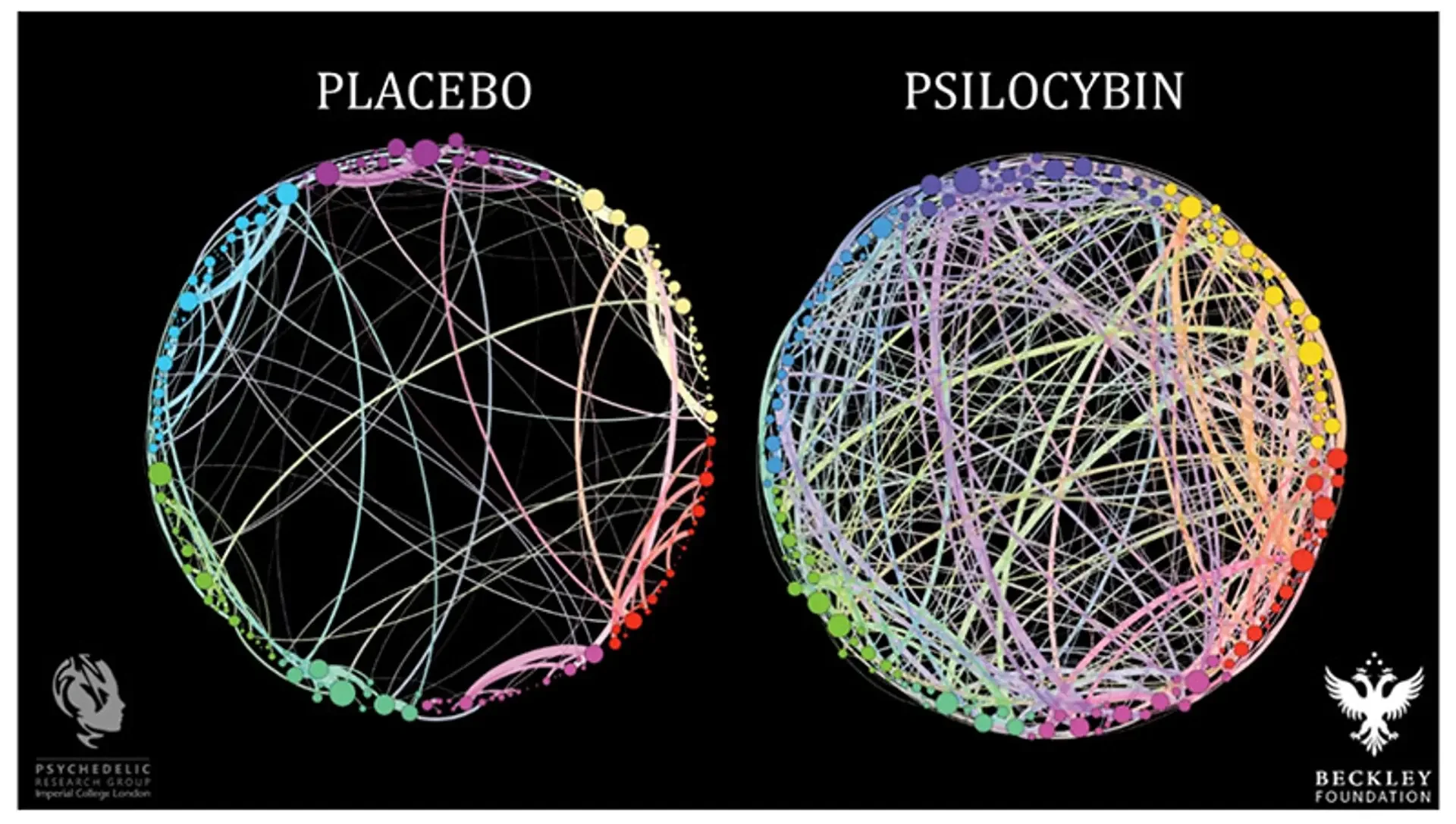
Image courtesy of the Beckley Foundation and Imperial College London, revealing expanded neural connectivity under psilocybin
What Harvard Proved and What Was Buried
Harvard, where William James first proposed the transmission theory, sits at the center of two defining chapters in psychedelic history.
The first is dark. The CIA's MKUltra program ran over 150 subprojects across two decades, testing LSD on soldiers, prisoners, and unsuspecting civilians. It was consciousness as a weapon. One of the most powerful intelligence agencies on earth studied the very substances it would later help criminalize, and when exposure threatened, it destroyed thousands of files.
The second is luminous. On Good Friday 1962, at Marsh Chapel, Harvard doctoral student Walter Pahnke administered psilocybin to ten divinity students in a double-blind experiment. The study grew from the broader Harvard Psilocybin Project led by Timothy Leary and Richard Alpert. Every subject reported profound mystical experience. Twenty-five years later, Rick Doblin tracked down the original subjects and found the effects had persisted across their entire lives. A single afternoon in a chapel basement. A quarter century of transformation. The lineage from 1962 to the Johns Hopkins Center for Psychedelic and Consciousness Research is direct and unbroken.
The political backlash that followed shut it all down. Not because the research failed. Because it succeeded in ways that threatened existing structures of authority. The research was never wrong. It was interrupted. And the questions it raised did not go away. They went underground.
When Governments Weaponize the Receiver
Brown imagines what happens when the same institutions that ran MKUltra gain access to modern neuroscience. I will not spoil what he builds, but the novel asks what happens when the brains-as-receiver model falls into the hands of institutions that see consciousness not as a birthright but as a resource to exploit.
Katherine's moral line is absolute: consciousness research must serve liberation, never control.
That tension is not fiction to me. When I served as a US Marine Security Guard and detachment commander at US Embassies in Russia, Germany, and Cyprus, holding a Top Secret clearance, I practiced remote viewing, astral projection, and lucid dreaming on my own time. I petitioned to become a remote viewer professionally. Every person in my chain of command looked me in the eye, time to come up with a lie!
Then retired viewers from Russian and British intelligence agencies, as well as those at Project Stargate, trained me. Stargate was the US government's classified remote viewing program, run through the Defense Intelligence Agency from the 1970s through 1995. The program was officially shuttered. But the people who had done it professionally taught me what they knew. I wrote about the broader reckoning in War After War.
The programs did not exist. Except they did. And the people running them were happy to teach a young Marine what his own government said was impossible. If there is a better metaphor for how institutions handle inconvenient consciousness, I have not found it.
When the Filter Cracks on Its Own
Not everyone chooses to thin the filter. Sometimes it ruptures.
Research published in Frontiers in Psychology found that psi experiences "emerge more easily during altered states of consciousness and tend to emerge during or after traumatic events." Stanislav and Christina Grof coined the term "spiritual emergency" to describe spontaneous openings that carry both transformational potential and genuine danger, especially without a container, a delimited context.
What makes these experiences remarkable is that they are not pathological. Etzel Cardeña and colleagues found that anomalous experiences "are neither necessary nor sufficient causes for psychopathology." They are, in the language of this post, what happens when the filter thins without permission.
I sometimes wonder whether what happened in Iraq cracked something open that did not close. Whether the moral injury of war, the slow fracturing of identity that happens when what you do and who you believe yourself to be can no longer coexist, loosened the filter in ways I did not choose and could not control. I do not know which came first: the shattering or the seeing. I am still learning how they are connected.
What I know is that Berlin, a few years later, became months of sustained, uninvited psi phenomena. Out-of-body experiences. Extrasensory perception. Psychokinesis. No substances were involved. Without a spiritual teacher or guide, what could have been the most meaningful period of my life became a spiritual emergency. I had no context, no container, no language. That absence is part of why I do this work now.
If you have ever had an experience you could not explain, a knowing that arrived before the evidence, a moment when time or space behaved differently than it should, you are not alone. The research suggests these experiences are far more common than our culture acknowledges. Most people dismiss them. Some are shaken by them. A few learn to work with them.
The Bridge Back
The Berlin opening drove me to seek meaning in everything that followed. Remote viewing. Contemplative practice. Eventually, the sacrament.
Psychedelics were not the origin of these experiences. They were a bridge back to them, and over time, a bridge toward integration, toward carrying what the sacrament continues to reveal into ordinary life.
For over a decade I have been mapping the edges of expanded perception. Biofeedback devices to monitor brainwave states during meditation. Specific breathwork and somatic practices on and off the sacrament. What I discovered is that this personal, intuitive work turns out to be remarkably close to what government classified programs studied for decades. I did not know that when I started. I only knew the territory was real because I had been there.
The body knows it before the mind agrees. Something in the chest opens. Something behind the eyes softens. And for a moment, the bandwidth widens. What we call "altered states" may be the least altered thing about us. They may be what consciousness actually looks like when the filter is not in the way. I explored the architecture of these crossings in Thresholds.
If separation itself is the illusion, then the question that matters is not whether the filter can be thinned. It is how. In my experience, there are two ways in.
“A human being is a part of the whole called by us universe, a part limited in time and space. He experiences himself, his thoughts and feeling as something separated from the rest, a kind of optical delusion of his consciousness.”
Two Doors Into the Same Room
They are not separate. They are phases of the same journey.
Clearing the receiver. Meeting grief, shame, and trauma so the static lifts and the signal comes through cleanly. Most people begin here. This is the work of healing, the work I wrote about in the Shame Addiction series.
Exploring the signal. Discovering what consciousness can access once the heaviest material has been met. This is the work of awakening.
Healing asks: can I stop hurting? Awakening asks: what am I when the pain is not running the show?
R. had done the clearing work across several ceremonies. He came to his fourth sitting not because anything was broken but because he sensed there was more. What opened had nothing to do with his personal history. He described a field of light in which every being he had ever known was present, not as memory but as living connections. He could feel the consciousness of people he had never met. He said: "I thought I was a drop trying to find the ocean. I had it backwards."
In the weeks after, he did not talk about visions. He talked about how differently he listened to people. How tenderness arrived in places it had not reached before. The mystical experience had not given him an escape from ordinary life. It had given him a reason to be more present inside it.
Once you have touched the field directly, the old story that you are broken loses its authority. I am still learning how to hold both doors at once. What I am seeing is a quiet migration. Like birds that feel the season turning before the temperature drops. More people arriving not because something is wrong, but because something in them knows there is more.
You do not fix a signal. You learn to receive it clearly.
The Fear That Runs the World
Fear of death is one of the engines that drives most human dysfunction. If the receiver model is even partially correct, that fear is based on a misunderstanding.
Brown draws on Terror Management Theory: fear of death makes us selfish, tribal, materialistic, and indifferent to the earth. The counter-finding is what matters. The 2006 Johns Hopkins psilocybin study, led by Roland Griffiths, found that a single session produced mystical experiences participants rated among the most meaningful of their lives. The effects persisted at fourteen-month follow-up. Subsequent research confirmed sustained decreases in death anxiety in those facing terminal illness. The grief underneath that fear, the grief of a life shaped by the assumption that it ends, is what I explored in the Grief series.
A client, S., arrived carrying a terminal diagnosis. During ceremony, she did not simply relax. She died. Not physically, but in the way the sacrament makes possible: the complete dissolution of identity, the boundary between self and everything else erasing. She was gone for hours.
When she opened her eyes, she said, quietly: "It is so much bigger than I thought. I have been afraid of the wrong thing my entire life." She was not speaking about the cancer. She was speaking about death itself. In the weeks that followed, she told me she felt thrust back into life, as though the ceremony had handed her back her days and said: use these. She began saying she was ready to live now. The diagnosis had not changed. Something deeper had.
“The elimination of the fear of death transforms the individual’s way of being in the world.”
At the Scottsdale Research Institute in Arizona, Dr. Sue Sisley is conducting the first FDA-approved clinical trial using whole psilocybin mushrooms to treat PTSD in veterans, firefighters, and police officers. Eight participants dose together, grouped by profession, with structured integration after. It is the first group-based model of its kind. The format reduces costs, builds communal support that isolation destroys, and opens a door to broader access through frameworks like state or federal "Right to Try Act" laws.
We sent these people to war. The least we can do is let them heal.
The horizon is closer than it looks. The AWARE study documented verified perception during cardiac arrest when the brain showed no measurable activity. A 2023 study in PNAS found a surge of organized brain activity at the moment of death, suggesting consciousness does not fade but intensifies as the body shuts down.
We are living inside a window of time in which the most fundamental question about human existence, whether awareness survives the body, is moving from philosophy to science. What emerges on the other side will reshape how we educate, how we grieve, how we govern, and whether our species can find its way to peace.
A species that knows what consciousness actually is has a chance. A species that does not will keep mistaking separation for reality and fear for wisdom.
Tuning the Receiver
Every contemplative tradition in history has been doing the same thing: learning to tune the receiver. Meditation builds the foundation that makes ceremony more productive. Ceremony reveals capacities that remote viewing and lucid dreaming can develop deliberately.
Brown describes how Mozart, handed a portable speaker playing his own symphony, would search for the orchestra inside the device. We are Mozart. We are listening to consciousness come through the speaker of our brains and looking inside for the orchestra. We cannot find it because it was never there.
Brown takes this further with a line that stopped me cold: "Muscles don't have memory. When you practice, you're fine-tuning your brain, gradually rewiring it to receive information more clearly from the universal consciousness." Even ordinary practice, in the receiver model, is tuning the instrument. The pianist's ten thousand hours did not build the music inside her fingers. They calibrated the antenna.
Here is where to begin.
Meditation. Start with the breath. Fifteen minutes a day. You are not building something new. You are quieting what obscures the signal. Over time, the narrator softens and the nervous system shifts toward equilibrium.
Ceremony. The sacrament can open in hours what meditation opens over years. But ceremony without a daily practice is a window into a room you have not yet learned to live in. I wrote about preparation in Psychedelic Preparation, and the red flags to watch for in Choosing a Psychedelic Guide.
Remote viewing. Have a friend place an object in a sealed envelope and practice receiving impressions before opening it. What matters is not initial accuracy. It is the willingness to notice what arrives before the rational mind edits it out.
Lucid dreaming. A nightly laboratory for exploring what awareness can do when the body's external receivers are offline. You already spend a third of your life in altered states. You might as well show up for them!
Self-remembering. Being aware of what you are perceiving while simultaneously aware that you are the one perceiving (see blog entry). The foundation beneath all the others. Also the hardest. I lose the thread a dozen times a day and start again.
None of these practices will give you certainty about the nature of consciousness. What they will give you is the door to direct experience. And direct experience is the only thing that has ever changed anyone's mind about what is real.
You cannot scroll your way to freedom. But you can sit still long enough to find it.
Questions to Sit With
Have you ever experienced something your current model of reality cannot explain?
What would change in how you live if you knew, with certainty, that consciousness survives the body?
What is the relationship between your fear of death and the way you show up in your closest relationships?
Are you clearing the receiver, or learning what it can access?
In Iraq, I asked a question with my body before I had words for it. Everything since has been the answer. The watcher I found outside my skull that day did not leave when the danger passed. It has been here the whole time, waiting for me to stop looking inside the radio for the signal.
Consciousness does not need a brain. It never did. M. discovered it when he stopped arguing with what was holding him. S. discovered it when she practiced dying and found herself thrust into life. R. discovered it when he realized the ocean was not somewhere else. None of them received new information. They received a new angle of seeing.
The only thing standing between you and a direct experience of this is the willingness to sit down, close your eyes, and listen.
“Sometimes a change in perspective is all it takes to reveal the Truth.”
If something in this post is still speaking to you, a free Ceremony Readiness Guide, biweekly Integration Circles, and a Discovery Call are there when the time is right. And if someone in your life is carrying a question that will not leave them alone, I would be grateful if you shared it. They may not have the word for why.
From my Heart to yours,
Yeshua Adonai
Psychedelic Guide
aboutyeshua.com
Yeshua is a traveling psychedelic guide currently based in Phoenix, Arizona. USMC combat veteran, former diplomat, and serial social entrepreneur devoted to mental health innovation, he has spent decades exploring contemplative traditions worldwide and learning to trust his own experience along the way.
Frequently Asked Questions
-
No. It is the latest novel in Dan Brown's Robert Langdon series, following Angels & Demons, The Da Vinci Code, and The Lost Symbol. Like its predecessors, it is a thriller built around real science and hidden history. This time, Brown turns Langdon's attention to the nature of consciousness, weaving research from Johns Hopkins School of Medicine, the Institute of Noetic Sciences, and declassified government psi programs into a fictional narrative. He told NPR he began as a skeptic and finished the book no longer fearing death. If the novel is a doorway, the sources behind it are the rooms worth exploring.
-
Not in the way gravity is proven. But it is no longer fringe. Peer-reviewed research from Imperial College London, Johns Hopkins, and the University of Virginia's Division of Perceptual Studies has documented phenomena the production model of consciousness cannot explain: expanded awareness during reduced brain activity, conscious experience during cardiac arrest, and physiological responses to events before they occur. The evidence is strong enough to take seriously and incomplete enough to hold with humility. That is where honest inquiry begins.
-
The idea that the brain does not produce consciousness but receives it, the way a radio receives a broadcast it did not generate. The model has a 130-year scientific lineagerunning from William James through Henri Bergson and Aldous Huxley to modern neuroimaging. What distinguishes it from philosophy is that the prediction it makes, that reducing brain activity should expand experience rather than diminish it, has been confirmed repeatedly in the lab. The receiver model does not claim to be proven. It claims to be the only framework that accounts for what the imaging data actually shows.
-
The Default Mode Network is a set of brain regions most active when you are not focused on the external world. It maintains your autobiographical self, the running story of who you are, what you have done, and what might happen next. It is, in effect, the narrator. Psychedelics quiet the DMN dramatically. When it steps aside, people consistently report ego dissolution, unity experiences, and a sense of consciousness expanding beyond personal identity. The DMN is not consciousness. It is the filter that keeps consciousness personal.
-
I would say: good. Skepticism is a form of respect for truth. What I would ask in return is whether the skepticism is directed at the evidence or at the implications. Most people who dismiss this work have not read Dr. Robin Carhart-Harris, Dr. Pim van Lommel, or Dr. Bruce Greyson. The discomfort is usually not with the data. It is with what the data suggests about the nature of identity and death. Start with the peer-reviewed literature and let the evidence do the talking.
-
A declassified US government program run through the Defense Intelligence Agency from the 1970s through 1995, testing whether military personnel could perceive distant locations through consciousness alone. Funded by the CIA and DIA, conducted at SRI International. Results remain disputed in the scientific community. The program was officially shuttered in 1995, but retired viewers trained me personally, and declassified files are available through the CIA's electronic reading room. Brown references the program in the novel and names Ingo Swann, one of its original participants.
-
Presentiment studies measure the body's physiological response to emotionally charged stimuli before the stimuli are randomly selected. Dean Radin, MS, PhD and colleagues at the Institute of Noetic Sciences (IONS) found that skin conductance, heart rate, and pupil dilation shift approximately 400 milliseconds before the image is chosen by a random number generator. The body appears to respond to an event that has not yet been determined. The effect is small but statistically robust and has been replicated across multiple independent laboratories. It does not prove precognition. It raises a question about the relationship between consciousness and time that no materialist model has answered.
-
The Global Consciousness Project placed random number generators at dozens of locations worldwide. During events of mass collective attention, including September 11, 2001, the generators documented a 7-sigma anomaly, a deviation from randomness so extreme it would occur by chance less than once in a trillion trials. The project does not prove nonlocal consciousness. It raises a question that materialist models have not been able to answer.
-
Most clinical trials have used synthetic psilocybin, a single isolated compound manufactured in a lab. Dr. Sue Sisley's work at the Scottsdale Research Institute uses whole psilocybin mushrooms, which contain a full spectrum of naturally co-occurring compounds. The distinction matters the way a single vitamin differs from whole food: context changes how the body receives it. The shift toward whole mushrooms aligns with how these sacraments have been used in indigenous and ceremonial settings for millennia.
-
I cannot give you certainty about its mechanism. I can tell you that the US government funded it for over two decades, that retired participants trained me, and that I have practiced for years with results I cannot explain through coincidence. The scientific debate remains open. What I trust is not a theory but a pattern of direct experience repeated across enough instances to take seriously.
-
No. Meditation, lucid dreaming, breathwork, and spontaneous openings, for example, can all thin the filter. My own most sustained period of expanded perception involved no substances at all. The sacrament is the most direct path I know, but it is not the only one. Many contemplative traditions have been tuning the receiver for thousands of years without it.
-
It means doing the inner work that lets the signal come through cleanly. In ceremony, this often looks like meeting the material your body has been carrying and letting it move. Grief surfaces. Shame loosens. The nervous system learns it is safe to feel again. In daily life, it looks like meditation, somatic practices, honest relationships, and the willingness to sit with what you have been avoiding. Most people begin here because the static is so loud they cannot hear anything else. The clearing does not end. But over time, the ratio shifts. Less static. More signal.
-
Any practice that opens the filter carries responsibility. Psychedelics amplify what is already present, which means unresolved trauma can surface with intensity. Set, setting, and the skill of whoever holds the space matter enormously. That is why I wrote about psychedelicpreparation and guide selection. The deeper risk, in my experience, is not the opening itself. It is the absence of integration afterward. Expanded perception without grounding becomes another form of disconnection.
-
Books
The Doors of Perception by Aldous Huxley (1954). The reducing valve metaphor that shaped the entire field.
The Varieties of Religious Experience by William James (1902). The philosophical foundation for the transmission-reception theory.
Consciousness Beyond Life by Pim van Lommel (2007). The Dutch cardiologist's landmark study of near-death experiences during cardiac arrest.
After by Bruce Greyson (2021). Decades of NDE research from the University of Virginia’s School of Medicine, Division of Perceptual Studies.
The Stormy Search for the Self by Stanislav Grof (1990). Spiritual emergency, spontaneous openings, and the transformational potential of nonordinary states.
How to Change Your Mind by Michael Pollan (2018). The cultural gateway that brought psychedelic research into mainstream conversation.
Real Magic by Dean Radin (2018). Presentiment, consciousness research, and the science behind phenomena most people dismiss.
The Secret of Secrets by Dan Brown (2025). The novel that weaves all of the above into a thriller and dedicates multiple chapters to psychedelics as a portal.
Organizations
Institute of Noetic Sciences. Founded by Apollo 14 astronaut Edgar Mitchell. Hosts the Global Consciousness Project and decades of presentiment research.
Johns Hopkins Center for Psychedelic and Consciousness Research. The leading clinical research program, from the landmark 2006 psilocybin study to ongoing trials.
Imperial College London Centre for Psychedelic Research. Robin Carhart-Harris's team. The entropic brain hypothesis and the fMRI studies that changed the field.
Beckley Foundation. Amanda Feilding's legacy. Over 80 peer-reviewed papers, including the iconic 2016 LSD brain images.
University of Virginia School of Medicine, Division of Perceptual Studies. The academic home of near-death experience, reincarnation, and consciousness-survival research since 1967.
Scottsdale Research Institute. Dr. Sue Sisley's FDA-approved clinical trial using whole psilocybin mushrooms for PTSD in veterans.
MAPS / Multidisciplinary Association for Psychedelic Studies. Rick Doblin's organization. The Good Friday follow-up study and decades of psychedelic policy advocacy.
Landmark Papers
Griffiths et al., "Psilocybin Can Occasion Mystical-Type Experiences", Psychopharmacology (2006). The Johns Hopkins study that reignited clinical psychedelic research.
Carhart-Harris et al., "The Entropic Brain", Frontiers in Human Neuroscience (2014). The theoretical framework for why reduced brain activity produces expanded experience.
Carhart-Harris et al., "Neural Correlates of the LSD Experience", PNAS (2016). The Beckley/Imperial brain images showing whole-brain connectivity under LSD.
van Lommel et al., "Near-Death Experience in Survivors of Cardiac Arrest", The Lancet (2001). Prospective study documenting conscious experience during zero brain activity.
Parnia et al., "AWARE Study", Resuscitation (2014). Verified perception during cardiac arrest across 15 hospitals.
Timmermann, "Surge of Neurophysiological Activity at Death", PNAS (2023). Evidence that consciousness intensifies rather than fades as the body shuts down.
Doblin, "Pahnke's Good Friday Experiment: A Long-Term Follow-Up", Journal of Transpersonal Psychology(1991). Twenty-five year follow-up confirming lasting effects of a single psilocybin session.
Blog Archive
explore the growing library
-
After the War
- Nov 17, 2025 05 | 11.11: War After War A Veteran’s Battle to Heal
-
Consciousness
- Aug 24, 2026 35 | Beholding: How the Chapel of Sacred Mirrors Returns Your Gaze
- Jun 1, 2026 29 | Leary's Eight Circuits: A Map of Consciousness That Both Frees and Binds
- May 18, 2026 28 | Cancer: The Other Healer in the Room
- Apr 20, 2026 26 | Harvard's Last Psychedelic Intersections Conference: A Practitioner's Review
- Mar 30, 2026 24 | Nonlocal Consciousness: What The Secret of Secrets Reveals About the Nature of Mind
- Mar 23, 2026 23 | Self-Remembering: When the Self Sees Itself
- Mar 16, 2026 22 | Hyparxis: The Dimension Where Real Change Becomes Possible
- Mar 9, 2026 21 | Thresholds: A Psychedelic Guide to Falling Apart on Purpose
-
Finding Purpose
- Jul 13, 2026 32 | Vows: How a Tree Learns to Love the Wind
- Apr 6, 2026 25 | Reset: What Becomes Available When You Choose to Dissolve
- Jan 26, 2026 15 | Beyond Belief: Psychedelics and the Post-Religious Spiritual Path
- Jan 5, 2026 12 | Beginning Again: The Practice of Presence Over Performance
- Dec 1, 2025 07 | Finding Purpose in Midlife: How to Regain Meaning
- Nov 24, 2025 06 | Unlock Leadership Potential With Psychedelic Coaching
-
Psychedelic Path
- Sep 21, 2026 37 | FDA public hearing: The Day the Sacred Was Ruled “Out of Scope”
- Aug 10, 2026 34 | Kaleidoscope: What Is Actually Happening Inside a Mushroom Journey
- Jun 29, 2026 31 | MDMA: Heart Medicine and the Oldest Name for God
- Jun 15, 2026 30 | Ketamine: The Mirror Molecule That Was Always Asking for a Witness
- Jan 19, 2026 14 | Microdosing Magic Mushrooms: A Guide to What Actually Works
- Dec 22, 2025 10 | From Darkness Into Light: Living the Insight
- Nov 3, 2025 03 | Ketamine Therapy Near Me: A Legal Pathway for Psychedelics
- Oct 27, 2025 02 | Arizona’s Psychedelic Awakening: Where Science Meets Soul
- Oct 20, 2025 01 | My Psychedelic Journey: A Path Through the Fog of Depression
-
Sacred Ceremony
- May 4, 2026 27 | Seekers Circle 25-26': Where Preparation Becomes Integration
- Feb 2, 2026 16 | Choosing a Psychedelic Guide: Questions Your Life Depends On
- Jan 12, 2026 13 | Psychedelic Preparation: The Work That Begins Before Ceremony
- Nov 10, 2025 04 | Magic Mushrooms: Remembering the Sacred Intelligence of Nature
-
Shadow Work
- Jul 27, 2026 33 | Bend: A Reckoning with the Feminine
- Mar 2, 2026 20 | The Shame Addiction: What the Body Learns (Part 3 of 3)
- Feb 23, 2026 19 | The Shame Addiction: What the Body Hides (Part 2 of 3)
- Feb 16, 2026 18 | The Shame Addiction: What the Body Carries (Part 1 of 3)
- Feb 9, 2026 17 | Stop Trying to Forgive: What Psilocybin and Grief Teach About Letting Go
- Dec 15, 2025 09 | Grief and the Path Back to Ourselves (part 2 of 2)
- Dec 8, 2025 08 | Grief and the Path Back to Ourselves (part 1 of 2)
- Tools for Integration
trending topics
- psilocybin
- psychedelic integration
- psychedelic guide
- harm reduction
- Arizona
- psychedelics
- integration
- transformation
- Fourth Way
- PTSD
- integration coaching
- letting go
- mental health
- nature
- neuroplasticity
- presence
- psychedelic preparation
- recovery
- self-awareness
- veterans healing
- Gurdjieff
- Long Now
- addiction
- alternative treatment
- becoming
- burnout
- combat veteran
- consciousness
- default mode network
- depression
- emotional healing
- ethics
- grief
- guide selection
- ketamine therapy
- legal
- loss
- magic mushrooms
- masculine and feminine
- mindfulness
- mushroom ceremony
- mystical experience
- personal growth
- plant medicine
- psychedelic healing
- red flags
- relationship healing
- relationships
- rites of passage
- sacred ceremony