
21 | Thresholds: A Psychedelic Guide to Falling Apart on Purpose
~17 MINS READ
HOW LIFE TRANSITIONS FOLLOW A THREE-PHASE ARCHITECTURE MAPPED BY EVERY WISDOM TRADITION. WHY THE SKILLS THAT BUILT YOUR LIFE CANNOT CROSS THE THRESHOLD. WHAT BIRTH, PSYCHEDELIC CEREMONY, AND THE NATURAL WORLD SHARE IN COMMON. WHAT PSILOCYBIN RESEARCH REVEALS ABOUT IDENTITY CHANGE AND THE NEUROSCIENCE OF LETTING GO. THE OUROBOROS AS THE OLDEST MAP OF TRANSFORMATION. AND HOW TO RECOGNIZE WHICH CROSSING YOU ARE IN RIGHT NOW.
“We suffer from a shortage of meaningful rites of passage.”
Whether you are navigating a midlife transition, preparing for psilocybin ceremony, grieving the end of a relationship, or standing in the disorienting space between who you have been and who you are becoming, this post maps the territory you are in. As a psychedelic guide and integration coach, I have come to see a pattern in life transitions so consistent it can only be called architecture. What follows draws from the anthropology of rites of passage, the neuroscience of psychedelic-assisted therapy, the Tibetan Buddhist teaching on bardos, the ancient symbol of the ouroboros, and the intelligence of the natural world to offer you a map for the crossing you are already in.
Something in you already knows.
Not the thinking part. Not the part that manages and plans and performs. Deeper than that. The part that wakes at 3 a.m. The part that feels the old container cracking before you have language for what is trying to come through.
You are being asked to cross.
Two Kinds of Living
Most of life is spent sustaining. Building structure. Performing roles. Holding things together through discipline and devotion. This is not wrong. Every functioning life requires it.
Sustaining asks: how do I hold this together? It rewards control, endurance, and performance. It builds the container. It is the roots holding the tree steady through the wind.
But periodically, something shifts. An identity that once fit begins to constrict. The skills that built the life stop working. That is not failure. That is a threshold to be crossed, announcing itself.
Crossing asks: what is asking to fall apart? It rewards surrender, presence, and trust. It is what happens when you outgrow the container. It is the leaves falling so the tree can survive winter.
Same tree. Different seasons. The dance between them is the whole life. Most of the people who come to me have spent years applying sustaining tools to a crossing situation. That is not a character flaw. It is the only language they were taught.
In my work, I do not just support people through psychedelic experiences. I support them through transitions. A psychedelic experience, like a birth, is part of a larger process. Life is attempting to move through us. Not just insight, but initiation. Not just healing, but transformation. If you are curious about how this path began for me, My Psychedelic Journey is where I tell that story.
That is why I speak in the language of thresholds. The gap between what was and what is becoming is not a mistake. It is the terrain of transformation. What got you here will not get you there, because "there" requires a version of you that does not yet exist. The body knows this before the mind does. You feel it as restlessness, as grief that has no object, as the strange sensation of being homesick inside your own life.
“And the day came when the risk to remain tight in a bud was more painful than the risk it took to blossom.
”
The Architecture of Crossing
A threshold is not a step. It is a passage. A lived crossing from one way of being into another. It may come through crisis or stillness, but it always asks something of us: a letting go, a surrender, a remembering.
In 1909, the anthropologist Arnold van Gennep discovered that rites of passage across every culture follow the same three-phase structure, a finding he published in his landmark work The Rites of Passage. Victor Turner deepened the work. William Bridges brought it into popular language with his book Transitions, named one of the fifty most important self-help books ever written. Those three phases have not changed in a century of study because they were never invented. It was observed.
The Ending. Every crossing begins with the old thing dying. The relationship. The role. The belief about who you are. Most people try to skip this. But the seed cannot sprout until the coat cracks open.
The In-Between. Turner called this liminality, from the Latin for threshold. People in this space are "betwixt and between," stripped of their former identity, reduced to raw material waiting to be reshaped. Bridges called it the neutral zone. I call it the gap. It feels like failure. It is actually the most creative and sacred phase of the entire process.
The New Beginning. This arrives not when we force it but when the crossing has been honored. You feel it in your bones. An old pattern drops. A mask loosens. Your nervous system softens. You begin choosing differently, not from effort but from clarity. You do not fit in your old skin anymore. Something in you has already crossed.
The philosopher J.G. Bennett named a dimension he called hyparxis, the dimension in which genuine change of being becomes possible. He defined it as "the hole through which an entity can become other than itself." At a threshold, anyone who has sat in ceremony, or in deep grief, or at the bedside of someone dying, has touched this. The strange widening of the present moment where past and future fold into now. That is where transformation actually occurs.
This transformation unfolds on many levels at once:
On a ceremony level, you enter, dissolve, emerge. On a life level, you shift into a new phase of purpose, clarity, or healing. On a soul level, you join a timeless spiral of death and rebirth. On a collective level, your transformation echoes outward into family, culture, and Nature.
You are not separate. You are part of an interdependent web of becoming. Each threshold crossed is part of a wider dance.
The major crossings of a human life include birth itself, the end of childhood, partnership, parenthood, the midlife passage when the ego constructed in the first half of life must surrender to something deeper, the death of those you love, and your own mortality. Jung saw this clearly. The first half of life builds the ego. The second half demands its surrender. James Hollis named it: the provisional personality must die for the true self to emerge.
Some thresholds arrive with intensity, what the mystics call a dark night of the soul. Others come gently, like a moment of grace when you realize: I am ready to love my life as it is. Both are real. Both matter.
The First Crossing: What Birth Teaches
Every living thing enters through a threshold. The whale calf is born into open ocean and must swim upward for its first breath or drown. The human infant is compressed through a passage so narrow it reshapes the skull, arriving gasping into a world that bears no resemblance to anything it has known. Birth is the first agreement between every creature and the universe: you will enter through difficulty, you will leave what held you, and you will not be given a map.
This is why every wisdom tradition places birth and death in the same breath. They are not opposites. They are the same door, walked through in different directions.
Stanislav Grof mapped four stages of the birth process that recur across every major life transition and every deep psychedelic experience. Oceanic unity: the undisturbed womb. Cosmic engulfment: contractions begin but there is no exit. The death-rebirth struggle: the passage itself, annihilation with no guarantee. And liberation: sudden expansion, the first breath. Leary, Alpert, and Metzner mapped this same architecture through the Tibetan Bardo Thodol onto the psychedelic experience: "You must be ready to accept the possibility that there is a limitless range of awareness for which we now have no words."
The body remembers what the mind forgets. In my practice, when it feels right, I invite clients into rebirthing breathwork, a sustained, connected breathing that can access this same territory without any substance intake at all. I have watched people shake, weep, curl into themselves, and then open into a stillness that no amount of talking could have reached. The body was waiting to complete something it started decades ago. It needed only the invitation and the room.
I have been present for the birth of my children. We prepared with intention: names chosen deliberately, songs commissioned, altars built with family, Celtic and native ancestral traditions woven in, blessing ceremonies held with elders, natural home births with midwives, and a forty-day postpartum period held by the community. Preparation is itself a form of integration.
But here is what birth taught me that preparation could not: when the labor began, I could not control a single thing that mattered. I could tend the fire. I could hold her hand. I could pray. But I could not guide the path. The crossing belonged to her body and to the life moving through it. I was the companion. The witness. Not the one doing the work.
“The cave you fear to enter holds the treasure you seek.”
The Bardo and the Ouroboros: Ancient Maps for Modern Crossings
The Tibetan tradition gave us the word bardo, meaning "intermediate state," an island of stillness in a moving stream. Most people associate it with what happens after death, but the teaching is far more immediate. Every moment of transition is a bardo. Every threshold places you in the space between identities.
Three bardos of dying map every crossing. The bardo of the moment of death: the instant the old form ends and the clear light of awareness is briefly unveiled. Most people flinch from it. The bardo of reality: visions arise, peaceful and wrathful, all projections of the mind. The bardo of becoming: karmic patterns pull consciousness toward its next form. In ceremony, I watch people move through these same bardos. The old identity cracks. Raw awareness floods in. Then the pull back into form, into the question: who am I now?
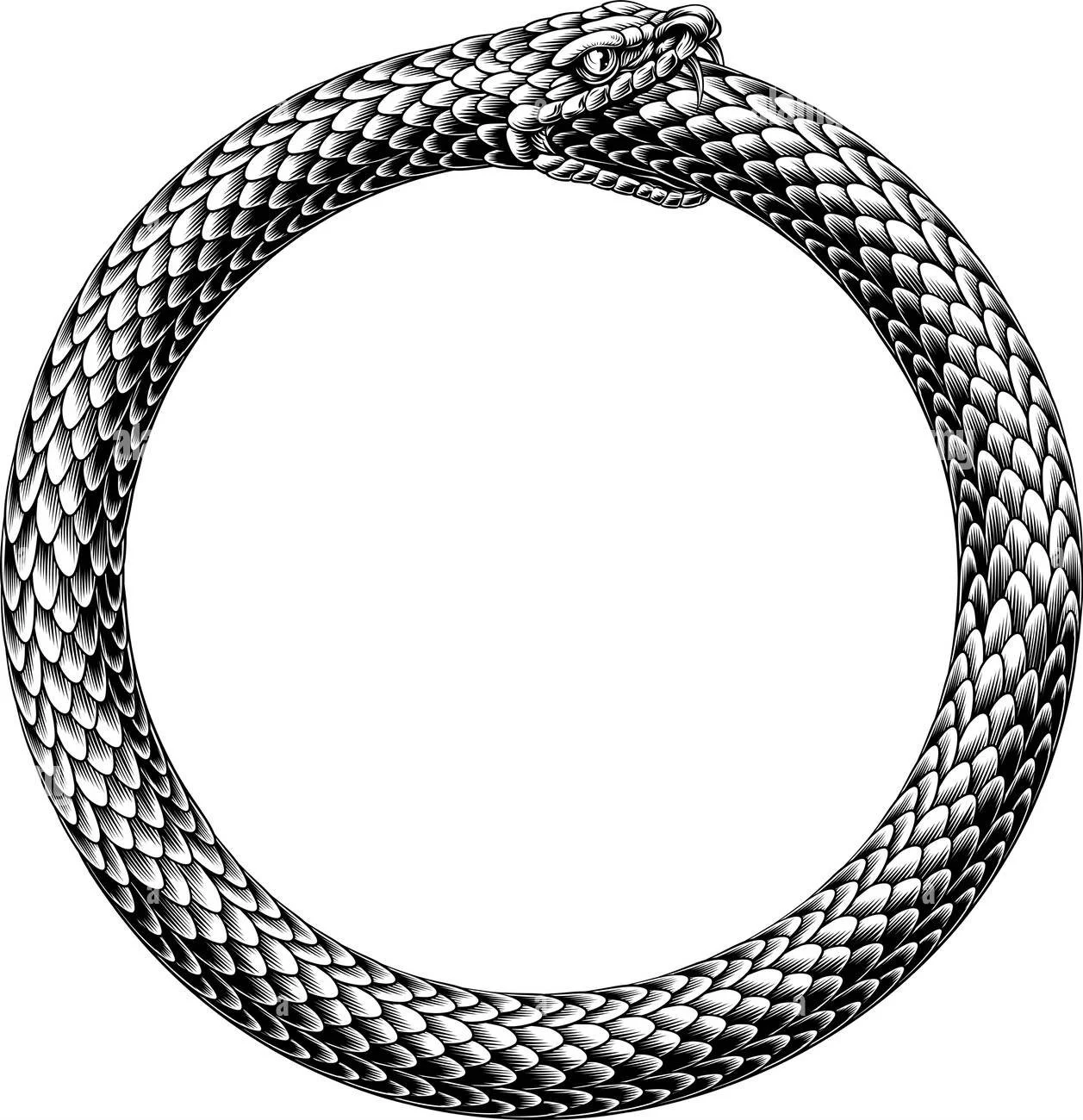
And then there is the ouroboros. The serpent devouring its own tail. One of the oldest symbols in human history. It appears in ancient Egypt as early as 1600 BCE, on the second shrine of Tutankhamun. It appears in Greek alchemical texts carrying the inscription “hen to pan,” the all is one. It appears in Norse mythology as Jörmungandr, in Hindu iconography, in Aztec art, in Gnostic texts. No culture that has looked closely at transformation has failed to arrive at this image.
Because this is what transformation looks like when you stop pretending it is a straight line. Not a path from broken to fixed. A circle. Ending feeding beginning feeding ending. Birth, life, death, rebirth. The tail becoming the mouth becoming the tail.
I have lived this cycle more times than I can count. After war. After divorce. After bankruptcy. After homelessness. After the distance from my children that I carry every day and choose to transform into devotion rather than bitterness. Each time I believed the crossing would be the last one. Each time life showed me the ouroboros does not stop turning.
Across my experience with ayahuasca, psilocybin, and DMT, I have encountered this circle from the inside. Each molecule opens a different door, but the architecture behind every door is the same. Dissolution of the familiar. Encounter with something vastly larger than the self. And the return, carrying something back that did not exist before. I wrote about my relationship with these sacraments and the spiritual path they opened in Beyond Belief: Psychedelics and the Post-Religious Spiritual Path. The DMT space in particular revealed the sensation of arriving at the center of the circle itself, the zero point where birth and death are not opposites but the same movement seen from different angles. A wholeness that holds all the phases at once. Not the ending. Not the beginning. Not the in-between. The still point around which all of it turns.
That is what the ouroboros has always been pointing at. Not the cycle. The center.
What the Natural World Already Knows
I studied biomimicry at Arizona State University's Biomimicry Center. But by the natural world, I do not mean only forests and animals. I mean the whole of it. From the behavior of stars to the behavior of your own cells. The pattern we have been tracing through this entire post is not a philosophy. It is physics. It operates at every scale. And once you see it, you cannot unsee it. The AskNature database documents thousands of examples of living systems that already know what our culture keeps trying to teach through self-help books.
A star sustains itself for billions of years through a precise balance between the gravity pulling it inward and the energy pushing it outward. Then the fuel runs out. The star collapses and explodes, releasing into the cosmos every heavy element it forged in its core. Carbon. Oxygen. Iron. The iron in your blood was made inside a dying star. The universe does not create its most essential elements during stability. It creates them during collapse.
Inside your own body, fifty to seventy billion cells die every day through programmed cell death. This is not disease. It is design. Your fingers began as webbed paddles in the womb. The cells between them had to die for your hands to take shape. You were sculpted by loss before you drew your first breath.
The caterpillar does not become a butterfly. It dissolves completely. And the immune system attacks the very cells that carry the blueprint for its new form. Only when enough of those cells find each other does the new pattern take hold. The lobster must rip out the lining of its own throat to shed the shell that once protected it. In old-growth forests, when an ancient tree falls, new trees grow directly out of its decaying body. The death of the old form becomes the ground for the next generation of life.
The same pattern. Every scale. Cosmos, body, creature, forest.
There is a story I return to often. A man walks through the desert, parched, and comes upon a well. He lowers his cup and drinks, but the water tastes of salt. He curses the well and moves on. A second well. Salt again. A third. Finally he sits in the sand and weeps. An old woman appears. "The water is not the problem," she says. "You are carrying the salt in the cup." He looks and sees the residue of everything he has been unable to release, caked into the vessel he drinks from. She says, "You do not need a new well. You need to shatter the cup." He says, "Then I will have nothing to drink from." She says, "Then you will have to learn to cup your hands. And that requires kneeling."
The stars do not resist their own collapse. The cells do not grieve their dissolution. The caterpillar does not negotiate with the enzymes. We are the only species that tells ourselves a story about why the crossing should not be happening.
The snake sheds its skin. The seed splits in darkness. We are born not by effort but through contraction and surrender.
So too with ceremony. So too with your life.
“The forces of creation and destruction are so tightly linked that sometimes we can’t tell where one begins and the other leaves off.”
What I See in Practice: Breakdown, Breakthrough, Return
A mother came to me after years of holding everything together for everyone else. She described a feeling of disappearing inside her own life, performing care so perfectly that no one noticed she was drowning. In ceremony, the first hours were spent weeping, not for any specific loss but for herself. The sacrament returned her to the experience of being held rather than holding. In the months that followed, through integration coaching, she began drawing boundaries that would have been unthinkable before. Not because she was stronger. Because she had finally been weak enough to let something change.
An executive arrived in the middle of what looked like the most successful season of his career. Everything was accelerating. He could not stop. In ceremony, his body did what his calendar never permitted: it stopped. He described hours of stillness that terrified him, because without the motion, he did not know who he was. That emptiness turned out to be the space the new life needed in order to emerge.
I have also sat with people at the final threshold. A man in his seventies, facing terminal cancer, who came to ceremony not to be healed but to practice dying. His session was among the most quiet and luminous I have ever witnessed. He said afterward that for the first time, he was not afraid. Not because the fear was gone, but because he had met what was on the other side of it and found it was not empty. It was vast. This is what the bardos teach.
The alchemists had a name for the pattern I see most often in the people who come to me. They called the first stage of transformation Nigredo, the blackening, the necessary dissolution of everything built on a false foundation. It is supposed to be uncomfortable. That is the point. But most people exit the process right before it completes. Dissolution feels like failure, so they abandon it and start something new. A new goal. A new system. A new version of themselves. And then the same thing happens again. The alchemists called this incomplete Nigredo. The material begins to dissolve but never fully releases, so it cannot reform into anything new. The tradition's insight was precise: you do not have a finishing problem. You have a relationship with dissolution. The Great Work does not ask you to be stronger. It asks you to trust the dissolving.
Those who release expectations and surrender into whatever the crossing brings move more smoothly through it. Those who grip hardest are not doing anything wrong. The gripping is the pattern the threshold is asking them to set down. The breakthrough is not a reward for effort. It is what remains when effort gives way.
The return is where the real work begins. Without a container afterward, people can remain stuck in the liminal phase. Neither fully in the old life nor the new one. This is what incomplete initiation looks like. It is why I hold Integration Circles and group cohorts, not only individual containers. Victor Turner found that people crossing together develop what he called communitas, a bond formed not through shared achievement but through shared dissolution. I witness this in every circle I hold. Something happens when one person names their crossing out loud and the room survives it. Permission moves through the room like weather. The atmosphere changes for everyone present.
I wrote about the role of the guide in this process, and the red flags to watch for, in Choosing a Psychedelic Guide: Questions Your Life Depends On.
What Neuroscience Reveals
The ancient traditions mapped the crossing through myth, symbol, and ritual. Neuroscience is now mapping the same territory through imaging and measurement. What is striking is not that they disagree. It is that they converge.
The brain has a threshold guardian. Your sense of stable identity is maintained by the Default Mode Network (DMN). It reinforces what you already believe about yourself and the world. In Joseph Campbell's language, it is the dragon at the gate. In Victor Turner's language, it is the structure that must dissolve before the initiate can be refashioned. A 2022 study in Nature Medicine showed that psilocybin loosens the DMN's grip, increasing global brain integration. The more this loosening occurred, the more the person's depression lifted. Rigid categories dissolving, novel connections forming, the raw material of a new identity becoming available.
The crossing has a direction. A 2016 study in Frontiers in Human Neuroscience found that the degree to which a person's sense of separate self dissolved during a psychedelic session predicted lasting increases in connectedness and wellbeing weeks later. From isolation toward belonging. From bracing toward openness. These are not cognitive achievements. They are the body learning, in real time, that it is safe to come out of hiding. That is not a pharmacological effect. That is a phase of a rite of passage.
The return requires mercy. A 2021 study in JAMA Psychiatry gave two psilocybin sessions to people with major depression, supported by guides through preparation, ceremony, and integration. At four weeks, 71% showed clinically significant improvement. But the word that matters most is "supported." The medicine did not do this alone. The clinical term for what makes the difference is self-compassion. The traditional term is mercy. Without it, the crossing opens a door, but the person cannot walk through. The threshold remains uncrossed.
This is why ceremony alone is not enough. The door opens for hours. The walk through takes months, sometimes years. Integration is not an add-on. It is the third phase of the rite, the return, the incorporation, the part our culture most consistently fails to provide. Without that container, people remain stuck in the liminal phase. Neither fully alive nor dead. Ghosts in their own lives. This is what incomplete initiation looks like. I explore this in Psychedelic Preparation: The Work That Begins Before Ceremony.
“Grief and love are sisters, woven together from the beginning.”
What Makes Crossing Possible
Surrender. Inanna, the Sumerian goddess, was stripped of one garment at each of seven gates on her descent to the underworld. She entered the final chamber naked. Even a goddess cannot cross clothed in the identity of the world she is leaving. And the first thing that must be set down is the belief that you can think your way through this.
The body. Because the threshold lives there before it lives anywhere else. You feel it as tightness, as sleeplessness, as the ache that has no diagnosis. No biography is more intelligent than your own body. Trust what it is telling you. I wrote about how the body carries what the mind cannot name in The Shame Addiction: What the Body Carries. And when you do listen, you will discover that the body cannot complete this process in isolation.
Community. You cannot cross alone. Malidoma Somé taught that ritual, community, and healing are inseparable. This is what I witness in my Integration Circles and group cohorts. But even within community, the crossing cannot be forced.
Invitation. In the Mysteries of Isis, no one could be initiated until the goddess appeared in a dream to call them. Readiness cannot be manufactured. The sacrament finds the person, not the other way around. If you feel the pull, pay attention. If you feel urgency, slow down. My free Ceremony Readiness Guide can help you discern the difference. And when the invitation arrives, it helps to have someone who has walked this territory before.
A guide. Not someone with all the answers. Someone who has crossed before and is willing to walk alongside. Someone still learning, still doing their own work, still honest about their own incompleteness. I wrote about what to look for in Choosing a Psychedelic Guide: Questions Your Life Depends On. But even the best guide cannot accelerate what the crossing requires.
Time. Bruce Feiler's research found the average life transition lasts five years. The body does not undo decades of patterning in a weekend. It undoes it in relationships that prove the original installation wrong, in moments accumulated over time. Rushing the process almost always extends it. And what best fills up that time, more than anything, is the willingness to feel what has been lost.
Grief. It is not the enemy of the crossing. It is the crossing itself. Every threshold involves the death of something that mattered, and that death deserves to be mourned before the new thing can fully arrive. I explored this more fully in Grief and the Path Back to Ourselves.
Questions to Sit With
Where in your life is something ending, even if you have not named it yet?
Where do you feel the threshold in your body?
What skills that once served you are now the obstacle?
Who is witnessing your crossing?
You Are Not the First to Cross
For thousands of years, humans built entire institutions around this crossing. The Egyptian mystery schools led initiates into darkness. The Eleusinian Mysteries enacted death and rebirth for two millennia. The alchemists mapped the blackening, the whitening, and the reddening. The Tibetan Buddhists understood that every transition is a bardo.
You are part of a lineage of crossers. This territory is not new. It only feels that way because our culture has forgotten how to mark it.
But your body has not forgotten. Contraction and surrender. Dissolution and reformation. The seed cracking open in the dark. The serpent swallowing its tail and beginning again.
You do not walk through the fire alone. Every step you take reshapes the world behind you.
The threshold is not just the fire. It is who you are when you step out of the ashes.
Trust the Crossing
If you are in the middle of a crossing and want to explore whether ceremony, integration coaching, or community might support you, a Discovery Call is where we begin. You can also start with my free Ceremony Readiness Guide. I do not offer a resumé. I share a series of initiatory crossings: breakdowns, awakenings, devotions, and returns. My hope is that by seeing how I walk through mine, you will be more trusting of your own. My Integration Circles are open if you want to do this work alongside others.
If this post may support someone you know, I'll be grateful if you share it. Someone in your life is carrying this quietly. They may not have words for it yet. Your willingness to pass it forward might be the thing that opens the door.
From my Heart to yours,
Yeshua Adonai
Psychedelic Guide
aboutyeshua.com
Yeshua is a traveling psychedelic guide currently based in Phoenix, Arizona. USMC combat veteran, former diplomat, and serial social entrepreneur devoted to mental health innovation, he has spent decades exploring contemplative traditions worldwide and learning to trust his own experience along the way.
Frequently Asked Questions
-
A bad season passes. A threshold asks you to become someone different. The distinction lives in the body. If the old coping strategies are failing, if the identity you have been performing no longer fits, if you feel simultaneously like something is dying and something is trying to be born, you are likely at a threshold. If you are unsure, that uncertainty itself may be the in-between.
-
No. Many of my clients work solely through integration coaching, group circles, or the Seekers Circle cohort, rarely or never entering ceremony. The architecture of crossing can be navigated through grief work, contemplative practice, somatic healing, nature immersion, and sustained community. The sacrament is not the transformation. It is one possible catalyst which is powerful but not necessary.
-
Change is the external event: the job ends, the relationship shifts, the diagnosis arrives. Transition is the internal process of coming to terms with what that change means for who you are. William Bridges made this distinction foundational to his work. Change can happen overnight. Transition takes its own time, and the body sets the pace.
-
Bruce Feiler's research across hundreds of American life stories found that the average major life transition lasts approximately five years. What I have learned from sitting with people in their crossings is that the timeline depends on how willing we are to stop resisting the ending and begin inhabiting the in-between. Rushing the process almost always extends it.
-
Yes. And most of my clients are. The midlife vocational shift arrives alongside a parental grief, alongside a spiritual reorientation, alongside a body that is changing. These crossings layer and amplify each other. The skill is not managing all of them at once. It is learning which one is asking for your attention right now.
-
Stanislav Grof found that the four stages of biological birth, from oceanic unity through compression, struggle, and liberation, recur in deep psychedelic sessions and at every major life threshold. Leary, Alpert, and Metzner mapped the same pattern through the Tibetan Book of the Dead in their 1964 manual The Psychedelic Experience. The teaching is that your body already carries the template for crossing. You have done this before.
-
Some people spend years in what William Bridges called the neutral zone. This is not failure. Sometimes it means the ending has not been fully grieved. Sometimes it means the body needs more time than the mind wants to give it. Sometimes the container, the relational support and the practices, is not adequate for the depth of the crossing. If you have been in the in-between for longer than feels right, it may be time to ask: what am I still holding onto, and who is with me in this?
-
The people I walk with have taught me more about thresholds than any book. But these books informed me of a language to honor what I lived, and my clients showed me.
Transitions: Making Sense of Life's Changes, by William Bridges. The most accessible guide to the three-phase structure of every crossing. Start here.
When Things Fall Apart, by Pema Chödrön. The most honest book I know about staying present when the ground disappears.
The Middle Passage: From Misery to Meaning in Midlife, by James Hollis. A Jungian analyst maps the midlife threshold with clinical precision and uncommon warmth.
The Wild Edge of Sorrow, by Francis Weller. The most important book on grief as an initiatory practice.
Soulcraft, by Bill Plotkin. Nature-based soul initiation for anyone who senses the crossing is ecological and spiritual.
The Hero with a Thousand Faces, by Joseph Campbell. The original mapping of descent, ordeal, and return.
Blog Archive
Explore the growing library
-
After the War
- Nov 17, 2025 05 | 11.11: War After War A Veteran’s Battle to Heal
-
Consciousness
- Aug 24, 2026 35 | Beholding: How the Chapel of Sacred Mirrors Returns Your Gaze
- Jun 1, 2026 29 | Leary's Eight Circuits: A Map of Consciousness That Both Frees and Binds
- May 18, 2026 28 | Cancer: The Other Healer in the Room
- Apr 20, 2026 26 | Harvard's Last Psychedelic Intersections Conference: A Practitioner's Review
- Mar 30, 2026 24 | Nonlocal Consciousness: What The Secret of Secrets Reveals About the Nature of Mind
- Mar 23, 2026 23 | Self-Remembering: When the Self Sees Itself
- Mar 16, 2026 22 | Hyparxis: The Dimension Where Real Change Becomes Possible
- Mar 9, 2026 21 | Thresholds: A Psychedelic Guide to Falling Apart on Purpose
-
Finding Purpose
- Jul 13, 2026 32 | Vows: How a Tree Learns to Love the Wind
- Apr 6, 2026 25 | Reset: What Becomes Available When You Choose to Dissolve
- Jan 26, 2026 15 | Beyond Belief: Psychedelics and the Post-Religious Spiritual Path
- Jan 5, 2026 12 | Beginning Again: The Practice of Presence Over Performance
- Dec 1, 2025 07 | Finding Purpose in Midlife: How to Regain Meaning
- Nov 24, 2025 06 | Unlock Leadership Potential With Psychedelic Coaching
-
Psychedelic Path
- Oct 5, 2026 38 | Vigil: A Safety Framework for Psychedelic Care
- Sep 21, 2026 37 | FDA public hearing: The Day the Sacred Was Ruled “Out of Scope”
- Aug 10, 2026 34 | Kaleidoscope: What Is Actually Happening Inside a Mushroom Journey
- Jun 29, 2026 31 | MDMA: Heart Medicine and the Oldest Name for God
- Jun 15, 2026 30 | Ketamine: The Mirror Molecule That Was Always Asking for a Witness
- Jan 19, 2026 14 | Microdosing Magic Mushrooms: A Guide to What Actually Works
- Dec 22, 2025 10 | From Darkness Into Light: Living the Insight
- Nov 3, 2025 03 | Ketamine Therapy Near Me: A Legal Pathway for Psychedelics
- Oct 27, 2025 02 | Arizona’s Psychedelic Awakening: Where Science Meets Soul
- Oct 20, 2025 01 | My Psychedelic Journey: A Path Through the Fog of Depression
-
Sacred Ceremony
- May 4, 2026 27 | Seekers Circle 25-26': Where Preparation Becomes Integration
- Feb 2, 2026 16 | Choosing a Psychedelic Guide: Questions Your Life Depends On
- Jan 12, 2026 13 | Psychedelic Preparation: The Work That Begins Before Ceremony
- Nov 10, 2025 04 | Magic Mushrooms: Remembering the Sacred Intelligence of Nature
-
Shadow Work
- Jul 27, 2026 33 | Bend: A Reckoning with the Feminine
- Mar 2, 2026 20 | The Shame Addiction: What the Body Learns (Part 3 of 3)
- Feb 23, 2026 19 | The Shame Addiction: What the Body Hides (Part 2 of 3)
- Feb 16, 2026 18 | The Shame Addiction: What the Body Carries (Part 1 of 3)
- Feb 9, 2026 17 | Stop Trying to Forgive: What Psilocybin and Grief Teach About Letting Go
- Dec 15, 2025 09 | Grief and the Path Back to Ourselves (part 2 of 2)
- Dec 8, 2025 08 | Grief and the Path Back to Ourselves (part 1 of 2)
- Tools for Integration
Trending topics
- psilocybin
- psychedelic integration
- harm reduction
- psychedelic guide
- Arizona
- psychedelics
- integration
- transformation
- veterans healing
- Fourth Way
- Long Now
- PTSD
- integration coaching
- letting go
- mental health
- nature
- neuroplasticity
- presence
- psychedelic preparation
- recovery
- self-awareness
- FDA psychedelic hearing
- FDA public hearing 2026
- Gurdjieff
- MDMA-assisted therapy
- Oregon psilocybin
- REMS
- White Oak
- addiction
- alternative treatment
- becoming
- burnout
- chaplaincy
- combat veteran
- consciousness
- default mode network
- depression
- docket FDA-2026-N-7542
- emotional healing
- ethics
- grief
- guide selection
- ketamine clinics
- ketamine therapy
- legal
- loss
- magic mushrooms
- masculine and feminine
- mast year
- mindfulness