
29 | Leary's Eight Circuits: A Map of Consciousness That Both Frees and Binds
~18 MINS READ
WHY EVERY MAP OF CONSCIOUSNESS IS BOTH A GIFT AND A FENCE. WHY THE NIGHT TIMOTHY LEARY PACED A SOLITARY CELL AND WROTE EIGHT CIRCUITS OF CONSCIOUSNESS ON THE BACK OF A STOLEN LEGAL BRIEF MATTERS TO YOU. HOW THE BARDO THODOL, LEARY'S 1964 PSYCHEDELIC MANUAL, AND GROF'S PERINATAL MATRICES ARE THREE VOICES SINGING THE SAME DEATH & REBIRTH SONG. WHY SACRAMENT IS THE WORD THAT PROTECTS THE WORK, AND WHY THE BODY HAS TO FEEL SAFE BEFORE ANY HIGHER CIRCUIT OPENS. WHAT I HAVE LEARNED ABOUT WHEN TO USE THE MAP AND WHEN TO SET IT DOWN. AND WHAT LEARY DID IN HIS FINAL HOUR THAT HIS WHOLE LIFE HAD BEEN PREPARING HIM FOR.

Indra’s Net: each drop reflecting the whole, each strand revealing the hidden pattern beneath ordinary sight. Like Leary’s circuits and every sacred map, the image points toward the woven nature of consciousness while reminding us not to mistake the web for paradise.
The Oldest Danger in the Spiritual Life
The most dangerous map of consciousness I know was drawn by a man in solitary confinement, on the back of a stolen legal brief, while he was secretly informing on his own rescuers. Before we come to him, an older story.
A man spent forty years drawing a map of paradise. He drew every river. Every gate. Every garden, every angel, every road. The map became his life. When he was very old, paradise itself came to visit him. Paradise sat in the chair beside his bed and watched him work. Paradise waited for him to look up. He did not look up. He was busy adding a corner he had missed.
When paradise left, the man kept drawing. The map outlasted the empire that had bordered it. People taught it to their children, who taught it to theirs. And every once in a while, in a quiet hour, paradise visits one of those students. Paradise sits in the chair beside the bed. And waits.
Most of the people who come to me arrive with the same hunger and the same question. “What is actually happening to me?”
The eight circuits. The bardos. The perinatal matrices. The states and stages. Every map of consciousness ever drawn was made by someone trying to name what they had seen. They are gifts. They are also, every one of them, a map Just a map. And no map of paradise has ever quite contained the paradise it describes. There are more cartographers than this essay can name. Patanjali's eight limbs. The Buddha's noble eightfold path. Teresa's interior castle. Gurdjieff's centers of being. Each drew a different angle on the same mountain.
“What if every diagram of the soul is also a wall? What if the framework you trust to find your way home is the very thing keeping you from arriving?”
“Think for yourself. Question authority.”
The Web is Always There, The Dew Makes it Visible
Walk through a meadow at dawn after a clear night and the world has changed.
Spider webs you never noticed are everywhere, hung between blades of grass, strung across the gap between two stones, suspended from one fence post to the next. The webs were there last night. The webs will be there well into the day. The dew makes them visible for an hour, and then the sun rises and they go invisible again, even though the webs themselves never moved.
In the Avatamsaka Sutra, there is an image of a vast net cast across the heavens by Indra, the Vedic king of the devas. At every knot of the net hangs a jewel. Each jewel reflects every other jewel, infinitely, and the looking happens from inside one of the jewels too. Indra's Net. The classical image of how reality is actually woven.
The meadow at dawn is Indra's Net made visible for an hour. The webs are the framework. The dew is the moment of awakening that lets you see the webs were always there. What every cartographer of consciousness has tried to do, from Leary to Patanjali to the Buddha, is the same as what the dew does. None of them invented anything. They made visible, for one hour, structures already woven into the architecture of mind.
The trouble starts when we mistake the dew for the web.
The map is a gift. The map is also a fence. Both, always.
The Man Who Drew the Map
Timothy Leary, born 1920, an American psychologist with a doctorate from Berkeley and a lecturer's appointment in Harvard's Department of Social Relations, was not a charlatan. The Berkeley PhD is real. The Harvard appointment is real. In August of 1960, in a borrowed villa in Cuernavaca, a Mazatec curandera, native shaman, placed seven mushrooms in his hand and he later wrote that he learned more in five hours than in fifteen years of academic psychology.
A historian's textbook entry: Harvard-trained psychologist, compromised research methods, drug convictions, prison escape. A revolutionary's biography: a man who refused to let the establishment dictate the inner life, who broke laws he believed unjust, who wrote a map of mind from inside the cell where the empire put him.
Both are true. Any version that flattens one into the other is missing what was actually there. The man was both. So is each of us. No one fits cleanly into the single category their culture wants to file them under.
One thread is worth carrying. In 1966 the district attorney who raided Leary's Millbrook estate, New York, was G. Gordon Liddy, the man who would later mastermind Watergate for the Nixon White House who in turn would hunt Leary across three continents. The web was already weaving itself, years before anyone could see it.
The story I keep returning to: Albert Hofmann, the Swiss chemist who first synthesized LSD, met Leary exactly once, in a Lausanne railway snack bar in September 1971. Hofmann later wrote of him as a man who soared high in the clouds, who tended to underrate practical difficulties and dangers. The man who made the molecule looked at the man who set it loose, and saw what was coming.
Two years after Nixon's June 17, 1971 declaration of the War on Drugs, the man Nixon allegedly called the most dangerous in America would be sitting in a windowless cell drafting the eight circuits.
“Leary, the most dangerous man in America.”
The Cell, The Decade, The Smuggled Pages
It is 1973. The California Medical Facility at Vacaville. Leary is fifty-three. Nixon has just completed a twenty-eight month international manhunt, ending at Kabul airport, January 14, 1973. And now a windowless cell.
He writes the seed of the eight-circuit framework here. Neurologic, 1973. A map of eight stages through which consciousness can move, from raw bodily survival up through the body's intelligence, the mind observing itself, the lineage that runs in the blood, and the recognition that what we call I is older and more diffuse than the body. On the back of a legal brief belonging to Angela Davis, the philosopher and political prisoner. The pages are smuggled out by his partner Joanna Harcourt-Smith. The seven circuits become eight at Folsom State Prison through 1975 and 1976. Published in 1977 as Exo-Psychology.
The full title carries the irony of its own undoing. A Manual on the Use of the Human Nervous System According to the Instructions of the Manufacturers. The first four circuits are equipment for survival on Earth. The next four were framed as equipment for what he believed was the species' next evolutionary step. Space migration. Intelligence increase. Life extension. SMI²LE was his acronym for it. Paradise, in his rendering, was out there. Future. Off-planet. Coming.
“Consciousness is the energy received and decoded by a structure.”
What the framework does not say is what the prison cell is doing to the man writing it. In 1974 Leary began cooperating with the FBI, informing on the Weather Underground members who had risked their freedom to free him four years earlier. Codename Charlie Thrush. I read this as the cell informing the eight-circuit map rather than corrupting it. A man inside a windowless room dreams of bird-like escape. Of course he does.
Every map of consciousness, including this one, is shaped by the room it was written in.
Eight Circuits, Eight Arms
The eight circuits are not, in my reading, a theory of the brain. They are a set of names for what happens to you, hour by hour, when consciousness stretches beyond ordinary waking, in deep meditation, in grief, in love, and most reliably under sacrament.
Watch an octopus on a coral reef. Two-thirds of its neurons live not in its head but distributed through its eight arms. Each arm tastes, decides, and acts with a measure of autonomy. Not eight stacked floors of a building. Eight semi-autonomous arms of one organism, each capable of running its own perception even while the whole creature breathes as one.
Here is each, in Leary's framing, and as I have come to know it.
The first set of four circuits needed to function as humans, Leary called “Terrestrial”:
Circuit One: Bio-Survival. Am I safe? Imprinted by the mother in infancy. In ceremony, the floor of the body. When it locks, breath shortens, vision narrows, nothing else can move.
Circuit Two: Emotional and Territorial. Where am I in the order? Imprinted by the family hierarchy. Power, dominance, submission. In ceremony, the old battles return.
Circuit Three: Semantic. What story am I telling? Imprinted by language. Mind in symbols and narrative. In ceremony the narrating voice becomes audible as one voice, not the truth.
Circuit Four: Socio-Sexual. Do I belong? Imprinted by tribal initiation. Role, gender, identity. In ceremony, the wounds of belonging surface, the longing to be chosen, the fear of being seen.
The next four he called Post-Larval. What opens when the first four loosen their grip:
Circuit Five: Neurosomatic. What does the body know? The body waking up outside fight or flight. In ceremony, the first taste of the body as friend rather than vehicle.
Circuit Six: Neuroelectric. Who is doing the seeing? Mind observing mind, what Leary called metaprogramming. In ceremony, the witness behind the thinker.
Circuit Seven: Neurogenetic. What runs in my blood? Ancestral memory, the lineage chorus. In ceremony, the patterns that began before you, the knowing that arrives without a source.
Circuit Eight: Neuroatomic. Where does mind end? Non-local awareness. In ceremony, the dissolve. The recognition that what you have called I is older and more diffuse than the body.
I will call him V. A returning client, hour three of his second psilocybin journey. The first hour he was pinned in survival panic, breath shallow, body braced. Circuit One: am I safe? The second hour his old anger at his father came up as a hot field around his chest. Circuit Two: where am I in the hierarchy? The third hour he began to speak in metaphor he had never used before, naming patterns in his life that had been invisible until that moment. Circuit Three opening into Circuit Six: the mind beginning to observe itself. By hour five he was crying without grief, the body weeping while the face was calm. Circuit Five: the body waking up. He had been to that ceremony before. He had not had words for any of it. Afterward, he said: "I have been running these patterns my whole life. Now I have names for them."
The naming is the gift. The territory was already there.
What the Bardo Already Knew
Twelve hundred years before Leary paced his cell in Vacaville, the eighth-century Indian master Padmasambhava hid a treasure text in the Gampo Hills, in southern Tibet, sealed for a future generation. Six centuries later, the tertön Karma Lingpa walked those hills and recovered it. The Bardo Thodol. Liberation Through Hearing in the Intermediate State.
The book is read aloud to the dying and to the recently dead, sometimes for forty-nine days after the body has stopped breathing. All of this is your own mind. Do not cling. Do not flee.
Old territory. New vocabulary. The eight circuits, to my eye, do what the bardos have been doing for over a millennia.
Leary himself saw the parallel before he wrote the circuits. In 1964, with Ralph Metzner and Richard Alpert, he published The Psychedelic Experience: A Manual Based on the Tibetan Book of the Dead. The book maps the three bardos onto the three phases of a high-dose journey. The chikhai bardo of clear light at peak dissolution. The chonyid bardo of peaceful and wrathful visions. The sidpa bardo of return to ordinary consciousness. A manual written to be read aloud to the journeyer the way the Bardo Thodol is read to the dying. The eight circuits would later map the structure of mind. The bardos map the journey through it.
Watch a tadpole become a frog. The tail does not fall off. It is dissolved from inside, the cells broken down by the same body that grew them. Lungs grow. Legs emerge. The creature at the end is not the creature at the start, and yet no death occurred. The Bardo Thodol is describing this same dissolution at the level of mind. Every ceremony I have sat does some version of this metamorphosis, the territory of Reset. So does every grief. So does every threshold a person crosses, the subject of Thresholds.
Every dissolution is also an arrival.
What Grof and Wilber Added
Stanislav Grof, the Czech-American psychiatrist who ran more LSD sessions than any researcher in history, anchored the same arc in the body. His four perinatal matrices move through the actual stages of physical birth: undisturbed womb, locked-in panic, titanic struggle, release. Patient after patient who had never been told what to expect described the same death-rebirth journey the bardo and The Psychedelic Experience (Leary, Metzner, Alpert) had been describing all along.
Three vocabularies. One territory. The dying. The journeyer. The newborn.
Ken Wilber, the American philosopher who integrates Eastern contemplation with Western developmental psychology, gave us the distinction that may matter most for anyone working with sacrament. States and stages are not the same thing. A state is a temporary phenomenological condition. A stage is structural, the floor you actually stand on. You can have a thousand states and develop almost no stages.
Watch the throat of a hummingbird. The gorget appears solid red from one angle, then black from another, then magenta from a third. The feathers never change. What changes is the angle of light and the position of the observer. The same mystical experience lands as enlightenment from one developmental position and as bypass from another.
This is the trap I have come to think Leary could not have named from inside the prison cell. The eight circuits describe states beautifully.
The framework has very little to say about the unhurried patient developmental work that lets a person hold those states without being broken by them – states arrive uninvited, stages are earned; states can support stages, they cannot become them.
What the Sacraments Actually Show
Leary did not write the eight circuits from his armchair. He wrote them from a body that had been opened by mushrooms in Cuernavaca, LSD in Cambridge, and a hundred other doors before he ever picked up a pen. Grof did not theorize the perinatal matrices. He sat with thousands of patients dissolving and emerging under LSD before the matrices appeared as a pattern. Wilber, the most theoretical of the three, refined his states-and-stages distinction by reading what the sacrament travelers had been reporting for fifty years and asking what they could not yet see. The maps were not invented from thinking. They were drawn from territory that was first accessed through sacrament. Before continuing, the sacraments deserve their own moment, on their own terms.
A note on the word. I call these sacraments and not drugs or medicines. Drug hands the substance to law enforcement and the war on drugs. Medicine hands it to clinics, prescriptions, and the medicalization that strips ceremony of its sacred container. Sacrament keeps the substance where every indigenous tradition has held it for thousands of years. Inside the protection of the sacred. The framing carries legal weight too. The First Amendment protects religious practice in a way it does not protect recreational or therapeutic use. The Native American Church holds peyote under that protection, the União do Vegetal and Santo Daime hold ayahuasca under it. Sacrament is the word that protects the work.
What I write here is my own experience and that of those I have sat with. Each sacrament arrives as a different teacher with a different character. Mushrooms as the gentle grandmother. Ayahuasca as Grandmother. The mescaline cacti as the slow grandfathers. Cacao as the heart-warmer. 5-MeO as the dissolve into pure being. Iboga, the stern father, I have not yet sat with.
The full character of each is in the FAQ. Asking the gentle grandmother to do what the void does would be a category error. Each is a different lens. The mountain is the same.
Every lens I have looked through with care has returned me to the same ground. Love. Not the love of greeting cards. The love that holds the practitioner’s whole nervous system. The love that lets a person feel safe enough to put the armor down.
The maps indicate the doors. The sacraments are doors. So are breathwork, deep nature, fasting, vigil, intentional travel, contemplative practice, sacred sexuality. What walks through is you.
“We are appearances of God to each other.”
Why I Keep Returning to Leary
I have lost my way inside this framework more than once, mistaken the map for the territory, as they say, mistaken the naming for the seeing. The eight circuits are still teaching me how to hold them.
Most of the people I sit with are already across the threshold of Nonlocal Consciousness and trying to find language for what happened. Sometimes another ceremony helps the work move. More often what they need is vocabulary and the patient labor of integration that turns experience into life. People come hoping a powerful enough opening will change them. They learn that however meaningful the experience, the changing of a life remains theirs to make. To choose differently, again and again. The eight circuits give the vocabulary. The choosing is theirs.
What I admire in Leary, even with everything I know about the man, is that he insisted what happened in psilocybin and LSD was not pathology but developmental territory, when pathology was the dominant frame the establishment would allow. The contemporary clinical revival at Johns Hopkins, MAPS, and the Imperial College Centre for Psychedelic Research owes more to that framing than is generally admitted. Leary’s framework is doing the work.
The threat Leary posed was never really about the drugs. The threat was that he handed people vocabulary for their own inner experience that the government state could not regulate. Authority requires that the inner life remain unspeakable, or speakable only in the institution's terms. Leary handed the vocabulary to anyone who could read.
Vocabulary is the first freedom. What is named can be chosen.
Years of ceremony work have taught me this. The vocabulary is not for argument. It is for compassion. Once you can name what is happening in your own circuits, you can stop fighting yourself. The Circuit-One panic is not an enemy. It is a frightened child who needs a hand, the wound traced in The Shame Addiction. Naming is the first act of welcome. The map is the gift of walking the territory awake. The territory is your own life, and you are allowed to love it.
The Body Has to Feel Safe First
Polyvagal research and every ceremony I have witnessed teach the same thing. You cannot reach the higher circuits from a nervous system stuck in fight or flight. The body needs to feel safe first.
Watch a tide pool at low tide. A whole bounded universe in a single rock basin. Anemones. Hermit crabs. Limpets gripped tight. Each tide pool is complete, imagining itself the entire ocean. When the tide returns, that complete world is inundated by a vastness it had no idea was there. This is what high-dose ceremony does to a Circuit-One nervous system that has not yet remembered safety. The flooding arrives. The work after, sometimes for years, is the slow rebuilding of the rim, the pivotal moment of Hyparxis, so that the next tide can arrive without dissolving the creature inside.
The body needs to feel safe first. Always.
The Gift and The Trap
A good framework gives us gifts. Vocabulary, the chief among them. Held too tightly, every map of consciousness becomes the cage that consciousness itself was trying to outgrow.
The Buddha saw it twenty-five hundred years ago. The teaching is a raft for crossing over, not a thing to be clung to once you have arrived.
Use the raft. Cross with it. Then leave it on the further shore.
“The map is not the territory.”
The Question Leary Left Us
Timothy Leary died on May 31, 1996, at his rented hilltop home in Beverly Hills, his son Zachary at his bedside.
In his final hour, the cartographer set down the map.
He clenched his fist. Why? He unclenched it. Why not? Fifty times in fifty different voices. Comic. Loving. Tragic. Afraid. Then he applauded. For himself. For the room. For the long strange trip. His last word, according to Zachary, was beautiful.
I like to imagine paradise was sitting in the chair beside his bed. Patient. As always.
Leary was called into being to be the cartographer the West did not know it needed. He showed up with humor and audacity, performing philosopher to the end. He braided the bardo and the mushroom and the prison cell into vocabulary a generation could read. He made the inner life sayable in English. Without him, this essay does not exist. Flawed and theatrical and vain, yes. None of that subtracts from what he made possible. In his final hour, fist clenching and unclenching, he did the one thing the cartographer in the parable did not. He stopped drawing. He set the map down. He looked up.
Every map ever drawn, Leary's circuits, Patanjali's limbs, the Buddha's eightfold path, Teresa's mansions, Gurdjieff's centers, was an arrow pointing at this one question. The cartographers spent their lives drawing the arrows. The arrows have been pointing at the chair beside the bed all along. When the dissolution comes, and it will come, by sacrament or by grief or by your last quiet breath, will you cling to the map, or will you set it down and meet what has been sitting beside you the whole time?
What has been sitting beside you is love. Not the small love. The vast one. The one that has watched every map you have drawn and not flinched.
The mountain is waiting. Paradise is patient. Love has been here the whole time.
Why not.
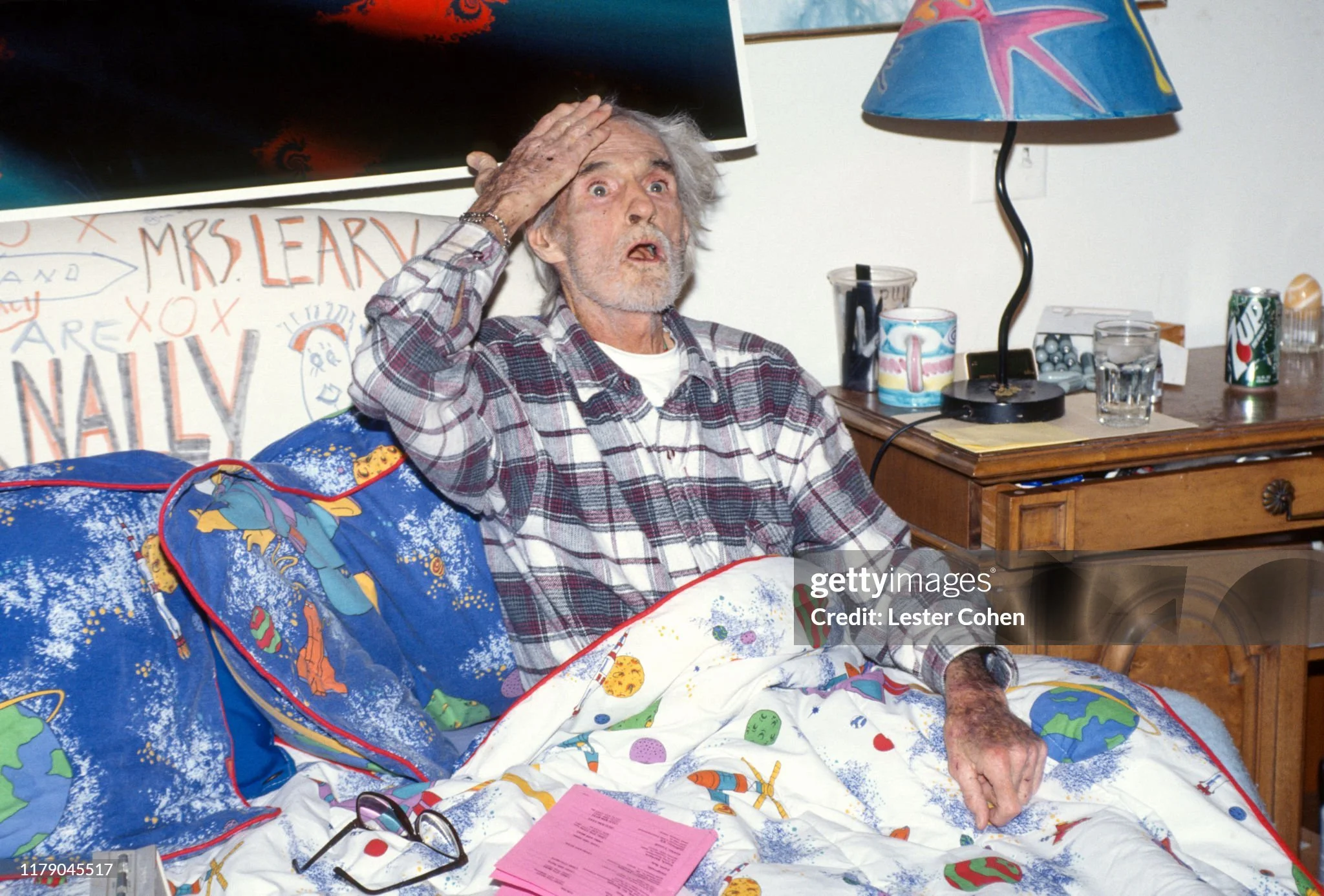
Timothy Leary, in his final days, circa May 1996, the cartographer nearing the moment of setting the map down. Photograph by Lester Cohen/Getty Images.
Questions to Sit With
When was the last time a framework helped you, and when did the same framework start getting in your way?
Where in your body does Circuit One live, right now, as you read this?
What story about yourself are you most attached to, and what would it be like to let it die?
What teaching, what map, what practice has become a wall rather than a raft?
If you took every map away, what would still be true?
If you have read this far and something stirred, I would be honored to talk with you about it. You can book a discovery call to explore whether ceremony work might fit where you are. The Ceremony Readiness Guide is a free starting place. The Online Integration Circles we host monthly are open to anyone who has done sacrament work and is metabolizing what came through.
If this resonated, please share it with one person who would want to read it. The work travels through real human relationships, not algorithms.
From my Heart to yours,
Yeshua Adonai
Psychedelic Guide
Yeshua Adonai is a USMC combat veteran, former diplomat, and psychedelic ceremony guide working with clients through preparation, ceremony, and integration. He writes a long-form blog series on consciousness, sacrament, and the intersection of ancient wisdom with modern research at aboutyeshua.com. He travels regularly between Maine, Arizona, and client locations across the country.
Frequently Asked Questions
-
The 8-circuit model is a developmental framework articulated by Timothy Leary in Exo-Psychology (1977) and elaborated by Robert Anton Wilson in Prometheus Rising (1983). It divides consciousness into eight functional circuits.
The first four circuits are what your nervous system does to keep you alive in human society. Circuit One, bio-survival, imprinted by the mother in infancy: am I safe? Circuit Two, emotional and territorial, imprinted by the family pecking order: am I dominant or submissive. Circuit Three, semantic, the mind in language: what story am I telling. Circuit Four, socio-sexual, the tribal codes: do I belong. Most adult anxiety, most family fights, most romantic power struggles, are these four still asking their old questions in disguise.
The next four circuits are what opens when the first four loosen their grip. Circuit Five, neurosomatic, the body waking up to its own intelligence outside of fight or flight. Circuit Six, neuroelectric, mind observing mind, what Leary called metaprogramming. Circuit Seven, neurogenetic, the lineage, ancestral memory, the chorus of voices older than your own. Circuit Eight, neuroatomic, non-local awareness, the consciousness that does not seem to be located in your skull at all.
The first four are framed as terrestrial or larval, necessary for human social functioning. The latter four are framed as higher or post-larval, accessed through contemplative practice, sacrament, or peak experience. The model has no anatomical referent. The "circuits" are not physical structures in the brain. It is best treated as a poetic developmental scaffolding, useful for naming territory but not as neuroscience. Leary developed the framework while incarcerated, originally drafting Neurologic in 1973 in solitary confinement at the California Medical Facility at Vacaville on the back of a legal brief, and continued elaborating it at Folsom State Prison through 1976. For a fuller overview of the model and its lineage, see the eight-circuit model entry on Wikipedia.
-
No, not in the sense of empirical neuroscience. Leary and Wilson never specified neural correlates for the eight circuits, and contemporary cognitive science does not recognize them as anatomical structures. Historians of science such as John Higgs and David Kaiser have been clear that the model was speculative futurism rather than empirical research. That said, the broad observations the model encodes are consistent with what is now known from attachment research, polyvagal theory, neuroimaging of meditators and psychedelic subjects, and the predictive coding literature. Early imprints from primary caregivers do shape later functioning. Bodily and contemplative practices do open different modes of awareness. Some experiences feel meta-cognitive while others feel non-local. The contemporary clinical revival, notably the work being done at Johns Hopkins Center for Psychedelic and Consciousness Research and the Imperial College Centre for Psychedelic Research, works with phenomenological maps that overlap with Leary's territory, even when they do not name him. The map is heuristic. The territory it points at is real.
-
The arc, in order:
October 22, 1920. Born in Springfield, Massachusetts, an only child in an Irish Catholic household.
1950. Took his PhD in psychology from the University of California Berkeley.
1959 through 1963. Held a lecturer's appointment at Harvard University in Cambridge, Massachusetts, in the Department of Social Relations.
August 1960. In Cuernavaca, Mexico, a town south of Mexico City, ate seven mushrooms a Mazatec curandera placed in his hand. The trajectory of his life pivoted.
1960 through 1962. Founded and ran the Harvard Psilocybin Project with his colleague Richard Alpert, who would later returned from India as Ram Dass. The project recruited the British writer Aldous Huxley, who had already explored mescaline in his 1954 The Doors of Perception. The Beat poet Allen Ginsberg had his first session at Leary's home in November 1960 and became Leary's chief recruiter into bohemia, later bringing Jack Kerouac and William S. Burroughs into the project. The Concord Prison study, in which Leary administered psilocybin to inmates at the Massachusetts state prison, reported a recidivism reduction that Rick Doblin, founder of the Multidisciplinary Association for Psychedelic Studies, showed in his 1998 follow-up was not statistically supported.
April 20, 1962. The Marsh Chapel Good Friday experiment at Boston University. The Harvard PhD candidate Walter Pahnke administered psilocybin to divinity students. Five of seven reported acute mystical experiences. One had to be physically restrained after fleeing the chapel convinced he was the returning Messiah.
May 1963. Harvard fired Leary and Alpert. They moved their work to a sixty-three room mansion in Millbrook, New York, in the Hudson Valley north of New York City, provided by the wealthy Mellon family heir Billy Hitchcock.
1964. Published The Psychedelic Experience: A Manual Based on the Tibetan Book of the Dead with Ralph Metzner and Richard Alpert, mapping the three bardos onto the phases of a high-dose journey. The book inspired John Lennon's song "Tomorrow Never Knows" on the Beatles' 1966 album Revolver.
March 11, 1966. Convicted under the federal Marijuana Tax Act of 1937 for a small amount of cannabis. Originally sentenced to thirty years.
1966. The Dutchess County district attorney G. Gordon Liddy raided the Millbrook estate. Liddy would later mastermind the 1972 Watergate break-in for the Nixon White House. He and Leary would, in the 1980s, tour the country together as point-counterpoint debate partners on college campuses.
January 14, 1967. Stood in front of thirty thousand people at the Human Be-In in Golden Gate Park, San Francisco's largest park, and gave America the slogan it would define him by: Turn on, tune in, drop out. The phrase had come to him in the shower after the Canadian media theorist Marshall McLuhan told him over lunch that he needed something snappy.
1968. Published The Politics of Ecstasy and the autobiographical High Priest, expanding his arguments for psychedelic spirituality to a mass audience.
May 19, 1969. The Supreme Court ruled in Leary v. United States that the federal Marijuana Tax Act of 1937 was unconstitutional, overturning his original conviction. On the same day, he announced his candidacy for Governor of California against the actor Ronald Reagan, with the slogan Come together, join the party.
June 1, 1969. Visited John Lennon and Yoko Ono at their Bed-In for Peace in Montreal, the anti-war demonstration in which the couple invited journalists into their hotel-room bed for eight days. Lennon agreed to write a campaign song for the gubernatorial run. The song eventually became "Come Together," recorded for the Beatles' Abbey Road in July 1969 after Leary's imprisonment derailed the campaign.
January 21, 1970. Sentenced to ten years in California state prison for less than a tenth of a gram of cannabis from a 1968 arrest in Laguna Beach.
September 13, 1970. Escaped from the California Men's Colony at San Luis Obispo, on the central California coast, financed by The Brotherhood of Eternal Love. He pulled himself hand-over-hand along a telephone wire over a barbed-wire fence and disappeared into a twenty-eight month international fugitive life. The militant left-wing Weather Underground smuggled him and his wife Rosemary out of the country.
September 1970. Arrived in Algiers, the capital of Algeria in North Africa, as the guest of Eldridge Cleaver, the exiled leader of the Black Panther Party who was running a government-in-exile there. The relationship deteriorated. Cleaver eventually had the Learys kidnapped from their apartment in what the underground press called a revolutionary bust, reportedly because Leary's hedonism was undermining Panther discipline.
1970. Published Jail Notes with a preface by Allen Ginsberg.
1971 through 1972. Fled Algeria for Switzerland, where Allen Ginsberg orchestrated an international press campaign that secured him temporary political asylum despite Nixon personally demanding his extradition. The Swiss declined.
January 14, 1973. Captured at the airport in Kabul, the capital of Afghanistan, by US narcotics agents.
1973. Returned to a windowless cell at the California Medical Facility in Vacaville, where he drafted Neurologic, the seed of the eight-circuit framework, on the back of a legal brief belonging to Angela Davis, the philosopher and political prisoner. The pages were smuggled out by his partner Joanna Harcourt-Smith. Same year, published Confessions of a Hope Fiend, his account of the escape and exile.
1974. Began cooperating with the FBI under the codename Charlie Thrush, providing information on the Weather Underground who had freed him. Allen Ginsberg, Ram Dass, and his son Jack publicly denounced him as an informant in a New York press conference.
1975 through 1976. At Folsom State Prison in central California, the seven circuits became eight. He read the Princeton physicist Gerard O'Neill on space colonies.
April 21, 1976. California Governor Jerry Brown signed his release.
1977. Published Exo-Psychology, his full articulation of the eight-circuit model.
1983. Published his autobiography Flashbacks. The novelist and futurist Robert Anton Wilson finished the popular articulation of the eight-circuit framework in Prometheus Rising the same year.
1980s. Toured the country in point-counterpoint college debates with G. Gordon Liddy, the same man who had raided his Millbrook home in 1966. Leary called himself a performing philosopher.
1994. Published Chaos and Cyber Culture, where he reframed his 1960s slogan for the digital age: Turn on, boot up, jack in. He often said the personal computer was the LSD of the 1990s.
January 1995. Diagnosed with inoperable prostate cancer. He chose what he called designer dying: a publicly documented, conscious dying process. He kept a website logging his daily condition and reflections in something close to a proto-blog.
May 31, 1996. Died at his rented hilltop home in Beverly Hills, California, his son Zachary at his bedside. His last word, according to Zachary, was beautiful.
For deeper engagement with this history, see the Britannica biographical entry, Don Lattin's Time magazine interview on The Harvard Psychedelic Club, and his Harvard Library Bulletin essay on Leary's legacy and the rebirth of psychedelic research.
-
In May 1974, while incarcerated at Folsom, Leary began cooperating with federal authorities, identifying members of the Weather Underground who had financed and executed his 1970 escape. The FBI gave him the codename Charlie Thrush. Leary identified individuals from photographs and was driven from prison to point at safehouses. By his own account, he was fifty-three, facing the prospect of dying in prison, under sustained pressure from federal agents and from his partner Joanna Harcourt-Smith, and had been told that cooperation would secure early release. He later claimed the cooperation was a deliberate deception that fed agents only information they already had, a defense his closest contemporaries did not accept. Allen Ginsberg, Ram Dass, and his son Jack publicly denounced him at a 1974 New York press conference. He was eventually deemed unreliable as a witness and no one was prosecuted on his evidence, but the cooperation is documented in 585 pages of FBI files released by the Smoking Gun in 1999. NPR has summarized the broader manhunt and its political context in a 2018 piece on the documentary The Most Dangerous Man in America. This is the part of the story that contemporary retellings tend to omit. It complicates the revolutionary mythology without canceling it.
-
The Bardo Thodol, "Liberation Through Hearing in the Intermediate State," is a Tibetan Buddhist text in the terma tradition, attributed to the eighth-century master Padmasambhava and discovered by the tertön Karma Lingpa in the fourteenth century. It describes six bardos, intermediate states, of which three are commonly referenced in the West: the moment of death, the appearance of luminous and wrathful deities, and the seeking of rebirth. The American anthropologist Walter Evans-Wentz brought the text to the West in 1927 with the first English translation, framed through a theosophical lens, as the Britannica entry on the Bardo Thödol notes. In 1964, Timothy Leary, the Harvard psychologist Richard Alpert (later Ram Dass), and the German-American psychotherapist Ralph Metzner published The Psychedelic Experience: A Manual Based on the Tibetan Book of the Dead, mapping the three later bardos onto the LSD trip. The mapping is brilliant scaffolding for set-and-setting work but is widely understood by Tibetan teachers and contemporary scholars as a creative re-purposing rather than a faithful translation. The Bardo Thodol is primarily a teaching about consciousness at and after physical death, and about the nature of mind across all transitions, not a manual for ceremony. For a thoughtful overview of the text's translation history, see the World History Encyclopedia entry.
-
Stanislav Grof, born 1931, is a Czech-American psychiatrist who began LSD research at the Psychiatric Research Institute in Prague in 1956 and continued at the Maryland Psychiatric Research Center after emigrating in 1967. He co-founded the field of transpersonal psychology and, after LSD criminalization, developed Holotropic Breathwork with his wife Christina Grof. His cartography of the unconscious describes four levels of psychedelic and holotropic experience: sensory-aesthetic, biographical-recollective, perinatal, and transpersonal. The four Basic Perinatal Matrices, BPMs, describe phenomenological patterns that appear to map onto stages of physical birth: amniotic union, no-exit constriction, death-rebirth struggle, and emergence. Grof's framework has its own controversies, including whether perinatal experiences are literal birth memories, but his clinical record across thousands of sessions makes his map among the most empirically grounded in transpersonal psychology.
-
The American philosopher Ken Wilber distinguishes between states of consciousness, which are temporary phenomenological conditions available to anyone at any developmental level, and stages of consciousness, which are stable structural achievements. A peak mystical experience is a state. The capacity to integrate that experience into ordinary life across years is a stage. The pre/trans fallacy observes that pre-rational and trans-rational states are both non-rational, and so are easily confused by observers operating from rational consciousness. Reductionists, like Sigmund Freud, collapse trans-rational mystical experience into pre-rational regression. Elevationists elevate pre-rational fusion into trans-rational realization. Both are errors. The fallacy matters most acutely in psychedelic and contemplative culture, where peak experiences are often interpreted as enlightenment when they may be regression. The rule of thumb: trans-rational states tend to include and integrate the rational. Pre-rational states bypass the rational because the rational has not yet been developed. This is why state access without stage development can produce spiritual emergencies, ego inflation, or pre/trans confusion rather than realization.
-
The term was coined by the American psychologist and Buddhist teacher John Welwood in 1984. It refers to the use of spiritual ideas and practices to sidestep or avoid facing unresolved emotional issues, psychological wounds, and unfinished developmental tasks. It looks like enlightenment talk used to avoid grief. It looks like compassion practice used to suppress legitimate anger. It looks like nondual realization claimed in lieu of doing trauma work. It is, in Welwood's own words from a Tricycle interview, the attempt to rise above the raw and messy side of our humanness before we have fully faced and made peace with it. Psychology Today has a useful introductory framing of the concept and its clinical implications. The corrective is not less spirituality but more honest spirituality: the kind that includes the ground floor of psychological development, somatic integration, and human relational repair.
-
Polyvagal theory was developed by the American neuroscientist Stephen Porges starting in 1994. He set out the consolidated framework in Polyvagal Theory: A Science of Safety (Frontiers in Integrative Neuroscience, 2022). It proposes that the autonomic nervous system has three hierarchically organized states. Ventral vagal is the state of safety and connection, prerequisite for openness, learning, and social engagement. Sympathetic is fight or flight. Dorsal vagal is shutdown or freeze. Porges introduced the concept of neuroception, the unconscious threat-scanning that happens below cognitive awareness and determines which state the nervous system is in. The Polyvagal Institute is the central clearinghouse for ongoing research and clinical application. For ceremony work this matters because higher states of consciousness, integration of trauma, and transpersonal opening are not accessible from a dysregulated nervous system. Trying to force access from sympathetic or dorsal states produces dissociation, panic, or spiritual bypass rather than realization. Ventral vagal safety is the precondition. This is why preparation, set, setting, and the relational container of the guide of a ceremony matter as much as the sacrament itself.
-
Vocabulary determines which world a substance belongs to. Drug places it under the Controlled Substances Act of 1970, the federal law that classifies psilocybin, LSD, DMT, mescaline, and MDMA as Schedule I, the most restrictive category, asserting they have no accepted medical use and high abuse potential. The word legitimizes the war on drugs. Medicine places the substance under the FDA, prescriptions, clinical trials, and the medicalization model that strips ceremony of its sacred container and treats the experience as a delivery mechanism for a therapeutic outcome. Both framings are real. Both have their place. Neither is what indigenous traditions have been doing for millennia, and neither is what I am doing in ceremony.
Sacrament is the older word. It places the substance inside the religious and spiritual context where every continuous lineage on Earth has held it. The Mazatec sabias have called the mushrooms los niños santos, the holy children, for at least four hundred years and probably much longer. The Wixárika of northern Mexico have walked their annual pilgrimage to Wirikuta to gather peyote for at least a thousand years. The Shipibo of the Peruvian Amazon hold ayahuasca through the icaros of their onanyas. The Bwiti of Gabon hold iboga as the sacred root of severance. The framing is not metaphorical. The substances are understood within these traditions as living beings, teachers, and channels of the sacred.
The legal stakes follow from the framing. The First Amendment of the United States Constitution protects the free exercise of religion. The Religious Freedom Restoration Act of 1993 strengthened that protection against substantial federal burdens on religious practice. Under these protections, the Native American Church holds peyote sacramentally with explicit federal exemption. The União do Vegetal and Santo Daime churches hold ayahuasca sacramentally under Supreme Court rulings (UDV in 2006). The legal rubric of sincere religious practice with established lineage and ceremonial structure is the rubric that grants protection. The legal rubric of recreational drug use or off-label medical use is the rubric that does not.
This is not a loophole. It is the recognition, however imperfectly enforced, that for these substances and these traditions the religious framing is the truthful one. The substances were given to humans through ceremony, held within ceremony, and pass their teaching through ceremony. To call them drugs is to misname what they are. To call them medicines is to constrain what they do. Sacrament is the word that fits.
The same substance can be a drug or a sacrament. The container determines which. Psilocybin in a music festival, taken without preparation, intention, or guide, is a drug. The same psilocybin in a ceremony, taken with prayer, with set and setting, with someone holding the space and someone walking the integration afterward, is a sacrament. Mescaline in a college dorm is a drug. Mescaline in the long night of a Native American Church tipi is a sacrament. The molecule does not change. The container changes everything.
This is the older teaching, hiding inside the vocabulary. The same money can be tithe or theft. The same touch can be assault or healing. The same words can be prayer or curse. The same hour can be wasted or holy. Sacred is not a property of the thing. Sacred is a property of the relationship to the thing. The container, the intention, the consent, the witness, the integration. These are what convert experience into meaning. Ceremony is the technology that makes the conversion reliable.
What I offer through practice as a psychedelic guide is harm reduction and spiritual guidance for those who are independently called to walk this path. People come to me already on the journey. My work is to help them prepare with care, hold the container with skill, and integrate the experience into the life they are actually living. The call is theirs. The container is what I bring. Vocabulary is a form of freedom.
-
A note on the family before the eleven sacraments. There are four classical psychedelics: psilocybin (in mushrooms), LSD, DMT, and mescaline (in peyote and San Pedro). They share a common neurochemistry. They act on the serotonin 5-HT2A receptor and produce the visionary, ego-dissolving states described across cultures and centuries. Some researchers include 5-MeO-DMT in this group. The others on this list work through different mechanisms. MDMA is an empathogen, releasing serotonin and opening the heart. Ketamine is a dissociative, acting on NMDA receptors. Iboga is its own category, working across many systems at once. Cacao is a heart-opening euphoriant rather than a psychedelic. Hapé is a sacred snuff for grounding and clarity.
There are many more sacraments and entheogens than the eleven I describe here. Salvia, kambo, datura, ololiuqui, blue lotus, kratom, and others. The wider family is vast, and humans have been finding doors for at least ten thousand years. I write about the ones I have walked with or have access to through trusted lineage holders.
My professional work centers on mushrooms. Of all the sacraments, I have come to know psilocybin most intimately. Hundreds of ceremonies. Nearly a decade and a half of devotion in a relationship. Indigenous teachers across traditions name the same principle: master one. Cultivate the relationship over time. Go deep with what you know rather than shallow with many. Mushrooms are gentle enough to forgive small mistakes. They produce a coherent narrative experience that supports integration. They have one of the longest documented Western clinical research arcs at Johns Hopkins and Imperial College, and the most accessible indigenous lineage through the Mazatec sabia tradition.
In rare cases I am open to pairing MDMA with mushrooms. This is for clients carrying trauma that has not surfaced through other approaches. MDMA disarms the threat response long enough for the heart to stay open, which lets the mushroom journey reach material that would otherwise stay armored. I use this sparingly, only after significant preparation, only with medical clearance, and never as a default. MAPS has documented MDMA's distinctive capacity to hold trauma safely during therapeutic work.
What follows is the family of eleven, in my own experience and that of practitioners I trust. Each is a different teacher with a different character, a different lineage, a different lens onto reality.
Mushrooms. What María Sabina called los niños santos, the holy children, arrive in my ceremonies as the gentle grandmother who shows you yourself with such care that the seeing does not break you. The lineage was carried for generations in the mountains of Oaxaca before R. Gordon Wasson opened the door in 1957, and a peer-reviewed examination of the ethical legacy of that opening.
DMT. Smoked, this is the brief breakthrough, fifteen minutes through the veil, and what I have seen there mirrors the Bardo Thodol with such precision I no longer think of them as separate territories. Rick Strassman's clinical work at the University of New Mexico in the 1990s remains the foundational scientific reference.
5-MeO-DMT. The dissolve into pure being, the self that worried not present to witness. Found in plants and in the secretion of the Sonoran Desert toad now under serious ecological pressure, and recent scholarship has questioned the fabricated ancestrality used to legitimize toad-derived ceremony in the West.
Ayahuasca. I know her as Grandmother. The vine of the soul, maternal and uncompromising, who works across many ceremonies rather than single events, often in group vs 1:1 with a shaman and heals by priority, not by what you ask for. The Shipibo onanyas of the Peruvian Amazon, the curanderos who hold the icaros, taught the lineage I respect most.
LSD. The long cosmic mirror, eight to twelve hours in which the architecture of one's own thinking comes into view, electric where the mushrooms are organic. Albert Hofmann first synthesized it in 1938 at Sandoz Laboratories, and his memoir LSD: My Problem Child is the definitive first-person account.
MDMA. The heart medicine. Ann Shulgin called it penicillin for the soul: it lets the trauma material finally be looked at, with the threat-response disarmed long enough to feel love that fear had been blocking. MAPS has carried the clinical research forward through the contemporary trials for trauma.
Ketamine. The threshold. Detaches rather than expands, opens a doorway out of the body's grip and the mind's loop into a quiet, dreamlike space where the heaviest stories briefly let go. The rapid antidepressant effect was discovered at Yale by John Krystal and colleagues beginning in the late 1990s. Useful for resetting. And it is legal.
Iboga. I have not yet sat with this one. Practitioners I trust speak of it as the stern father-root of the West African Bwiti tradition of Gabon, a sacrament of severance and life-review that shows you in unflinching detail what you have been avoiding, and Chacruna's transnational history of Tabernanthe iboga contextualizes the lineage within current ethical questions.
The mescaline cacti. I have come to know these as the slow grandfathers: peyote of the desert, hikuri in Wixárika, sacrament of the Native American Church walked for thousands of years on the Wixárika pilgrimage to Wirikuta; and San Pedro, the wachuma of the Andes, used in Peruvian ceremony since the Chavín culture three thousand years ago. Where peyote is the hammer, San Pedro is the feather.
Cacao. The gentle heart-warmer. Not psychedelic. The Mayan elders of Lake Atitlán hold Theobroma cacao as one of the great deities of ancient cosmology, the food of the gods, and what I have known of it in circle is the soft warmth in the chest, the reminder that the deepest medicine is sometimes simply love and a shared cup.
Hapé. The sacred Amazonian snuff of the Yawanawá, the Huni Kuin, and the Katukina, mapacho tobacco and tree ash administered with the tepi. It calls scattered spirit back into the body in a single breath, clears rumination, and marks the threshold of deeper work.
None is interchangeable with another. Each is a different lens. The mountain is the same.
-
This is not a question the internet can answer. The honest answer is that the right sacrament depends on what the work in front of you actually is, what your nervous system is ready for, what container you have, and what lineage you are entering relationship with. A discovery call is the place to begin that conversation, and the Ceremony Readiness Guide is a useful starting point for the questions that come before the call.
-
Difficult experiences are not failures. They are unfinished. The work is integration, which is the slower, longer, less glamorous part of the path. If something opened in ceremony that you have not been able to close, or if you are carrying a sense of something incomplete, the most important thing is to find a competent integration practitioner. This is true whether the original ceremony was supported or unsupported. Working with someone who knows the territory, who knows the maps and where they help and where they trap, who knows polyvagal and trauma work and the contemplative traditions, is how the unfinished becomes finished. Integration Circles, individual integration sessions, somatic therapy, contemplative practice, and time, in some combination, are the path. The MAPS site maintains pointers to clinically informed integration resources for those needing additional support.
-
A good framework gives us five gifts. Vocabulary, words for what was previously unspeakable. Normalization, the recognition that what is happening to you is happening to others, and is part of the territory. Staged expectation, knowing roughly what each phase asks of you so you do not flee the difficult middle. Differentiation, the ability to tell one phenomenon from another rather than collapsing them all into anxiety or all into enlightenment. Titration, the capacity to take in only as much as the system can metabolize at once.
The same framework, held the wrong way, invites seven traps. Premature literalism, mistaking the diagram for the territory, the danger Alfred Korzybski first named with his aphorism that the map is not the territory. Spiritual bypassing, using the framework's higher concepts to avoid the lower work the body actually needs. Pre/trans confusion, mistaking pre-rational regression for trans-rational realization, or vice versa. Ego inflation, using the framework as evidence that you are now special. Reductionism, collapsing the territory into the diagram so completely that the territory disappears. The lock of certainty, defending the map against any evidence that something else might be happening. Colonial extraction, taking a framework out of its lineage and using it without relationship to the people who carry it.
The Buddha's image is still the right one. The teaching is a raft for crossing over. The trouble starts when we keep carrying the raft after we have reached the other shore.
-
Beyond the figures named in the body of this essay, the wider lineage includes Sri Aurobindo, the Indian sage and philosopher whose Integral Yoga charts an evolutionary movement of consciousness from matter through life and mind to supermind and bliss. Ramana Maharshi, the South Indian sage whose method of self-inquiry, asking who am I, is one of the most direct contemplative pointers ever offered. Aldous Huxley, the British writer whose The Doors of Perception (1954) and The Perennial Philosophy (1945) introduced a generation to the proposition that the world's mystical traditions are pointing at the same territory. Mircea Eliade, the Romanian historian of religion whose work on shamanic ecstasy mapped the cross-cultural architecture of altered states. The Christian contemplatives Meister Eckhart and John of the Cross. The Sufi cartographers Ibn Arabi and Rumi. The Kashmiri Shaivites and the Mahamudra masters. Each tradition has its own cartography. None of them is the territory. All of them have shown someone the way home in a particular way at the right moment.
-
Three things, in my experience and in the experience of practitioners I respect. First, a good framework names the experience without pathologizing it, the corrective Stanislav Grof has been making the case for since the 1960s through what is now transpersonal psychology. Second, a good framework offers vocabulary for the territory while you are still walking it, not just retrospectively. Not so you can label the experience and miss it, but so you can recognize what is happening clearly enough to stay open inside it. Vocabulary is what lets a person sit with overwhelm without flinching, because they can name what is moving through them and trust that it has a shape and a function. Third, a good framework leads to discernment, and discernment leads to choice, and choice leads to alignment. With language for what is happening, you can tell a Circuit-One panic from a genuine danger signal, a Circuit-Six insight from inflation, a Grof perinatal contraction from biographical material. With choice comes the freedom to align your life with what you have actually seen, instead of being pulled around by experiences you cannot name. The framework does not replace the territory. It gives you the capacity to walk the territory awake and choose where to put your feet.
-
The body needs to feel safe first. The map is not the mountain. Love has been here the whole time. Do not cling. Do not flee.
Blog Archive
explore the growing library
-
After the War
- Nov 17, 2025 05 | 11.11: War After War A Veteran’s Battle to Heal
-
Consciousness
- Aug 24, 2026 35 | Beholding: How the Chapel of Sacred Mirrors Returns Your Gaze
- Jun 1, 2026 29 | Leary's Eight Circuits: A Map of Consciousness That Both Frees and Binds
- May 18, 2026 28 | Cancer: The Other Healer in the Room
- Apr 20, 2026 26 | Harvard's Last Psychedelic Intersections Conference: A Practitioner's Review
- Mar 30, 2026 24 | Nonlocal Consciousness: What The Secret of Secrets Reveals About the Nature of Mind
- Mar 23, 2026 23 | Self-Remembering: When the Self Sees Itself
- Mar 16, 2026 22 | Hyparxis: The Dimension Where Real Change Becomes Possible
- Mar 9, 2026 21 | Thresholds: A Psychedelic Guide to Falling Apart on Purpose
-
Finding Purpose
- Jul 13, 2026 32 | Vows: How a Tree Learns to Love the Wind
- Apr 6, 2026 25 | Reset: What Becomes Available When You Choose to Dissolve
- Jan 26, 2026 15 | Beyond Belief: Psychedelics and the Post-Religious Spiritual Path
- Jan 5, 2026 12 | Beginning Again: The Practice of Presence Over Performance
- Dec 1, 2025 07 | Finding Purpose in Midlife: How to Regain Meaning
- Nov 24, 2025 06 | Unlock Leadership Potential With Psychedelic Coaching
-
Psychedelic Path
- Oct 5, 2026 38 | Vigil: A Safety Framework for Psychedelic Care
- Sep 21, 2026 37 | FDA public hearing: The Day the Sacred Was Ruled “Out of Scope”
- Aug 10, 2026 34 | Kaleidoscope: What Is Actually Happening Inside a Mushroom Journey
- Jun 29, 2026 31 | MDMA: Heart Medicine and the Oldest Name for God
- Jun 15, 2026 30 | Ketamine: The Mirror Molecule That Was Always Asking for a Witness
- Jan 19, 2026 14 | Microdosing Magic Mushrooms: A Guide to What Actually Works
- Dec 22, 2025 10 | From Darkness Into Light: Living the Insight
- Nov 3, 2025 03 | Ketamine Therapy Near Me: A Legal Pathway for Psychedelics
- Oct 27, 2025 02 | Arizona’s Psychedelic Awakening: Where Science Meets Soul
- Oct 20, 2025 01 | My Psychedelic Journey: A Path Through the Fog of Depression
-
Sacred Ceremony
- May 4, 2026 27 | Seekers Circle 25-26': Where Preparation Becomes Integration
- Feb 2, 2026 16 | Choosing a Psychedelic Guide: Questions Your Life Depends On
- Jan 12, 2026 13 | Psychedelic Preparation: The Work That Begins Before Ceremony
- Nov 10, 2025 04 | Magic Mushrooms: Remembering the Sacred Intelligence of Nature
-
Shadow Work
- Jul 27, 2026 33 | Bend: A Reckoning with the Feminine
- Mar 2, 2026 20 | The Shame Addiction: What the Body Learns (Part 3 of 3)
- Feb 23, 2026 19 | The Shame Addiction: What the Body Hides (Part 2 of 3)
- Feb 16, 2026 18 | The Shame Addiction: What the Body Carries (Part 1 of 3)
- Feb 9, 2026 17 | Stop Trying to Forgive: What Psilocybin and Grief Teach About Letting Go
- Dec 15, 2025 09 | Grief and the Path Back to Ourselves (part 2 of 2)
- Dec 8, 2025 08 | Grief and the Path Back to Ourselves (part 1 of 2)
- Tools for Integration
trending topics
- psilocybin
- psychedelic integration
- harm reduction
- psychedelic guide
- Arizona
- psychedelics
- integration
- transformation
- veterans healing
- Fourth Way
- Long Now
- PTSD
- integration coaching
- letting go
- mental health
- nature
- neuroplasticity
- presence
- psychedelic preparation
- recovery
- self-awareness
- FDA psychedelic hearing
- FDA public hearing 2026
- Gurdjieff
- MDMA-assisted therapy
- Oregon psilocybin
- REMS
- White Oak
- addiction
- alternative treatment
- becoming
- burnout
- chaplaincy
- combat veteran
- consciousness
- default mode network
- depression
- docket FDA-2026-N-7542
- emotional healing
- ethics
- grief
- guide selection
- ketamine clinics
- ketamine therapy
- legal
- loss
- magic mushrooms
- masculine and feminine
- mast year
- mindfulness