
31 | MDMA: Heart Medicine and the Oldest Name for God
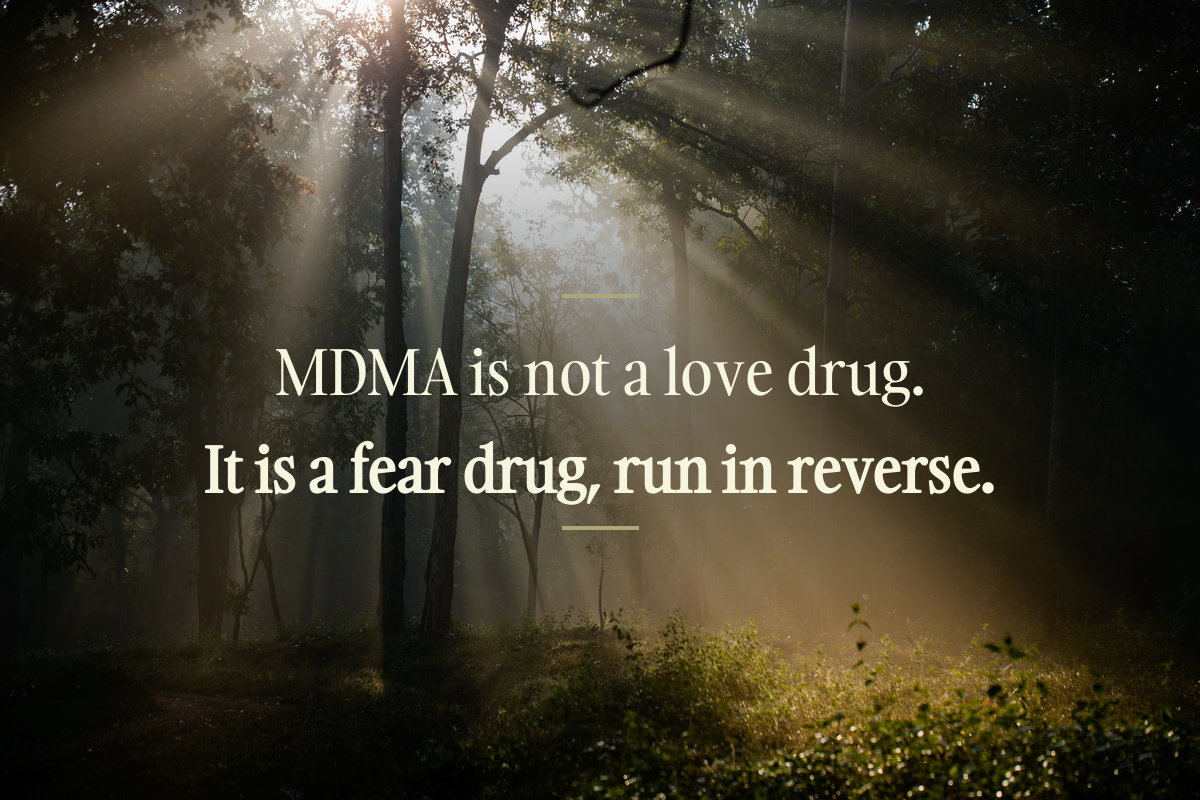
The fear lifted like fog. The light was always coming through. (Photo by Syed Ali on Unsplash)
A few words before we begin. I am a psychedelic guide and a spiritual companion, not a doctor, and nothing here is medical advice. MDMA is a Schedule I substance in the United States, and I do not supply it or any other substance to anyone. What I offer is harm reduction, preparation, and integration for adults 21 and older who have independently chosen this path, alongside professional care, never in place of it. This path is not for everyone, and certain medical and psychological conditions can make it unsafe. Every choice is yours, made with your own care team. With that said...
~16 MINS READ
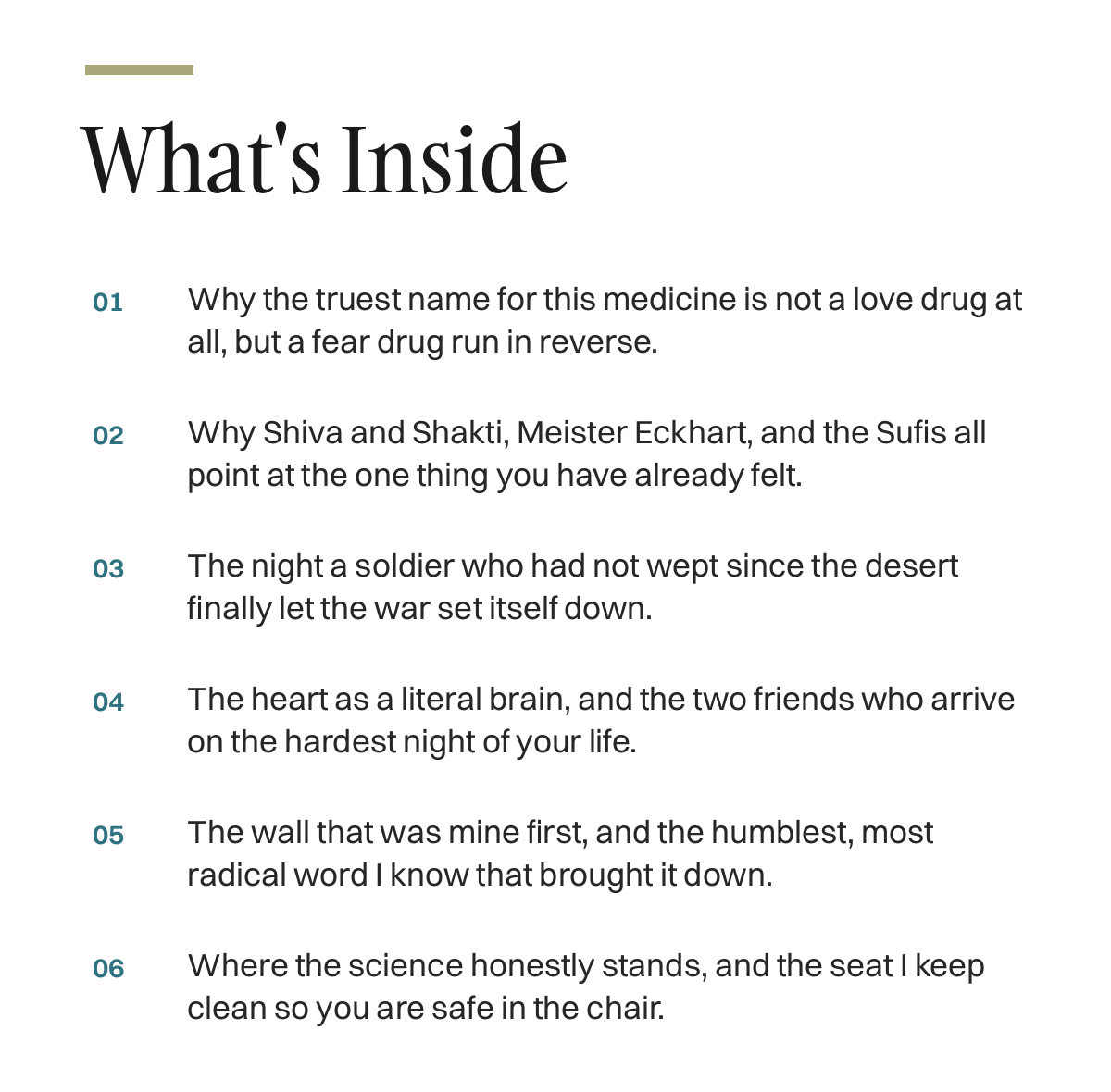
THE MEDICINE WE NAMED FOR A PARTY, AND WHAT IT ACTUALLY IS. WHAT LOVE IS. WHY SHIVA AND SHAKTI AND MEISTER ECKHART AND THE SUFIS ALL POINT AT THE SAME THING, AND WHY YOU HAVE ALREADY FELT IT AT A BIRTH, AT A DEATHBED, THE FIRST NIGHT OF LOVE. THE HEART AS A LITERAL BRAIN. TWO FRIENDS WHO ARRIVE ON THE HARDEST NIGHT OF YOUR LIFE. THE WALL THAT WAS MINE FIRST, AND HOW I LEARNED I WAS ENOUGH. THE SEAT I KEEP CLEAN. AND THE OLDEST INSTRUCTION HIDING UNDER ALL OF IT, THAT THE LOVE YOU LONG FOR WAS NEVER ABSENT, ONLY VEILED. (The history, the science, the trials, and how I actually hold this work are all answered in the FAQs below.)
They told us it was a party drug. They also told us God lives in a building. I have come to believe both are misdirections, and that the same molecule has something to say about the second.
He had not wept since the desert.
Not at the funerals. Not at the births. Not when his daughter took her first steps across a kitchen floor while he watched from the doorway, present and absent at once, a man behind glass. He could feel the love in the room the way you feel heat through a window. There, and unreachable. He had spent two decades scanning every room for the threat. The war had ended for everyone but his nervous system.
In the late afternoon of a long ceremony, with a clinician's intake and medical screening already behind us and a sober steward holding the room, I watched the weight he had carried for over twenty years set itself down, because for the first time since the war, his body decided it was safe enough to stop bracing. The fear lifted off his face like mist off the trees when the light finds its way through. And underneath it, intact, was everything he had been certain he had lost. He wept like the daughter he could finally feel.
The Medicine We Named for a Party
Let us start with the unromantic truth. MDMA is a made thing. It did not grow. There is no plant it was harvested from, no lineage of grandmothers who sang to it. It was assembled in a laboratory, and where the mushroom rots and returns to the soil, a crystal of MDMA kept dry and dark sat inert, all but immortal. That is the difference between a grown thing and a made thing.
Which is why I will mostly not call it a sacrament. I reserve that word for psilocybin and the plant teachers, as I have since the beginning. MDMA I call the heart medicine. It has collected more aliases than almost any molecule alive, and they trace its strange journey. On the dance floor it became ecstasy, then “E,” then “X,” then “Molly,” short for “molecular,” the pure form, a promise the baggie rarely keeps. Clinicians call it an “entactogen,” "touching within." And the therapist who first carried it into healing called it "Adam," for the innocence before shame. A party drug, a chemical, and a doorway to Eden, all the same molecule. What it does, under all the names, is gentler: it lowers fear and raises the chemistry of trust, leaving you yourself, able to turn toward what you have spent years turning away from.
“The medicine does not add love. It lowers the fear that hid it.”
What Love Actually Is
To earn that, I have to say what I mean, because we use the word for everything from a spouse to a sandwich. Love is not a feeling you manufacture and aim at someone. Love is what is already there when the wall between you and another, between you and yourself, between you and everything, stops being enforced. Fear builds the wall. Love is the ground behind it.
The traditions say this with a unanimity hard to explain away. The tantric teachers of Kashmir described reality as two poles of a single consciousness, Shiva and Shakti, stillness and energy, eternally reaching for each other. Meister Eckhart said it without an inch of distance: the eye through which I see God is the same through which God sees me. The Sufis built a path on the separate self dissolving in the Beloved like salt in water; Lao Tzu pointed at it in the folding of yin into yang; the word “ubuntu” states it flatly, a person is a person through other persons. Strip away the doctrines, and the same insight rises to the surface. We are not separate. Love is the name for remembering it.
“your task is not to seek for love, but merely to seek and find all the barriers within yourself that you have built against it.”
And the forest shows it whole in a single image. Stand in an old grove and what you see is separateness: each tree alone in its own bark, reaching, competing for light. That is the surface. Underground, it is one body. A mycorrhizal network of fungal thread laces root to root, and through it the trees feed each other, carbon, water, warning, the tall nursing seedlings in their shade, the dying pushing their last sugars to kin. The ecologist Suzanne Simard named the elders mother trees; how much they mother is still argued, the wiring is not. The separateness is the part you can see. The connection was always there. And this is exactly how the heart medicine works. It does not weave the web. It softens the fear that makes you feel like a single tree, until you feel the forest you were always rooted in. The thread that ties it is a fungus, kin to the mushroom that, in ceremony, shows you the web from the inside.
“Which is why the truest name for it is not a love drug at all. It is a fear drug, run in reverse.”
The Heart Is Not a Metaphor
We have always located love in the heart, and I used to think that was poetry. It is not only poetry. Your heart contains its own nervous system, roughly forty thousand neurons, a network neurocardiologists call the heart's "little brain." The great nerve between heart and brain runs mostly the wrong way: most fibers carry signals up, not down. The chest is not a symbol of feeling. It is an instrument.
The heart is mostly speaking and the brain mostly listening. It keeps a rhythm the body reads as safety or danger, and your mood leans toward whatever it is saying before a thought has formed.
Researchers at the HeartMath Institute named the smooth, ordered version of that rhythm coherence, and showed it can be trained, that a body can learn to steady its own heart toward safety. The heart medicine reaches the same coherence chemically, flooding the system with the safety the heart has been trying to signal all along.
And the long arc of the science agrees with the mystics. The Harvard Study of Adult Development, which has followed lives for over eighty years, found the strongest predictor of a healthy, happy life is not wealth or fame but the quality of our loving relationships. Love, safety, and the heart are one circuit.
And what MDMA does to that circuit is bathe it in oxytocin while it calms the amygdala, the brain's threat alarm. Quiet the fear and what is left is love. The argument I made in Nonlocal Consciousness: the brain is a filter, not a generator, and dampening it produces more, not less. Love floods in like light through a window always there.
“Less fear, more love.”
And here I have to be clear, or the whole argument collapses into sentiment. Science can tell us what produces this state and that it is reliable. It cannot tell us whether the Love a person meets there is the ground of being or only the brain's chemistry of belonging wearing the face of God. What Paul Ricœur called the second naïveté, embracing a sacred symbol fully while knowing it is a symbol, is the posture this asks. The medicine does not answer the question. It removes the fear that kept you from asking.
“I feel absolutely clean inside, and there is nothing but pure euphoria.”
What It Feels Like, for Those Who Have Never
If you have never taken it, the usual words, euphoria, empathy, openness, are accurate and useless, the way "ocean" is useless to someone who has never stood in the surf. But you have almost certainly felt this chemistry already, not from a substance but from your own life. If you have held your newborn in the first hour, certain you would burn down the earth for this small stranger, you have felt it; that flood is largely oxytocin, the same chemistry the heart medicine releases. If you have fallen in love and stayed up until the sky turned gray, you have felt it. If you have sat with someone as they were dying and felt, underneath the grief, an unbearable tenderness, you have felt it. MDMA is that same flood, summoned on purpose inside a safe container. The capacity was always yours; the medicine opens the valve that ordinary fear keeps closed.
“You have been here before. You simply were not allowed to stay.”
Two Friends Who Arrive on the Hardest Night of Your Life
MDMA and the mushroom are not a ranking. They are two friends who do different things, imagine them both arriving at your door on the hardest night of your life.
The first does not say much. She sits on the floor beside you, puts her arm around you, does not flinch at the mess. She just says, “I got you. You don't need to hold it together for me.” And something in your chest, braced for years, loosens. That is the heart medicine. She makes where you are bearable enough to stop running.
The second friend is elusive, and a little stranger. He waits until she settles you, then says, “Now that you are steady, there is something you have been afraid to look at. Come with me.” And he opens a door you did not know was there, the walls fall away, and you see the whole shape of the thing, the grief, the pattern, from above, like a landscape instead of a trap. That is the mushroom. Sent in before you are steadied, the door can be terrifying; but when the first friend has her arm around you, you can look at whatever he shows you and not come apart. She, the heart medicine, holds you. He, the mushroom, shows you. Sometimes they come on the same long day, the heart medicine first and the mushroom hours later; sometimes on separate journeys altogether. Held first, then shown.
And this is the heart medicine's subtlest miracle, the reason couples are among my favorite to sit with. When two people who love each other are both held by that first friend, the wall does not only come down inside each of them. It comes down between them. The fear that has run the relationship for years goes still, and they can say and hear what they could not before. I have watched partners hardened into roommates remember, in an afternoon, why they chose each other. I know couples, some I have sat with, others on their own, who return to it to clear the resentment that silts up in any long love. I have done it myself, with former partners, both held by a guide, and it deepened us in ways years of talking had not reached. This is not couples therapy. But it can return two people to the ground they were built on.
“insight into your darker side, but without self-hatred and without shame.”
The Wall Was Mine First
For most of my life, I could not let love in. I could perform it, give it strategically, the way you give ground in a negotiation. But to receive it, to let another's care land somewhere soft and stay, I could not. I served in combat. I worked in intelligence, where reading people is a survival skill and trusting them a liability. Underneath both was a childhood that taught me love was conditional. My nervous system was a fortress with no unguarded gate. I called it discernment. It was a wall. And it was not only mine, it is a wound the family I grew up in has carried hand to hand, an heirloom no one wanted. I am committed to being the one who sets it down.
Living behind that wall felt like being underwater. Functioning, even succeeding, but always holding my breath, certain the surface was for other people. A nervous system that never stands down learns to call drowning normal. What MDMA did, the first times, was let me surface. For a few hours the fear went quiet and I could breathe, and the world looked sunlit instead of submerged, no longer a threat to manage but a place I might belong. The opening never lasted; I would sink back under. But each time I surfaced I caught a new reference point and built a life that held a little more air. Surface, breathe, decide, build. For me it took many years. I have always been a slow learner, dyslexic, the kid who dreaded reading aloud and decided early that slow meant not enough.
And it did not only meet me in ceremony. I have danced on this medicine countless times, from Burning Man to the hills above Silicon Valley to tantric circles relearning touch, and it taught my guarded body to move, to be seen, to take up space without bracing. The same gift each time: a little more freedom, a little more trust, a little more armor set down. The heart medicine has been one of the truest gifts of my life.
Because that is what the medicine kept returning me to: the most unglamorous revelation available to a man like me – I was enough. A man who secretly believes he is not enough spends his life trying to fix everyone around him, renovating others like fixer-uppers to prove his worth. I was exhausting. I can say that now with affection for the man I was.
Enough is the humblest word I know, and the most radical. I am enough. You are enough. This, between us, is enough. The world, astonishingly, is enough. I came to call it “enoughness:” the cellular knowing that nothing more needs adding or earning. When I stopped trying to earn my place, I could finally see other people clearly, not as projects but as whole, contradictory, holy creatures who needed no improvement from me. Self-love was not the consolation prize. It was the key. The wall came down from the inside, stone by stone, until the water I thought would drown me turned out to be the world itself, breathable all along, and I was breathing.
This is why I can tell you the wall comes down. I am not reporting it from outside. Mine did.
“The course of therapy is determined by the individual’s own inner healing intelligence.”
The Seat I Keep Clean
Knowing something and living it are different arrivals. Years ago, my heart cracked open on this medicine, I proposed to a woman on the anniversary we met. An open heart fogs the goggles, and I gazed lovingly past the narcissism, the red flags, the whole flapping parade. Reader, do not propose on MDMA! (The sober cousin of this error, mistaking an early, chemistry-drunk night for a foundation, is a post for another day.) I did it again the following year, because, as established: slow learner. An open heart bonds fast, and it took me a while to learn the warmth was not always a future. Sometimes it was just the medicine. That is why I now hold the work as I do.
The same fast warmth lands in the chair across from me. People on the heart medicine have, in full sincerity, decided I am their best friend, that they are a little in love with me, more often flooded with love for the people who matter most. I take none of it personally and all of it seriously. The love is real; its aim is just generous. So I turn it around: before you give it all away, let some land on you. That turn inward, toward the self that waited longest for it, is often where the deepest healing lives.
I do not partake with those I sit with. When I hold ceremony, I stay sober, the steady point in the room. I hold this line because the very thing that makes the heart medicine heal, the lowering of defenses, is exactly what makes a guide's betrayal catastrophic. A medicine of trust does not ask less of the one holding it. It asks more, which is why choosing a guide is everything. One exception: with a second, fully sober facilitator holding the container, I may take a lower dose to meet a person where they are, never as recreation.
But the vow underneath the vow is simpler than any rule. My aim, when I do not know what else to do, is to embody love, no matter what arises in the room. Love in action, not a feeling I wait to arrive. So I open my heart, meet whatever arrives with radical curiosity, and hold one intention, with the person's consent: may the highest good for them and all their relationships be made manifest, and whatever is not for their good is not welcome. Held that way, I have witnessed, time and again, what I can only call miracles. I am inside the circle, not above it. But I will not be foggy in the chair where you are most exposed.
“The seat I offer you is one I keep clean.”
The Longer Arc
Step back and a pattern shows itself. This medicine was found by accident, lost for sixty years, banned, exiled to the dance floor, and is now studied in the same government hospitals that once outlawed it. Not a straight line. A spiral, a truth glimpsed, buried, rediscovered, and slowly brought home. One man, Rick Doblin, founded MAPS in 1986 and gave forty years to carrying it from banned street drug toward the FDA's door, weathering ridicule, regulatory walls, and no small judgment from his own field, and staying, by every account of those who have stood in rooms with him, humble and with a warm smile through all of it. His long road is told in the documentary What a Trip. Forty years of stubborn, loving work, and the door is now opening.
“PTSD is a disorder of fear; MDMA reduces fear.”
My near-term read is a calculated projection: the ground is moving faster than in forty years. A 2026 federal executive order began fast-tracking it, the VA launched its own MDMA trial for veterans, and analysts like Psychedelic Alpha expect the first psychedelic medicines approved federally within a few years, psilocybin likely before MDMA, in licensed, supervised centers. Approval is the start of the hard part, not the end; I go deeper in the rest of this text. The arc is long, and it bends the way the mystics and the molecules agree it bends. My work is to be useful in my small stretch of it, and to trust the unfolding; so can yours.
The Fear Was Only the Thing in Front of It
The love you long for was never what you lacked. The soldier did not need love installed in him. I did not need to become someone better before I could receive it. Each of us needs the same thing: for the fear to go still long enough that what is already there can be felt. The medicine does it chemically. The mushroom does it by dissolving the self. Prayer does it. Grief does it. Dancing all night does it, the open secret the young adults chasing Molly and ecstasy stumbled into by accident. Holding a dying animal does it, as I learned from a doe in a garden. The path matters less than the direction: toward the barriers, not the love. The love takes care of itself once the barriers come down.
Whether what floods in is God or only the chemistry of belonging, I cannot tell you, and have stopped needing to. I only know that every tradition that tried to name the root of it all arrived at the same word, and that I have watched it arrive on the faces of people who walked in certain they had lost it. Including, once, myself.
The fear was only ever fog. The light it hid was reaching us the whole time. We did not come here to be repaired. We came to remember what fear was hiding.
Questions to Sit With
If the love you long for was never absent, only veiled, what is the fear that has been standing in front of it?
Where have you mistaken the safety of staying guarded for the truth of being safe?
What in yourself have you been trying to fix or earn, that may have been whole all along?
If God is another word for love, and love is carried in the body, what has your own heart been trying to tell the rest of you?
A Word on Walking This Path
If the wall this post named is one you know from the inside, the work is not to manufacture the love. It is to find the support that lets the fear come down and stay down. That support, far more than any single afternoon, is where lives actually change.
I work with people in two containers, and they are the heart of what I do.
Ceremony container is the full guided journey: weeks of preparation, a full day of ceremony held with screening and a sober steward, and the integration that follows, walked one-on-one across a season.
Coaching container is the ongoing season of integration: six one-on-one sessions, every other week over three months, where insight becomes a changed life. It is the deepest and most enduring of what I do.
The first is the journey. The second is the long work of living it. If we are a fit, that is the work I would do with you.
A lighter or free first step is open too: my Ceremony Readiness Guide, the monthly Online Integration Circle and other events, and, for those I have already walked with one-on-one, the Seekers Circle, a six-month group arc I open once a year.
And if we are not a fit, find your people anyway, another guide, a circle, a therapist, someone solid, because no one should carry what these medicines reveal alone. I do not supply substances. What I offer is companionship, discernment, and steady soles for the long walk.
If this post might help someone standing at this threshold, or who has been told the only door is a pharmacy or a building, I would be grateful if you shared it.
From my Heart to yours,
Yeshua Adonai
Psychedelic Guide
Yeshua is a traveling psychedelic guide currently based in Scottsdale, Arizona. A former Marine who served in combat and a veteran of high-discretion international work in intelligence and diplomacy, he has spent decades exploring contemplative traditions worldwide and learning, slowly and honestly, to trust his own experience along the way. Posts arrive every other Monday. Learn more at aboutyeshua.com.
Frequently Asked Questions
A deeper reference follows: what MDMA is, where it came from, what the science shows, who it serves, and how this work is actually held; each answer with somewhere to read further. Browse what is useful to you; you do not need to read it straight through.
-
A synthetic compound, first made in 1912, that lowers the brain's fear response while raising the chemistry of trust and connection. Clinicians classify it as an entactogen, meaning "touching within." It is not a classical psychedelic and rarely produces visions; it tends to leave a person fully themselves while making it possible to turn toward painful material without being overwhelmed. I call it “the heart medicine.” For research literature, the MAPS MDMA library is the most thorough starting point.
-
Chemically, MDMA is the active ingredient people are usually seeking, but in practice, they are not the same thing at all. Clinical-grade MDMA is of known purity and exact dose; street "molly" and "ecstasy" are unregulated, and in one drug-checking analysis, only about sixty percent of samples sold as molly actually contained MDMA at all; the other forty percent contained none, cut with cathinones, the so-called bath salts, then methamphetamine, or worse.. Worth naming too: much of what is sold as molly is actually MDA, a close chemical cousin that is more stimulating, harder on the body, and longer in its comedown. The street label tells you nothing about what is in the capsule. If you want to understand adulteration and testing, DanceSafe is the most established harm-reduction resource.
-
It does not produce the compulsive physical dependence of opioids or alcohol, and in the MAPS protocol it was used only two or three times across an entire course of care, each session spaced several weeks apart with talk therapy and integration in between. That said, anything that makes us feel good can be misused, and recreational patterns are a real thing. The clinical model deliberately avoids this recreational intent by using it infrequently and with intention. The National Institute on Drug Abuse maintains a balanced overview of MDMA's effects and risks.
-
The history is a relay race. In 1912, a chemist named Anton Köllisch at the German pharmaceutical company Merck synthesized MDMA by accident while trying to make a drug to stop bleeding, and it slept in a patent file for sixty years. It was rediscovered in 1976 by the chemist Alexander "Sasha" Shulgin, who tried it on himself; he and his wife Ann Shulgin, a lay therapist, helped carry it into the therapeutic underground. By the early 1980s, it had escaped onto the dance floor as "ecstasy," and in 1985, the U.S. Drug Enforcement Administration (DEA) used emergency powers to ban it; when its own administrative law judge later recommended a medical schedule, the agency overruled him and kept it Schedule I. Then in 1986, a young activist named Rick Doblin founded MAPS and devoted the next four decades to one stubborn mission: proving this medicine safe and effective enough to bring it back as legitimate treatment. Nearly every modern MDMA trial traces to that work. For the fuller story, the MAPS history of MDMA is the primary source.
-
MDMA has been studied for approval by the Food and Drug Administration (FDA) for more than two decades; it received Breakthrough Therapy designation in 2017. A landmark 2018 trial in The Lancet Psychiatry with veterans, firefighters, and police officers found sixty-eight percent of the full-dose group no longer met PTSD criteria a month after two sessions, versus twenty-nine percent for the control group. Two Phase 3 trials in Nature Medicine found roughly sixty-six percent lost their PTSD diagnosis. You can read every study at ClinicalTrials.gov.
-
No, and not yet. MDMA is a Schedule I substance, studied under FDA-regulated trials but not currently approved as a medicine. In 2024, the FDA declined to approve MDMA-assisted therapy and asked for another trial, citing study-design and blinding concerns, as well as misconduct at one trial site. The benefit data is strong; the road is unfinished, and it should not be rushed past the ethics. I do not supply MDMA or any other substance. For the current status, Lykos Therapeutics is the sponsor pursuing FDA approval.
-
In August 2024 the FDA declined to approve the first MDMA-assisted therapy application, a watershed the field had built toward for forty years. An advisory committee had voted overwhelmingly against approval, and the agency’s letter named three problems: trials that could not truly be blinded (people can tell when they are on MDMA), questions about durability and bias, and unreported adverse events; three related papers were later retracted. Unfortunately, the sponsor had already laid off most of its staff, and headlines called it the end of psychedelic medicine. But many serious people read it as a reset rather than an ending, a demand that the field meet the same standard as any other medicine. Research continues across the U.S. Department of Veterans Affairs (VA), universities, and new sponsors; the science that produced two-thirds remission did not evaporate because one application stumbled. The lesson is the oldest one in this post: shortcuts betray trust, and a medicine of trust cannot afford that. The independent media outlet, community & consultancy firm Psychedelic Alpha tracks it closely.
-
A great deal, and fast! In April 2026, a federal executive order directed agencies to expedite psychedelic research, named MDMA among the drugs eligible for priority FDA review, set aside $50 million to match state programs, and directed agencies to fast-track the rescheduling review for any of these medicines that complete Phase 3, the process that, after FDA approval, can move them from Schedule I to Schedule III and recognize a legitimate medical use. When the first National Priority Vouchers were issued days later, on April 24, they went to two psilocybin programs and one MDMA-like compound, not to MDMA itself, a quiet confirmation of which medicine is actually furthest along. Weeks later, in May 2026, the VA launched a new MDMA trial for about eighty veterans with PTSD and alcohol use disorder (results expected in 2030), one of nineteen active VA psychedelic studies backed by more than twenty-three million dollars of public money. The Department of Defense has separately funded active-duty research. After forty years, MAPS, the nonprofit that carried this medicine the whole way, says the field is closer to mainstream integration than at any point in modern history.
-
No. Trauma is where the research is deepest, but the same wall of fear stands between plenty of people and their own lives who would never call it trauma: the high-achiever who feels hollow, the couple who have gone quiet, the person who simply cannot let love in… You do not need a diagnosis to be carrying a wall. You only need to be ready to look at it. My post on finding purpose in midlife speaks to this reader.
-
Deeply relevant, and the VA is now involved. The Department of Veterans Affairs runs nineteen active psychedelic trials, and in 2026 launched a new MDMA trial for veterans with PTSD and alcohol use disorder. But you cannot yet receive this through the VA outside a trial; the VA says clinical use waits on FDA approval and discourages going it alone, and on the danger of doing this unsupported, we agree. The honest paths today are to check trial eligibility and keep with your care team. My own veteran story is in War After War.
-
It can, and there is both a long lineage and formal research behind couples work with MDMA, reaching back to underground couples sessions in Santa Fe, NM. Couples are my favorite work. But two honest cautions: a shared chemical opening is not the same as shared repair, and the same lowering of the wall that lets two people find each other again can also reveal, gently, that a relationship has run its course. The medicine does not decide that; it only makes the truth easier to feel.
-
It will not turn you into someone you are not; it tends to “return you” to yourself. The opening itself is temporary, a few hours, and what lasts is not the afternoon, but what you do with it. The medicine shows you a new reference point; integration is the slow work of building a life around it. That is why this is the work of building a foundation for lasting change, the slow and rewarding part, not a single dose. It is the heart of why I hold preparation and integration as the real work.
-
I have sat with hundreds of MDMA ceremonies, sometimes with the heart medicine alone, more often paired with the mushroom; the heart medicine first to lower fear, the mushroom after to go deeper. “Stabilize, then dissolve.” These combined journeys run most of a day; they are exhausting and, in my experience, open more than either medicine alone. By choice, I do not facilitate group MDMA ceremonies; my deepest work is one-on-one and with couples. The real work is not the afternoon but the months of integration around it. I mention the above to account for the logic, never as instructions to act alone. See how I hold ceremony.
-
Screening always comes first: every person I sit with is cleared by a healthcare professional trained in this work, because the heart this medicine opens is also a literal heart, and certain medications, including common antidepressants, and certain cardiac conditions, make it dangerous. For heavier histories, I bring a clinician into the support itself. The dose is then set individually, within a narrow band determined in advance: too little and the body can get the stimulation without the heart-opening, which leaves a person anxious and wired rather than soft; too much and the day becomes about overwhelm. More is never deeper. Precision is a form of respect.
-
Real ones. Cardiovascular strain, dangerous interactions with SSRIs and MAOIs, overheating and dangerous changes in blood sodium in uncontrolled settings, and a low mood in the days after as serotonin recovers, plus psychological contraindications. Frequent recreational use is its own risk: leaning on it again and again outruns the brain's ability to restore serotonin, which is part of why the clinical model uses it so sparingly. This is exactly why screening, setting, a carefully set dose, and a sober steward are not luxuries; they are the work. The National Institute on Drug Abuse summarizes the physiological risks.
-
The opening has a cost the body pays afterward. In the day or two following, many people feel a dip some call the "Tuesday blues," a low, tender mood as serotonin replenishes. It is usually mild after a single intentional session, more pronounced after heavy or repeated use, and it passes. Rest, water, electrolytes, gentle food, time outdoors, gentle supplements, and holding off on big decisions while the system resets all help, which is one more reason integration is not an add-on but part of the medicine itself. One caution on the most common supplement: 5-HTP can ease the serotonin rebound, but timing matters. Never take it during or right after the session, or alongside SSRIs, and wait at least twenty-four to forty-eight hours, because loading serotonin too soon can trigger serotonin syndrome.
-
I do not supply substances to anyone. What I offer is consultation, helping you think clearly about research, sourcing decisions, and above all, testing for safety, so that whatever you choose, you choose it informed rather than blind. Slowing down to know what one actually has is one of the most loving things a person can do for themselves. For testing specifics, DanceSafe is the standard harm-reduction resource.
-
I am a traveling psychedelic guide, mobile by design, so the honest answer is that I am not based anywhere in the way that word usually implies. The heart of this work, the preparation before and the integration after, happens over Zoom, which means most of what I do reaches people wherever they are. I have sat with seekers who flew in from Europe, South America, Canada, and from all across the United States. The ceremonies themselves are occasional, and we arrange them in whatever way serves the person: sometimes a client travels to me, sometimes I travel to them, and sometimes we both meet at a destination chosen for the work, an out-of-country retreat or an Airbnb they book themselves. I do keep a few community hubs I return to often. One is Arizona, around Phoenix, Scottsdale, Gilbert, Sedona, Tucson, Tempe, Mesa, and Flagstaff, one of the most active states in the country on psychedelic policy, having funded psilocybin research at its universities, passed a law allowing workers' compensation coverage for MDMA treatment, and seen repeated bipartisan efforts to license supervised psychedelic-therapy centers. The other is New England, where I spend regular time around Portland, Maine and Boston; the region has moved faster than most of the country, with Portland decriminalizing psychedelics in 2023, eight Massachusetts cities, Cambridge, Somerville, Northampton, Easthampton, Amherst, Medford, Salem, and Provincetown, passing similar measures, and veteran-focused therapy bills advancing on Beacon Hill. MDMA remains Schedule I everywhere in the United States today, so wherever we meet, my work is preparation, harm reduction, and integration, never supply. Geography is secondary to the heart that calls you into this work. Wherever you are, we can begin with a Discovery Call.
-
Not like a prescription you fill at a pharmacy and take home. Every serious model, the FDA trials, Australia's prescribing framework, and Oregon's psilocybin centers, administers it as medically supervised multi-session therapy: pharmaceutical-grade MDMA, given in a licensed setting, across several day-long sessions spaced weeks apart, with trained facilitators and integration between them. When approval comes, expect licensed clinics and certified-therapist models rather than retail sales, which is exactly why preparation and integration, the work I do, will matter as much then as now.
-
A calculated projection, not a prophecy, and I accept to be wrong on timing and right on direction. Analysts who track the field, like Psychedelic Alpha, the independent media outlet, community & consultancy firm, anticipate the first psychedelic approvals coming in waves, psilocybin likely before MDMA, and RAND, the nonprofit, nonpartisan research & information organization, finds public support today (2026) roughly where cannabis sat in the mid-1990s. Five years out: MDMA approved, or nearly so, reaching veterans and the dying first, expensive and uneven. Ten years: an established if still specialized treatment, paired routinely with integration support, no longer shocking to mention, the way ketamine has quietly become ordinary. Twenty years: I suspect the medicine will matter less than the shift it helped trigger, a culture that treats the wall of fear as tendable rather than shameful. But approval is the starting line, not the finish, and the harder work comes after: building licensed clinics, since this is not a take-home pill; training enough facilitators well, in two-person teams over many hours; closing the gap on access and cost, since early treatment will be expensive and insurance will lag, even as benefits administrators like Enthea, which already lets employers cover ketamine-assisted therapy the way they cover dental or vision, move to add other psychedelics as each wins approval; manufacturing and securing pharmaceutical-grade supply; keeping honest harm reduction for an underground that will not vanish; and above all, the months of integration and real community that make the change last, the work I believe matters most, and which no approval can manufacture. A field that rushes past these will stumble. A field that takes them seriously will earn the trust this medicine requires. The compound is just a key. What I am betting on is the door staying open.
-
With a conversation. Book a Discovery Call, and we will talk honestly about where you are, whether this work fits, and what it would ask of you. You can also start with my free Ceremony Readiness Guide, or join the monthly Online Integration Circle. No pressure. No obligation. The first step is not a ceremony. It is a question asked out loud.
Blog Archive
explore the growing library
-
After the War
- Nov 17, 2025 05 | 11.11: War After War A Veteran’s Battle to Heal
-
Consciousness
- Aug 24, 2026 35 | Beholding: How the Chapel of Sacred Mirrors Returns Your Gaze
- Jun 1, 2026 29 | Leary's Eight Circuits: A Map of Consciousness That Both Frees and Binds
- May 18, 2026 28 | Cancer: The Other Healer in the Room
- Apr 20, 2026 26 | Harvard's Last Psychedelic Intersections Conference: A Practitioner's Review
- Mar 30, 2026 24 | Nonlocal Consciousness: What The Secret of Secrets Reveals About the Nature of Mind
- Mar 23, 2026 23 | Self-Remembering: When the Self Sees Itself
- Mar 16, 2026 22 | Hyparxis: The Dimension Where Real Change Becomes Possible
- Mar 9, 2026 21 | Thresholds: A Psychedelic Guide to Falling Apart on Purpose
-
Finding Purpose
- Jul 13, 2026 32 | Vows: How a Tree Learns to Love the Wind
- Apr 6, 2026 25 | Reset: What Becomes Available When You Choose to Dissolve
- Jan 26, 2026 15 | Beyond Belief: Psychedelics and the Post-Religious Spiritual Path
- Jan 5, 2026 12 | Beginning Again: The Practice of Presence Over Performance
- Dec 1, 2025 07 | Finding Purpose in Midlife: How to Regain Meaning
- Nov 24, 2025 06 | Unlock Leadership Potential With Psychedelic Coaching
-
Psychedelic Path
- Sep 21, 2026 37 | FDA public hearing: The Day the Sacred Was Ruled “Out of Scope”
- Aug 10, 2026 34 | Kaleidoscope: What Is Actually Happening Inside a Mushroom Journey
- Jun 29, 2026 31 | MDMA: Heart Medicine and the Oldest Name for God
- Jun 15, 2026 30 | Ketamine: The Mirror Molecule That Was Always Asking for a Witness
- Jan 19, 2026 14 | Microdosing Magic Mushrooms: A Guide to What Actually Works
- Dec 22, 2025 10 | From Darkness Into Light: Living the Insight
- Nov 3, 2025 03 | Ketamine Therapy Near Me: A Legal Pathway for Psychedelics
- Oct 27, 2025 02 | Arizona’s Psychedelic Awakening: Where Science Meets Soul
- Oct 20, 2025 01 | My Psychedelic Journey: A Path Through the Fog of Depression
-
Sacred Ceremony
- May 4, 2026 27 | Seekers Circle 25-26': Where Preparation Becomes Integration
- Feb 2, 2026 16 | Choosing a Psychedelic Guide: Questions Your Life Depends On
- Jan 12, 2026 13 | Psychedelic Preparation: The Work That Begins Before Ceremony
- Nov 10, 2025 04 | Magic Mushrooms: Remembering the Sacred Intelligence of Nature
-
Shadow Work
- Jul 27, 2026 33 | Bend: A Reckoning with the Feminine
- Mar 2, 2026 20 | The Shame Addiction: What the Body Learns (Part 3 of 3)
- Feb 23, 2026 19 | The Shame Addiction: What the Body Hides (Part 2 of 3)
- Feb 16, 2026 18 | The Shame Addiction: What the Body Carries (Part 1 of 3)
- Feb 9, 2026 17 | Stop Trying to Forgive: What Psilocybin and Grief Teach About Letting Go
- Dec 15, 2025 09 | Grief and the Path Back to Ourselves (part 2 of 2)
- Dec 8, 2025 08 | Grief and the Path Back to Ourselves (part 1 of 2)
- Tools for Integration
trending topics
- psilocybin
- psychedelic integration
- psychedelic guide
- harm reduction
- Arizona
- psychedelics
- integration
- transformation
- Fourth Way
- PTSD
- integration coaching
- letting go
- mental health
- nature
- neuroplasticity
- presence
- psychedelic preparation
- recovery
- self-awareness
- veterans healing
- Gurdjieff
- Long Now
- addiction
- alternative treatment
- becoming
- burnout
- combat veteran
- consciousness
- default mode network
- depression
- emotional healing
- ethics
- grief
- guide selection
- ketamine therapy
- legal
- loss
- magic mushrooms
- masculine and feminine
- mindfulness
- mushroom ceremony
- mystical experience
- personal growth
- plant medicine
- psychedelic healing
- red flags
- relationship healing
- relationships
- rites of passage
- sacred ceremony