
34 | Kaleidoscope: What Is Actually Happening Inside a Mushroom Journey
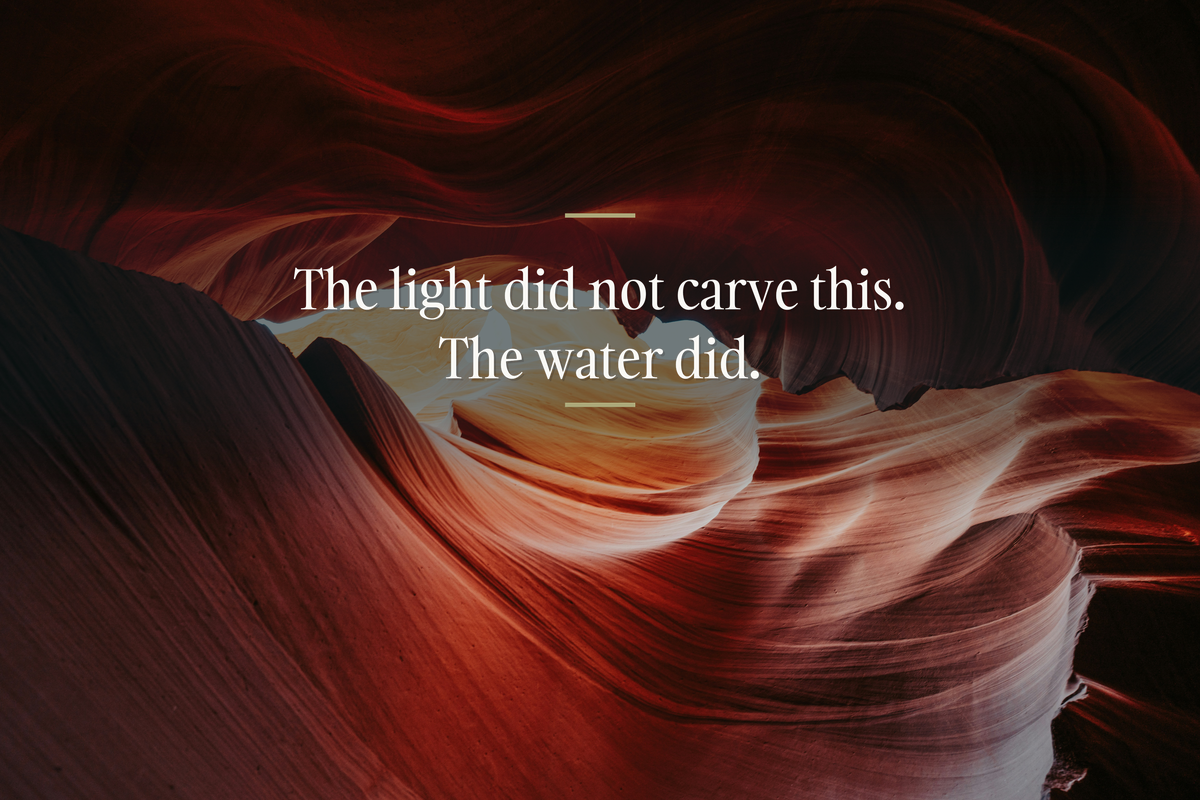
Tsé bighánílíní, "the place where water runs through rocks." Antelope Canyon, Navajo Nation, Arizona. Photo by Jake Johnson on Unsplash
I spent decades trying to have the watchfulness cut out of me. It turned out to be the qualification.
A few words before we begin. This piece touches war, paranoia, shame and grief, and it touches a body that could no longer move. Go gently with yourself. It also describes a dose far beyond anything used in a clinic, which is not for most people and which I would not have anyone attempt without a trained guide in the room. Psilocybin remains federally illegal. My full disclaimer is in the footer of every page. With that said…
~20 MINS READ
A MONASTERY IN 2010 WHERE I WAS CERTAIN THE MONKS HAD COME TO KILL ME. ELECTION NIGHT 2024, A CEREMONY BEGUN EYES OPEN, AND THE MOST SIGNIFICANT NIGHT OF MY LIFE, WHICH TOOK A DECADE TO BECOME READY FOR. THREE MIRRORS AT SIXTY DEGREES, AND A CANYON ON NAVAJO LAND THAT DOES THE SAME THING AT SCALE. WHAT I HAVE LEARNED FROM PEOPLE WITH NO MUSCLE LEFT TO BRACE WITH, WHO STILL HAD TO LET GO. AND A CAT WHO CLIMBED ONTO MY BACK WHILE I WEPT INTO THE GRASS.
(The neuroscience, the legality, and the contraindications live in the FAQs below.)
You have read about the ceremony. The room, the eyeshades, the sober steward at the door. None of it tells you what you want to know. What happens inside you.
But I have to start earlier, because years before I ever had a guided mushroom ceremony I had to learn the harder thing.
I went to a monastery in 2010 because I could not sit still in my own kitchen. I had come home from the war and brought its machinery with me, and it did not know how to power down. I had begun to suspect the people I loved most, or I would close my eyes to meditate and feel a weapon at the back of my head.
The First Turn
The place was Deer Park Monastery, outside Escondido, California, where monks walked slowly and questions were not required. I spent my first week clocking the exits. You cannot order a sentry to stop being a sentry. The bell woke us before five, and I would lie on a thin mat catching, from a washroom across the hamlet, the peppermint of a bar of Dr. Bronner's soap. Hold that detail. It comes back, though not in this essay.
Then the monk who built the place came into the hall. Thich Nhat Hanh moved more slowly than anyone I had watched, with no visible effort. I had spent two decades reading bodies for threat, and I could not find a single defended thing in his. Compassion sat in his shoulders, which was the teaching before he said a word. Then he said it. When a pain rises in you, turn to it the way you turn to a face you have not seen in years. Hello, my old friend. I know you. Come, sit, let us have some tea.
So I tried it on the fear, and the scanning did not stop so much as change what it hunted for. Attention that had swept a room for threat could sweep instead for the breath, the grain of the floor, the light in a hall built for silence. The breath is where they told me to start, and years later it is still where I start everyone.
The vigilance did not have to die. It had to be turned. Nothing in you needs removing. Some of it needs rotating. That was the first turn, and it took me fourteen years to find out what it had prepared me for.
The Dose, and Why It Is Not the Doorway
November 5, 2024. I sat facing a guide I trust, as her client. That is how I do this. I do not hold myself. Both of us cross-legged, eyes open, because I had asked for that beforehand. No eyeshades and a playlist to start with. A face.
I picked the date. It was election day, the country was arguing with itself about light and dark, and that was the argument I wanted to meet at a scale I could manage. I also knew I was going to die. Not the body, the one who manages the body. Decades of preparation had told me what that much does and I lay down anyway. Less like being brave than like knowing what I had signed.
Roughly fifteen grams of potent dried mushroom. Three times what McKenna called a heroic dose, and roughly five times the high end of what Johns Hopkins gives. A mega-macro, a ridiculous phrase for a ridiculous quantity, and I am printing it because the honest thing here is uncomfortable in both directions.
That night was the most significant of my life and the amount was part of why. There is a threshold, and beneath it the far country stays shut. The conditions finish the job: no sound, no sight, over half an ounce of a potent strain on an empty stomach, a trained guide in the room, and nothing else in the blood. Remove every anchor at once and you will be blasted somewhere, ready or not.
And if you take one line from this page, take this one. What decides how far you go is not the amount. It is how much you can let go, and whether that somewhere is a country or a car crash is decided by it.
My letting go took diligent devotion to build. There is no weight stack for letting go. You cannot max out, no one spots you, and the rep never changes: open your hand while what you love is still in it.
The cost climbs with the quantity. The odds of terror rise alongside the odds of awe. And that night was one night. It is not how I usually work with the sacrament, and it is not where I have spent most of my hours. The smaller rooms are where the years went, and where nearly everything I know came from. If the prospect of facing your own death and everything in you that is not love reads as an invitation, you may be one of the few this is written for. If it reads as a warning, believe it. And do not do this alone. You would not venture in on white water you have never seen without somebody who knows the river. Read the number as biography, not a target.
I will finish that night at the end of this letter. First what an ordinary one holds, and then the machine underneath both.
A door does not care how hard you knock. It cares whether your hands are empty.
What Most People Get Instead
The question I get is the opposite one. Not what fifteen grams is like. What a first time holds, and whether any of it comes at three to four and a half grams, for someone prepared for it, in a quiet room with somebody watching the door. Most of it is, and that is where nearly everyone should begin.
Here is one shape it takes, and most of it is felt before it is seen. Warmth moving up from the belly. The jaw letting go of a grip it has held since childhood. Colors deepen, edges soften, geometry arrives behind closed eyes. Ordinary objects appear to be in motion. Music becomes almost unreasonably beautiful and turns into a kind of conversation, and your hands may move with it before you decide to. Emotions come in waves, often grief that has been standing in line for years waiting for a moment when nobody would interrupt it. Tears show up ahead of the reason for them. Somewhere in the middle a pattern in your own life comes clear, one you have been standing too close to, and it does not arrive as an idea. It arrives in the chest, already obvious.
And you stay yourself the whole time. That is the part most seekers are relieved to hear. You know who you are, where you are, who is sitting with you. What gets set down, you set down.
The connectedness people bring back, which the research suggests is what changes lives, is fully available in that room and does not require the amount I took. My night was one man's business at the far end of a long practice. Yours will likely be better if it does not try to look like it.
None of that is a promise. It is one shape of many, and I have held enough ceremonies to know substances do not read the brochure. Which is why I ask everyone to write their intentions down beforehand, longhand, then let them go the way a child lets go of a paper airplane. Fold it. Throw it. Do not run after it to correct the flight. The throw is yours. Where it lands is not.
You are not going to be given a bigger night. You are going to be given your own.
The Instrument You Are Looking Through
Return to that room for a moment, me on the mat and my guide sitting across from me. Within an hour after partaking, layers came online between us. Sheets of film standing in the air around her body and mine, some carrying rows of vibrating golden characters unmistakably a language and unmistakably about her. And between us, strands.
Ribbons of colored light, lit from inside, leaving a bright turning point in my body and arriving at the matching one in hers. Crown to crown. Heart to heart. Root to root. Not still, moving the way a wave moves through water, and something passing along them in both directions.
Later the same script arrived on the back of my own hand. I turned the hand over and the palm held the cosmos. Our solar system, turning. Beings on worlds I have no vocabulary for, and running between all of it every thread visible at once, the way a hawk sees every field in a county. All of it inside me, and me inside it. There was more, and I will not describe all of it. Then geometry behind closed eyes. The same small family of shapes gets reported across centuries and across cultures with no contact, and the reason is not mystical. For years I assumed my own geometry was about me.
It was about eyes. I looked a long time for words for all of it, and the spiritual ones failed me.
What worked was a child's toy, and to explain why I have to start with what is true right now, sober, reading this. A brain is sealed inside a dark and silent skull. It does not touch the world, and neither do you. What arrives is electrical signal, and the brain guesses what caused it, then corrects the guess against whatever comes next. Anil Seth at Sussex calls ordinary perception a controlled hallucination. When our hallucinations agree, we call it reality. Neither of us has seen the world. We have seen the guesses.
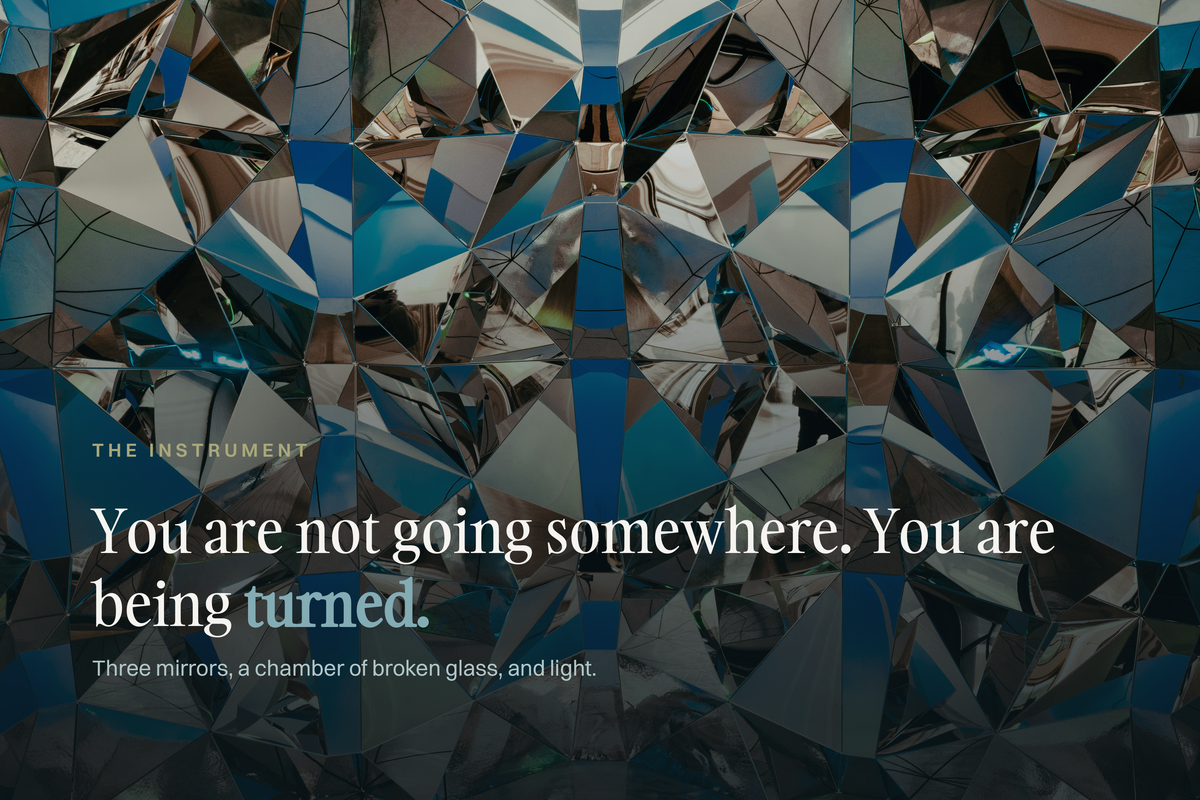
A kaleidoscope is three mirrors at sixty degrees inside a tube, a chamber of broken glass and light. One degree of turn and the cathedral you were looking at is gone forever and another stands where it was. The substance is the light. Your life is the glass. Your mind is the mirrors. Your attention is the eye at the end of the tube.
If a toy feels too small for your life, there is a version four hours north of me. Antelope Canyon sits on Navajo land outside Page, Arizona, where the upper slot is called Tsé bighánílíní, the place where water runs through rocks, and where one step at midday rearranges the whole cathedral, though nothing about the stone has changed. The same machine at two sizes. Mirrors and walls. Broken glass and carved rock. And look at what each is made of. Somebody's scrap, swept up. Ten thousand years of flood. Neither picked its shape, and neither became worth looking at until it was broken in a particular order.
Which leaves the question this letter is for.
“change the way you look at things and the things you look at change.”
The Four Turns
So what does the turning. Four moves, in this order, and they are the tube itself.
The light enters. A gate deep in the brain loosens, and more of the world comes upstairs than you were built to process in an hour.
The mirrors move. The network that keeps you continuous, stitching this moment to the last and calling the result you, goes quiet, and the angle you have looked from since childhood shifts a few degrees.
The pattern turns. What was loose in the chamber reassembles into a shape you cannot unsee. People call this insight. It is closer to inventory.
The tube stays loose. For weeks. What you do in that stretch is what the new shape hardens into.
The mechanics are in the FAQ. I did not get these four from a book. I got them from sitting through the same sequence in rooms with nothing else in common, then went looking for what researchers had already named. In one breath, for the friend who asks over dinner: your life is the chamber, whether you picture it as broken glass in a tube or a canyon cut by water, the medicine is the light, and what moves is the angle.
Though angle is the wrong word for what it does to you. I used to think this was about perspective. See it differently and the suffering loosens. That is true, and it is the smaller half. There is seeing your life differently, and there is being different while you live it. The tube does not only change the picture. It changes the one holding it.
The medicine can turn the tube. It cannot take your turn.
The Glass You Bring
Most of the night walks in on your own two feet. Researchers in Zurich pooled four hundred and nine supervised psilocybin sessions and tested twenty-four variables against what people experienced. Dose predicted nearly everything. But for fear, one variable beat it by more than double.
The room.
Sessions run inside a scanner produced more than twice the anxiety that dose did. The other rooms had been furnished to be pleasant. Same molecule, same milligrams, different furniture, different outcome. It is hard to dissolve the boundary of the self while a fluorescent tube hums at you, and now there is research showing it.
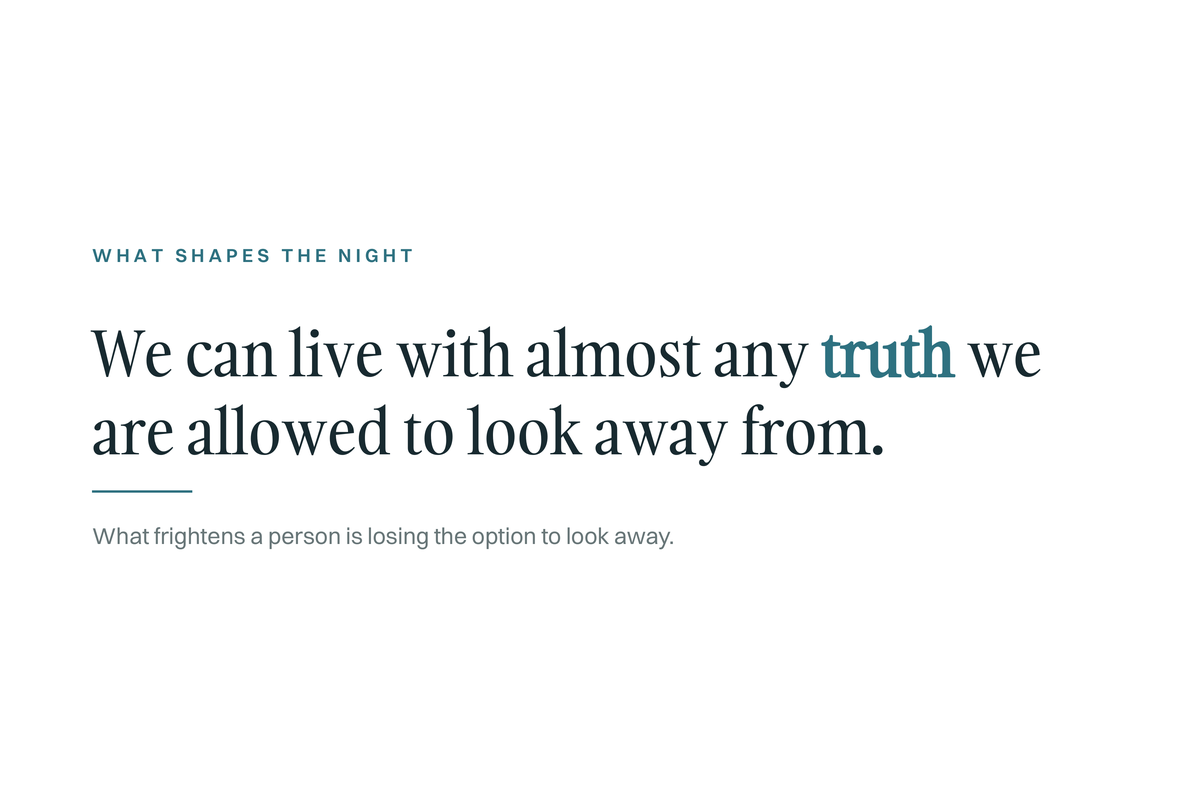
The floods that cut that canyon finished ten thousand years before the light you see came down the slot. The light gets the photographs. The water did the shaping, the way whatever broke in you did the shaping long before a medicine arrived to shine through it. So in the week before a ceremony I care less what someone has read than who they are still angry at. Near where I live, a tinaja is a rock basin holding the rare desert rain, and in its dry sediment seeds wait years for it.
The rain does not decide what grows.
The Least Holy Half Hour
It begins, for almost everybody, exactly like this. Thirty minutes in, I yawn, and then yawn again and it is not tiredness. A chill climbs the back of my legs. My stomach turns over once and the thought arrives fully formed: I have made a mistake, and there are at least a handful of hours left.
This does not make it onto the poster. The opening act of a night I spent months preparing for resembles mild food poisoning.
Then it moves in an order worth knowing. The gut, where the animal lives; it has no opinion about my plans. Plenty meet the sacred with a bucket in their lap and there is no dignified sentence for that. Then the root, where there is a charge too many are embarrassed to name because it may feel erotic, whereas they came expecting something holy. Then the chest, where the grief is kept and the ribs go tight around it. Last the head, arriving late, with least to say.
The medicines on this path work by subtraction. Heart medicine lowers the guard. This one removes the exits.
Then the fear arrives. A voice I half recognize, my own but older and colder, says its one line. This was a mistake. Underneath is the real event, which is not a thought: I understand, in the body, that I cannot stop what I started. Most mythologies station a figure at that door, not to bar the traveler but to learn whether he goes through anyway. It has your voice.
The scary part was never the monster. It was the doorknob turning.
When the Body Makes a Fist
Somewhere in the deep, most of us meet an edge. We push. The pushing makes it worse. I ask where it is being held, because it is rarely abstract. The jaw. The throat. The pelvis clenched like a man bracing for a punch he has expected since he was nine. You do not decide your way out of a grip the body is making. Clamp your hand around a kaleidoscope and you get one image, held rigid. Not a wrong image. The one you will be given, because you would not let it turn.
Lifeguards do not advise a swimmer caught in a rip current to be stronger. They tell them to stop being strong in the wrong direction, to quit swimming for the beach and let the water carry them out until it tires and lets go, which it does. Of nearly two thousand people recalling their hardest psilocybin experience, thirty-nine percent ranked it among the five hardest things they had lived through, and eighty-four percent said they benefited anyway.
Awe and terror pour from the same tap.
Which is what I did not expect on my own night. There was no fight in it. The tuition had been paid in smaller rooms, and I was not pushed anywhere. I was carried, the way water takes a swimmer who has stopped swimming, and what took me in was tender about it.
What we call surrender is mostly just stopping.
I have sat with people who had no muscle left to brace with, whose bodies had stopped taking instructions entirely, and they still had to let go, and the letting go was still the work, and they did it. What they taught me belongs here: the body is not the price of admission. Willingness is.
“resistance usually comes from fighting what’s happening.”
The One Dial That Stays Yours
This is what I teach before anyone takes anything. It often gets skipped. It is foundational.
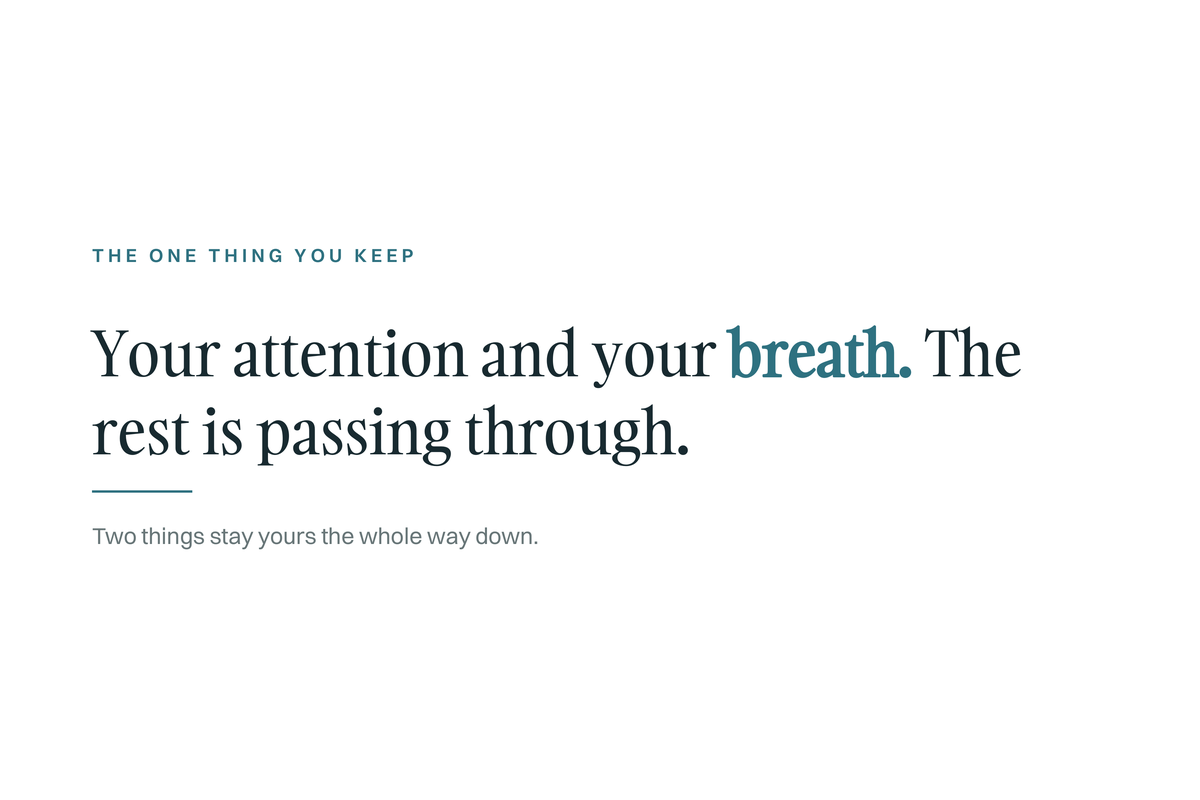
Very little in a journey answers to you. Not the images, not the timing, not what surfaces, not how long it lasts. Two are yours the whole descent. Your attention, and your breath.
The breath sits on the border between what the body does without asking and what you can take hold of, which makes it the one control panel you have on your own nervous system from the inside. And it has more dials than anyone mentions. Breadth. Depth. Rhythm. Speed. And the intention behind it, the dial everyone rolls their eyes at until they try it. Every pilot I trust flies with a hand on that panel, and the ones who forget it is there report a rougher flight.
Lengthen the exhale until it runs longer than the inhale and the body reads it as safety and stands down. Not mysticism. Wiring. It works whether or not you believe in it, and that is the best kind of tool.
Which makes the instruction small enough to remember at the worst moment. When the ceiling moves. When the voice says this was a mistake. Do not think yourself anywhere. Put the exhale out longer than the inhale, three or four times, and let the body come down before the mind gets a vote. And if you forget, you have not failed anything. Forgetting is what a guide is for. That is the moment I lean in and breathe it beside you until your body finds the rhythm on its own, and nobody has to remember anything. I practice it on ordinary days for the reason a swimmer practices in a pool. The night you need it is not the night to learn it, and a nervous system that has done it ten thousand times will do it when the rest of you has gone offline. Which is the part almost everybody sleeps through.
After the Light Moves
What you must not do is decide, while still in the room, what any of it means. This is the instruction people resist most and the one my clients taught me to stop giving too early. I did it for years. The same loosening that lets buried material surface also turns up the feeling of insight itself, and it fires on true things and false things alike.
Certainty in a journey is a symptom, not evidence.
So attend to what you feel over what you see. Someone comes out wanting to know what the serpent meant, whether the figure was real, and while they ask, whatever was moving through their chest goes unattended. The seeing is only there to bring the feeling forward, and once it has done that the image can go.
Watch a potter at the wheel. The hands do not explain. They press, the clay rises, and no word is said to the clay about what it is becoming. The clay does not need to understand the vessel in order to become it. The grief moving through your chest at hour three is not a message waiting to be read. It is pressure.
By mid-afternoon the light moves off the sandstone and the stone keeps the shape. Then it is morning, and the temptation is to believe the ceremony is over. The weeks after are where I do most of my work, because the brain comes apart and reassembles almost the way it was. Almost. One connection between two regions stays looser than it started, for weeks.
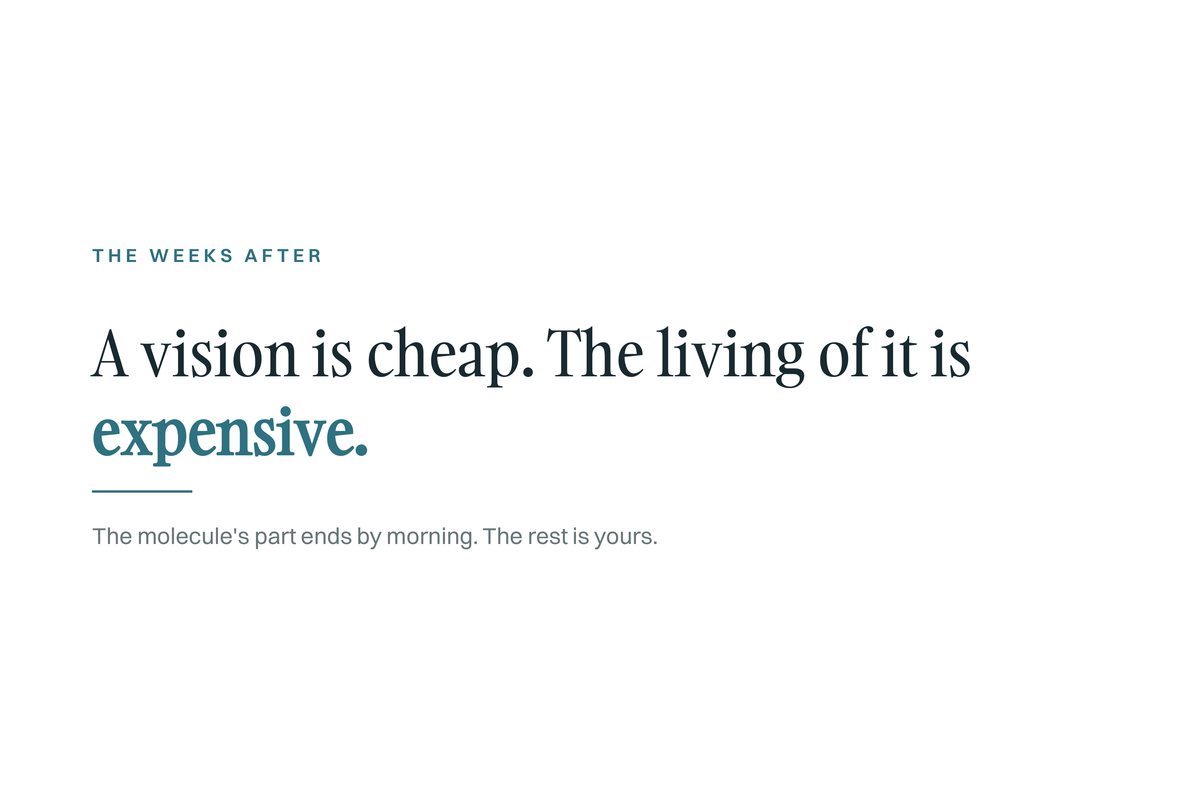
The molecule's part ends by morning. The weeks after are yours.
So write it down within a day, before the story hardens into an anecdote, and find one move the journey is asking of an actual relationship. A broken bone does not heal back into its old shape; for a few weeks it lays down a soft callus, and the load you put through it then is what the new bone hardens into. I have been there while that bone set crooked and while it set well, and the difference was usually one small act, done on a morning when nobody was looking. What it costs to let a self dissolve is Reset.
“have patience with everything unresolved, and try to love the questions themselves.”
The Last Turn
Which brings me back to that night, and the part I have been trying to say for nearly two years without getting it right.
I was present at a beginning. Not the memory of one, and not a vision of one. A beginning, underway, with me inside it and no edge where I stopped and it started. The beginning. What people mean when they say the big bang, except that phrase sounds like an explosion, and this was quieter than an explosion. There was no room for it to happen in. It made the room.
And it was the end at the same time. Not before the end, not leading to it. The same event, and the only honest word I have for the shape of it is round. A circle. A zero, holding everything that has ever been and everything that is, with nothing outside it and nothing left over.
A man who tells you he was present at the beginning of the universe is usually about to sell you something. I know. I have met him, at retreats, holding a very small cup of tea.
What made something out of nothing was not a force. Nothing pushed. It was a quality of being, closer to love than to power, and it required a death to do it, a giving up so complete that no separate thing survived the making. That is the part I cannot get around. The cost was total, and the paying of it was the making.
I did not watch this happen. I was what was happening. My birth and the birth of all of it were one birth. My death and the death of all of it were one death. Not a comparison. The same event, seen from inside the only vantage I had.
Creation and dying are one motion. Every taboo we have built around birth, and around death, stands in front of the same door. I have carried it since without a sentence that does not cheapen it, and I am not going to find one tonight. What I can say is that nothing since has frightened me the way I expected, and nothing since has felt ordinary.
Late that night, long after dark, I went outside.
There was a tree in the yard, lit from inside like a lamp somebody forgot to switch off. Running out from it, under the grass and under the plants, were channels of light moving both directions at once. Sugar going out. Water coming in. It looked like the arrivals board at an airport, if the airport were run by a tree and nothing was ever delayed.
Then whatever had been holding me upright let go. I went down onto my hands and knees in the wet grass and wept, and it was not insight and not gratitude exactly. It was that the grass and the counting on the screen inside and the war I came home from and the people I have loved badly were running correctly and had been the entire time, and I had spent the better part of my life auditing a system which never asked to be audited.
I am aware of how that sounds. Which is when the cat walked over, climbed onto my back, and lay down. She had no opinion about it. A warm man in the grass at an unusual hour. She stayed while I cried into the dirt, and I have rarely felt less like a spiritual person and more like an animal among animals, which turned out to be the point.
The largest thing I have known arrived at ground level, with a cat on my back.
There Was Never a Line
Here is the dinner table version, because I have tried to say this in holy language and holy language is where it goes to die. All my life I had felt like a small thing looking out at a big thing. Me in here. The world out there. Something like a pane of glass between the two. That night the glass was gone, and it did not break. It had never been installed. I could not find the line where I stopped and everything else started, because there is no line. There never was one. I had only gotten very good at drawing it. Decades of practice at a line that was not there, which is not the kind of skill you put on a résumé.
Nothing was added to me. Nothing was handed over. A wave does not have to swim to the ocean. It is the ocean, doing a shape, for a while. So whatever you have been reaching for, peace or belonging or the word you use when nobody is listening, you are not far from it. You are made out of it. That was not a nice thought in the grass that night. It was a fact about my own body, and I have never gotten over it.
It was a milestone, not a summit, and milestones are things you pass. What I want to say plainly is that I wish this for you. Not my dose and not my night. The knowing that nothing is out of order, and that what you have been looking for is what you are standing inside. The sentence I carried out is one I still say at red lights. It's all good. All of it.
This does not arrive in one evening, any more than one multivitamin makes a body. It helps to carry a certain madness, an appetite for dying that nobody should fake. Going there disturbs a life. Mine was disturbed, and underneath the disturbance it was moving me toward truth, and I will go back.
But I go back most days without any of it. That is the part I did not expect, and it is the whole of what I have to teach about integration. You do not return through the images, and you do not return through what you decided it meant. You return through the quality of the experience, what it felt like from the inside, called up on purpose. That much is portable. It arrives in the body before it arrives as a memory.
What Comes Back
My circumstances that November did not improve. Not one bill, not one estrangement, not one hour of what I had done or failed to do. The bills in particular were unmoved. All of it was still there in the morning. What was gone was the line. I was not standing outside my life anymore, grading it. I was in it, and it was in me, and there was nothing left to hold at arm's length. Which is how heaven and hell stopped being opposite ends of a life and became something much closer than that. One breath apart on most days. The breath is the hinge.
I do not hold it. I lose it in traffic, in email, in the middle of a sentence I am proud of. Find it again, lose it by lunch. Nothing here gets achieved and kept. It gets remembered and forgotten and remembered, a hundred times before dinner. A person breathes around twenty thousand times a day. Twenty thousand chances to turn back toward it, and you will miss most of them, and there is always another one coming. A ballplayer who fails seven times out of ten goes to the Hall of Fame. I would not put my own numbers that high, and I am not discouraged.
The monk who taught me to greet my fear was pointing at this. So was the carpenter I am named after, when he said the kingdom was not coming with signs to observe, that it was already in their midst. Different men, different centuries, different claims, and I will not flatten them into agreement. What each keeps insisting is that you do not have to fix this moment first. It is already the place where you get to choose what you bring.
Nothing needs to arrive. You need to turn.
Four ways I use it now, and none of them are ceremonial.
At hour eight, tired, the person on the mat still out there and hours to go, I go back to this unitive experience and something comes up through me that was not there a minute before. Not willpower. A surge of energy. I have come to rely on it.
On a bad day, when the old arithmetic starts again, I go back and what returns is not comfort. It is a correction. Oh. Right. ‘It’s all good.’
In meditation, when I stop reaching for stillness and evoke that night instead, it puts me somewhere no practice of mine has reached on its own. Serenity. Complete connectedness. My chest opening. More in my body at the end than when I sat down.
And sometimes I am with somebody, and behind me there is a lamp or a window or the sun, and I catch its glint in their eye. Half a second, and I am back inside the white light that consumed me. Then I am here again, more here than before, grateful for no reason I could name. And not only here. In all of it at once, with them.
Awe is what is left when the arguing stops.
“there is a world beyond ours, a world that is far away, nearby and invisible.”
The One Who Holds the Tube Steady
I have not healed anybody. I have kept vigil while people healed themselves, which is a different sentence, and the difference is most of what I know. I hold the tube steady. A smaller job than it sounds and harder than it looks. If you are weighing anyone to sit with you, I have written the questions your life depends on elsewhere.
From the outside, my job is a grown man paid to sit very still in the dark. Close enough. Up close, it is eight to ten hours of using my own body as the reference instrument, because I cannot feel theirs, only my own. I sit where a person can feel me without being touched, and I watch my own breath first, because a breath I am holding will show up in them inside a minute. When my belly hardens I know it is coming before the room shows it. When my jaw sets I know I have started managing instead of accompanying, and that is the failure nobody warns you about. A nervous system borrows calm the way a spooked horse settles beside a steady one. My job is to be the steady partner.
Everything here is the best picture we have this year, and some will look partial in ten. María Sabina and the Mazatec carried the sacred mushrooms for centuries, and when she opened her world to outsiders it cost her her home, her standing, and the trust of her own people. We have access because she paid for it. And if you believe none of it, that matters less than you would think. Nobody was ever argued into awe.
Years after the monastery, a friend named what I had circled for a decade. He said the watchfulness was not what stood between me and this work. It was the qualification. I had spent a decade trying to have the hypervigilance cut out of me, along with the shame I carried out of combat and the covert work after it. That sentry shows up again in Bend, costing me people I loved. I wanted a surgeon. What I needed was a turn, a turn of the kaleidoscope’s tube.
Hypervigilance and hyperpresence are one instrument at two settings. One sweeps for what might kill you. The other notices what is here. No new faculty was issued to me and I did not earn a better one. The alchemists were not making gold out of nothing; they were asking what enough heat does to the black rock a man is already carrying. The watchfulness I hated is what keeps me in the chair at hour eleven, when everyone else has gone quiet or gone home and the person on the mat is still out there, catching the half second when a breath changes. That is not healing anyone. It is staying awake beside them while they do it.
Nothing was wasted. Not even the war.
Same glass. Same stone. Same light. One degree, one step, one breath.
The watchfulness I once used to find the threat in every room, I now use to find the half-second when your breath changes.
Questions to Sit With
What would it be to meet the thing you have been at war with in yourself and greet it like someone you had missed?
Where are you swimming hard against a current, certain the fighting is the only thing keeping you afloat?
Are you defending something or are you perceiving the world directly?
What would one degree of turning look like, this week, in the room you are sitting in now?
Before You Go
A gentler word, because this letter has spent time with war, with a body that stopped answering, and with the fear of dying. If any of that is alive in you tonight, you do not have to carry it alone and a ceremony is not where you have to start. In the United States, you can call or text 988, the Suicide and Crisis Lifeline, any hour of any day, and reach a person. Reaching for help is the oldest form of strength we have.
And if it is not a crisis, only a weight you have been carrying by yourself for longer than you meant to, tell one person this week. A friend. A partner. Somebody who has walked it and did not come back smug. And if it has no name, if it is only a nagging you have never said out loud, that counts. Tell someone anyway. The naming often happens in the telling.
If that person turns out to be me, the door is at aboutyeshua.com. If it is somebody else, that is just as good, and I mean that. What matters is that you stop being the only one who knows.
In two weeks, I will take you to a building above the Hudson River where I found my own visions already painted on the walls, and where that bar of soap finally made sense sixteen years later.
If this gave you language for a fear you have never had words for, send it to the one person you know standing at their own trailhead, trying to decide whether to go in.
Start with the window. Not the light. Not the picture on the wall. The window.
It lets you watch the road. It keeps the cold night on its side. And when the sun hangs low your own face rises in the pane, faint, and standing in the rain, which is the only way that most of us are ever shown the face we wore.
A whole life. A good one.
Then the storm. Then the branch. Nobody asks the glass. The pieces will not hold the rain. No road. No warmth. No face.
For years I asked to be a window again. Take the war out, I said. Take the ache. And something answered, low and plain: that is the tooth you bite with.
Then someone set the pieces in the dark where the light comes in aslant, the way the water worked the stone ten thousand years to carve a room one blade of light at noon could enter and set the whole wall blooming.
And they throw a shape no window can, here the length of a breath, gone with the moving hand.
The light does not know your name. It does not ask. It does not aim. It comes the way the morning comes and everything broken answers.
So. You. Holding what you have held since before you had a word for it, sure the broken part is the wall between you and your life.
Friend, it is not the wall. It is the glass.
You held one as a child. A tube, three mirrors, and a few bright bits of nothing much, and every turn a world made new.
The old word for it means one who watches beautiful forms. That is what you were at six. That is what you are.
The bits do not change. The light does not change. Only the angle. Only the hand, and the hand is yours.
So turn the way you look at things and the things you look at turn.
The poem is on a page you can print. Download it here
From my Heart to yours,
Yeshua Adonai
Psychedelic Guide
Yeshua is a trauma-informed psychedelic guide, integration coach, and writer. A Marine Corps combat veteran, former diplomat, and mental health executive, he serves sacred mushroom and MDMA ceremonies, integrates ketamine treatment in clinics, supports clinical trials, advises policymakers and organizations, and mentors new guides while building technology for the field. He lives in Scottsdale, Arizona, keeps an office in Gilbert, and travels the country, including monthly to communities around Portland, Maine. Most of his work is remote. He counts himself a fellow traveler, still learning to trust his own experience. Posts arrive every other Monday at aboutyeshua.com.
Take a breath here. That was a long way in and a long way back, and your body has been reading about its own dissolution. Put your feet on the floor. Let the exhale go longer than the inhale. The questions below will keep.
Frequently Asked Questions
A deeper reference follows: what is happening in the brain, what the research shows, what the honest limits are, and how this work is held. Each answer has somewhere to read further. Browse what is useful; reading it straight through is not a requirement.
-
This is the current picture, which is real and unfinished. Psilocybin is a prodrug: the body converts it to psilocin, which binds the 5-HT2A serotonin receptor, densest in the parts of cortex handling self-reference, meaning, and vision. Block that receptor and the experience does not happen. The thalamus lets through more than it usually would. The network that maintains your sense of being a continuous self loses coherence. In a 2024 study in Nature tracking volunteers across roughly eighteen scans each, psilocybin desynchronized brain activity at more than three times the level of a stimulant control. One connection between two regions stayed loosened for weeks afterward, which is the finding the fourth turn rests on.
-
A short set of orientations clinical volunteers rehearse during preparation and that a guide repeats back in the room. Bill Richards at Johns Hopkins School of Medicine is most responsible for the modern version. Trust, let go, be open. Trust the trajectory. If you see a door, open it. Move toward the frightening figure rather than away, and ask what it came to teach you. If you feel like you are dissolving, go ahead, because that is a feature and it is followed by return. You will not be left alone and you do not have to manage your body. Volunteers receive roughly eight hours of preparation before they are given anything. Outside a trial, almost nobody is taught them. Richards set them down at length in Sacred Knowledge.
-
A hard passage and a harmful one are not the same thing, though fear insists they are. In a survey of 1,993 people recalling their single most difficult psilocybin experience, thirty-nine percent ranked it among the five hardest things they had lived through, and eighty-four percent said they benefited anyway. That is not a promise hard passages are safe to walk alone. It is the reason preparation, screening, and a trusted guide exist. And a minority do carry difficulty far longer: a 2023 study in PLOS ONE documented extended difficulties lasting a year or more for a meaningful share of those affected. Anyone who tells you this is risk-free is selling something.
-
The honest list is longer than most websites admit. A personal or family history of psychosis, schizophrenia, or bipolar I, because of the risk of precipitating mania or psychosis. Certain cardiac conditions. Active suicidal crisis or acute instability. Pregnancy. And a real set of medication interactions, including lithium, which has been associated with seizures in self reported cases. These questions belong to you and a prescriber who knows this terrain, not to a blog post. The Spirit Pharmacist is the resource I point people toward for medication questions.
-
Both, and holding the two together is the honest answer. The geometric patterns are your visual cortex made visible, which can be shown mathematically. The presences arise from a brain doing something extraordinary. That the mechanism is real does not make the meaning fake, and that the meaning is profound does not make the mechanism mystical. I take this question up properly in Nonlocal Consciousness, and William James got there first, in 1902.
-
Because the map between your eye and your visual cortex is a specific geometric transformation. Heinrich Klüver catalogued the recurring shapes into four families a century ago, and mathematicians later derived them from the anatomy of the visual cortex: run a wave of activity across that cortical sheet, translate it back through the map, and you get the tunnels, spirals, lattices, and honeycombs people report. You are seeing the structure of your own seeing.
-
Almost certainly not, and it is worth knowing why. The idea came from Rick Strassman's 2001 book DMT: The Spirit Molecule and was offered as a hypothesis, not a finding. David Nichols later ran the numbers and showed the gland would need to produce orders of magnitude more DMT than it plausibly can, and when the same lab later removed the gland, brain levels did not change at all. What is real is stranger. DMT reproduces near-death phenomenology almost feature for feature in the lab, and a dying brain has been recorded surging rather than fading. The link between those states is not a molecule. It is what happens when the brain's model of itself lets go.
-
Two explanations and a remainder, and I will not collapse them into one. The first explanation is hardware: we have brains built to detect other minds, and when the boundary of the self loosens, that machinery fires with nobody in the room. It is the wiring that finds a face in a cloud, running without brakes. The second is the biography we share. We were all born. We were all small and watched. That common material is where the guardian at the threshold comes from. The remainder I cannot close. Benny Shanon spent years building a careful map of ayahuasca experience, and he is no mystic. He could not explain his own central finding: drinkers from cultures with no contact, atheists included, keep meeting the same content. Jaguars. Serpents. Palaces. Light. Jung called that an archetype, which names the pattern without explaining it.
-
Less than people hope in the first week, and more than they expect by the third month. Researchers built an instrument for the most common report: the Watts Connectedness Scale asks whether you feel connected to yourself, to other people, to the world. Across more than a thousand people the answers rose after a psychedelic experience, further with psilocybin than with a standard antidepressant. The active ingredient looks less like insight and more like belonging, which is also why integration is the part I charge for and the part people skip.
-
One, the light enters. Deep in the brain sits a gate called the thalamus, deciding how much of the world gets upstairs at any moment. It is why you are not, right now, swamped by the feeling of your own socks. The mushroom loosens that gate, and a Zurich team watched the same gate open under LSD.. Huxley guessed at a valve like this seventy years ago; a Zurich team watched it open.
Two, the mirrors move. A network runs in the background keeping you continuous, stitching this moment to the last and calling the result you. Under the sacrament it quiets, the angle shifts a few degrees, and the furniture of your own mind throws a shadow you do not recognize.
Three, the pattern turns. Little arrives from outside. The thing you did not say, the conversation you rehearsed for eleven years, the grief you filed and forgot, reassembles into a shape you cannot unsee.
Four, the tube stays loose. By morning the light is gone and the network reassembles nearly the way it was. Nearly. One connection stays looser for weeks. The journey is one night. The turning is a season.
-
Because most of your serotonin is not in your head. It lives in your gut, and nausea runs up a nerve to a small patch at the base of the skull, one of the few spots where the brain lets the bloodstream in, so it can taste what you swallowed and vote on sending it back. The oldest part of you votes first, before your intentions get a hearing. Yawning, chills, and waves of muscle tension belong to the same opening act. Researchers have begun asking whether the gut is doing more of this work than anyone assumed.
-
Closer than you would guess. A systematic comparison of the two states found they share vivid imagery, amplified emotion, the surfacing of avoided material, and the loosening of self, with the closest match being lucid dreaming, the mixed state where you are asleep and aware at once. The difference matters too: in ceremony you keep enough waking clarity to work with what arrives, which is the whole reason a ceremony can be therapeutic and a dream usually is not. The body proves this all night. It goes on making its small requests, and some part of you keeps answering them, even while the rest of you is somewhere a dream could not follow.
-
More setting than anyone selling you a molecule will admit. In a pooled analysis of 409 supervised psilocybin sessions across twenty-three studies, dose was the strongest predictor of nearly every outcome, but for anxiety specifically, the strongest predictor of all twenty-four variables tested was the setting: sessions run inside a scanner produced anxiety at more than twice the effect size of dose. The same study found that pre-dose anxiety did not significantly predict a difficult session, while being keyed-up and restless beforehand did. More than eighty percent of the variance in fear went unexplained. We can tilt the odds. Nobody can promise a night.
-
It may be more for you than for almost anyone. The people who most fear losing control are usually the ones most exhausted by holding it. I know that fear from the inside. I came to this work a combat veteran whose nervous system could not stand down. The fear is not disqualifying. It is information. Thresholds is the longer answer.
-
Lengthen the exhale until it is longer than the inhale, which moves the nervous system out of alarm.
Feel your back against what is holding you.
Open your eyes and look at one real object in the room; in the Nature study above, giving the brain a perceptual task measurably reduced the disruption while it was happening.
Reach for the hand you agreed on in daylight.
Then stop trying to get back, and let the wave crest.
If you are with a guide, you do not have to remember any of this. The Fireside Project runs a free psychedelic peer-support line if you need a human voice, and the Zendo Project publishes the four principles I work by
-
Because the feeling of truth is itself turned up during a journey. Researchers describe the sense of insight as a metacognitive signal rather than a verdict, a click that fires when pieces fit, and under relaxed priors it fires more often and harder, on true things and false things alike. Sit with it a week. What survives contact with a normal week was worth having. What evaporates never was.
-
Four to six hours, generally, and how you experience the music predicts more about the outcome than the intensity of the drug does. Onset in the first thirty to sixty minutes, the peak somewhere between the second and third hour, then a long descent that is often where the tenderest work happens. Ceremony days with me run longer than the medicine itself. See The Work That Begins Before Ceremony and, for what a six-month container looks like, Seekers Circle.
-
It changes it, and the honest answer has two halves. Dose is a real lever, not a detail. There is a threshold below which the boundary of the self does not go, and the Johns Hopkins dose-response work found effects rising with dose across the range they tested. Very high amounts open territory that smaller ones do not. That is the half most harm-reduction writing leaves out, and leaving it out is its own kind of dishonesty, because a person who believes dose is irrelevant will be careless with it.
The other half is that the odds of a hard passage climb at the same rate. In the same work, challenging experiences at thirty milligrams per seventy kilos were significantly higher than at twenty, while volunteers at the lower dose were still calling it among the most meaningful events of their lives more than a year later. So there is no simple ladder. There is a threshold, then a long stretch where more buys duration and difficulty, then a far country that costs a great deal to visit and is not for most people. Dose is matched to a person's capacity and their container, arrived at with a guide, and never chased alone.
A starting range is often three to four and a half grams, and it is not always given at once. Onset tells a guide things a plan cannot, so a portion held back and offered later is sometimes the more careful choice than a single larger amount at the start. There is no prize for intensity, and there is no substitute for preparation.
-
Different tools, different countries, different legal status. Ketamine is dissociative, shorter, dose-controlled, and the only one legally prescribable in most of the United States; I wrote about it in Ketamine: The Mirror Molecule. MDMA lowers the fear response while keeping you fully yourself, which is why it suits relational and trauma work; that is Heart Medicine and the Oldest Name for God. The sacrament tends toward dissolution and the mystical. Sequencing decisions belong to qualified clinicians, not to a blog.
-
On April 18, 2026, Executive Order 14401, Accelerating Medical Treatments for Serious Mental Illness, directed the FDA to prioritize review of certain psychedelic medicines, opened an access pathway for eligible patients, and steered fifty million dollars toward research. Six days later, the FDA issued National Priority Vouchers to three programs, including Compass Pathways for psilocybin in treatment-resistant depression. None of that legalizes anything, the evidence standard did not move, and even after an approval the DEA would still have to reschedule psilocybin before it could be dispensed. Legal scholars at Harvard's Petrie-Flom Center note that a president cannot reschedule a substance by order. Treat every 2026 approval timeline you read as a projection, including Compass Pathways' own.
-
Psilocybin remains federally illegal. I do not supply it or any other substance. Oregon and Colorado have opened supervised state pathways where a session happens at a licensed service center with a trained facilitator present for the full duration. If federal approval arrives, the likely shape is narrower still: a clinic, a prescribing physician, and a supervised administration requirement written into the label. Research access is expanding, including in Arizona, where the Scottsdale Research Institute is studying whole mushrooms for PTSD in veterans and first responders. My work is preparation, harm reduction, and integration for adults making their own informed choices, alongside professional care and never in place of it.
-
For the science, the publication pages at the Johns Hopkins School of Medicine and the Imperial College London’s Centre for Psychedelic Research are the primary sources most articles are quoting.
For the phenomenology, Bill Richards' Sacred Knowledge and Michael Pollan's How to Change Your Mind.
For the philosophy, Chris Letheby's Philosophy of Psychedelics and William James' The Varieties of Religious Experience.
For harm reduction, the Zendo Project and the Fireside Project.
For policy and trial tracking, Psychedelic Alpha and ClinicalTrials.gov.
Read the primary sources when you can; most of what circulates online is a summary of a summary.
-
I live in Scottsdale, Arizona, and my office is in Gilbert. I work with seekers across the nation, with many in cities including Phoenix, Sedona, Tucson, Tempe, Mesa, and Flagstaff, and I travel throughout the United States, including monthly to communities around Portland, Maine, and greater New England. Most of what I do is remote, so geography is rarely the obstacle people expect, and when travel makes sense, I either meet clients where they are or we choose a destination together for a private retreat. Preparation and integration coaching are available anywhere.
-
Two shapes, and they are the whole of what I offer.
A ceremony container is the full guided journey: weeks of preparation, a full day held with screening and a sober steward, and the integration that follows, walked one-on-one across a season.
A coaching container is that integration on its own, six sessions every other week over three months, which is where insight becomes a changed life and is the deeper and more enduring of the two. The first is the doorway.
Additionally, my Ceremony Readiness Guide is free if you would rather start by reading, and there is a monthly online integration circle that costs nothing to attend.
-
With a conversation rather than a commitment. A free discovery call is where we meet, where you ask everything this letter left unanswered, and where we work out together whether this path and this guide are right for you. If we are not a fit, find your people anyway: another guide, a circle, a therapist who knows this terrain. I do not supply substances. What I offer is companionship, discernment, and steady soles for a long walk.
Blog Archive
explore the growing library
-
After the War
- Nov 17, 2025 05 | 11.11: War After War A Veteran’s Battle to Heal
-
Consciousness
- Aug 24, 2026 35 | Beholding: How the Chapel of Sacred Mirrors Returns Your Gaze
- Jun 1, 2026 29 | Leary's Eight Circuits: A Map of Consciousness That Both Frees and Binds
- May 18, 2026 28 | Cancer: The Other Healer in the Room
- Apr 20, 2026 26 | Harvard's Last Psychedelic Intersections Conference: A Practitioner's Review
- Mar 30, 2026 24 | Nonlocal Consciousness: What The Secret of Secrets Reveals About the Nature of Mind
- Mar 23, 2026 23 | Self-Remembering: When the Self Sees Itself
- Mar 16, 2026 22 | Hyparxis: The Dimension Where Real Change Becomes Possible
- Mar 9, 2026 21 | Thresholds: A Psychedelic Guide to Falling Apart on Purpose
-
Finding Purpose
- Jul 13, 2026 32 | Vows: How a Tree Learns to Love the Wind
- Apr 6, 2026 25 | Reset: What Becomes Available When You Choose to Dissolve
- Jan 26, 2026 15 | Beyond Belief: Psychedelics and the Post-Religious Spiritual Path
- Jan 5, 2026 12 | Beginning Again: The Practice of Presence Over Performance
- Dec 1, 2025 07 | Finding Purpose in Midlife: How to Regain Meaning
- Nov 24, 2025 06 | Unlock Leadership Potential With Psychedelic Coaching
-
Psychedelic Path
- Sep 21, 2026 37 | FDA public hearing: The Day the Sacred Was Ruled “Out of Scope”
- Aug 10, 2026 34 | Kaleidoscope: What Is Actually Happening Inside a Mushroom Journey
- Jun 29, 2026 31 | MDMA: Heart Medicine and the Oldest Name for God
- Jun 15, 2026 30 | Ketamine: The Mirror Molecule That Was Always Asking for a Witness
- Jan 19, 2026 14 | Microdosing Magic Mushrooms: A Guide to What Actually Works
- Dec 22, 2025 10 | From Darkness Into Light: Living the Insight
- Nov 3, 2025 03 | Ketamine Therapy Near Me: A Legal Pathway for Psychedelics
- Oct 27, 2025 02 | Arizona’s Psychedelic Awakening: Where Science Meets Soul
- Oct 20, 2025 01 | My Psychedelic Journey: A Path Through the Fog of Depression
-
Sacred Ceremony
- May 4, 2026 27 | Seekers Circle 25-26': Where Preparation Becomes Integration
- Feb 2, 2026 16 | Choosing a Psychedelic Guide: Questions Your Life Depends On
- Jan 12, 2026 13 | Psychedelic Preparation: The Work That Begins Before Ceremony
- Nov 10, 2025 04 | Magic Mushrooms: Remembering the Sacred Intelligence of Nature
-
Shadow Work
- Jul 27, 2026 33 | Bend: A Reckoning with the Feminine
- Mar 2, 2026 20 | The Shame Addiction: What the Body Learns (Part 3 of 3)
- Feb 23, 2026 19 | The Shame Addiction: What the Body Hides (Part 2 of 3)
- Feb 16, 2026 18 | The Shame Addiction: What the Body Carries (Part 1 of 3)
- Feb 9, 2026 17 | Stop Trying to Forgive: What Psilocybin and Grief Teach About Letting Go
- Dec 15, 2025 09 | Grief and the Path Back to Ourselves (part 2 of 2)
- Dec 8, 2025 08 | Grief and the Path Back to Ourselves (part 1 of 2)
- Tools for Integration
trending topics
- psilocybin
- psychedelic integration
- psychedelic guide
- harm reduction
- Arizona
- psychedelics
- integration
- transformation
- Fourth Way
- PTSD
- integration coaching
- letting go
- mental health
- nature
- neuroplasticity
- presence
- psychedelic preparation
- recovery
- self-awareness
- veterans healing
- Gurdjieff
- Long Now
- addiction
- alternative treatment
- becoming
- burnout
- combat veteran
- consciousness
- default mode network
- depression
- emotional healing
- ethics
- grief
- guide selection
- ketamine therapy
- legal
- loss
- magic mushrooms
- masculine and feminine
- mindfulness
- mushroom ceremony
- mystical experience
- personal growth
- plant medicine
- psychedelic healing
- red flags
- relationship healing
- relationships
- rites of passage
- sacred ceremony