
37 | FDA public hearing: The Day the Sacred Was Ruled “Out of Scope”
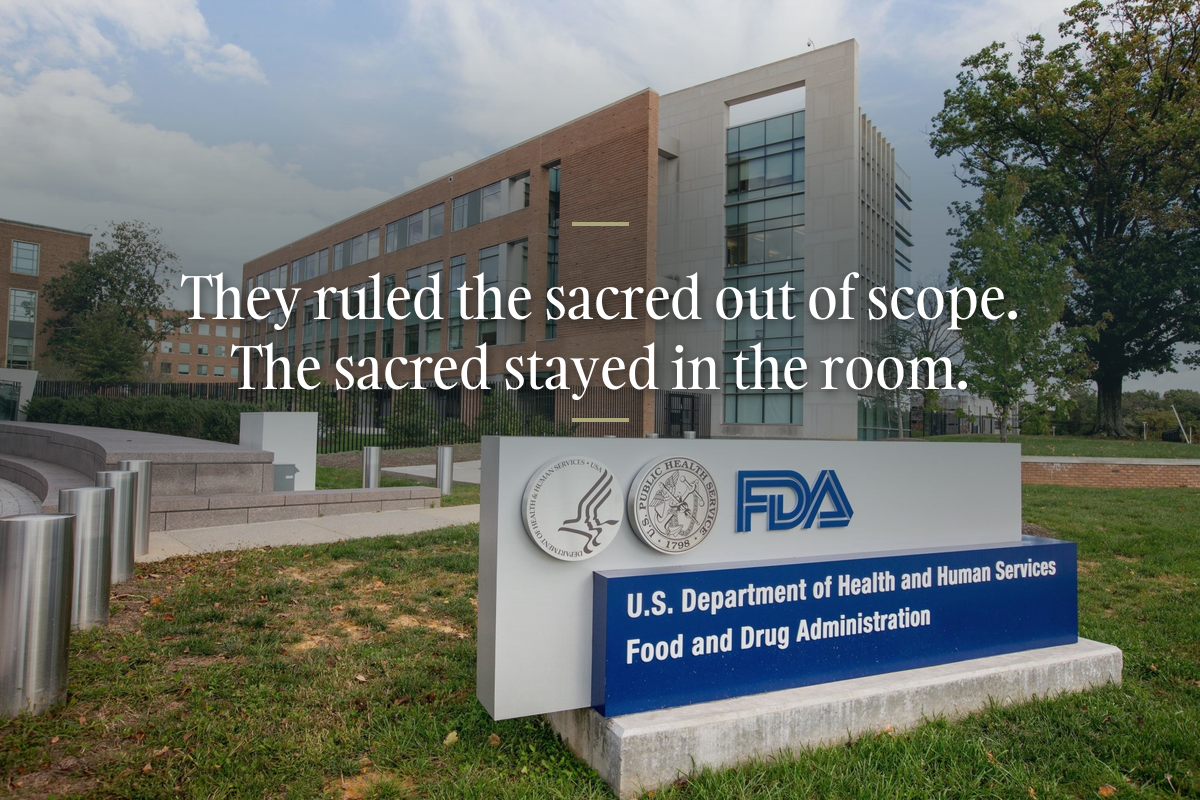
The FDA's White Oak campus, Silver Spring, Maryland, on ground where the Navy once tested mines. The sign names the inspector. The oaks behind the sign were here first. Photo: U.S. Food and Drug Administration.
On Monday, 14 September 02026, the Food and Drug Administration held Considerations for Potential Future Therapeutic Use of Psychedelic Drugs, docket FDA-2026-N-7542, the first ‘Part 15’ hearing on these medicines as a class. Eighty speakers had been drawn by lottery in advance, each given under two minutes at the podium. Five federal bodies listened from the front of the room: the FDA, NIDA, SAMHSA, the Veterans Health Administration, and ARPA-H, named in full in the FAQs. I watched the stream from start to finish. Sadly, not one asked a question across four hours. The written docket stays open until 5 October, and this letter is my filing.
The FDA, the Agency, asked four questions. How a provider should be trained? How a patient should be kept safe? How the care reaches a patient? What data ought to be collected? Then, before the first speaker stood, the Federal Register Notice ruled five subjects “out of bounds,” among them "religious, ceremonial, or personal (non-medical) use."
So the government asked who should sit beside a patient whose mind comes apart, and ruled out of bounds the experience most likely to happen while the mind is open. This letter is about the gap between those two decisions.
Why you might weigh any of this. For much of my adult life, I was a patient in the traditional mental health system, and for most of those years the system was doing an honest best. Post-traumatic stress after the Marines. Depression the textbooks call treatment-resistant, the polite way of saying the shelf ran out. A stretch where I was planning an exit rather than a week. By the end, my marriage was gone and so was my housing.
Past the end of the shelf, there was no single miracle. Structured MDMA sessions, held by humans who knew the work, gave me the first hours in years where my body believed in safety. Mushrooms lifted the depression. The medicine opened a door, and the years walked me through.
The searching came long before the work did. Since the Marines, I have spent fifteen years in healthcare innovation. Chief operating officer at Lief Therapeutics, whose FDA-cleared biometric device for nervous system regulation reaches thousands of patients nationally. Work with the California Department of Public Health on opening public data, so others could build on what the state already knew. A mindfulness program inside Facebook. Years teaching pharmaceutical executives to design for health rather than for the management of pain. None of this work reached what was wrong with me. So I know the building from the inside, and I know what the building could not do for me.
I now sit with adults past twenty-one who chose this path for themselves. Close to five hundred ceremonies, and thousands of hours of integration after them, offered as harm reduction. I am also the integration partner at a ketamine clinic in Arizona, where the medicine is prescribed and the setting licensed, and I support clinical trials in this field. So this letter comes from three seats: the patient the system could not hold, the practitioner who holds others now, and the operator, from those fifteen years, who has watched a good idea die for want of an owner. An approval is one step. The infrastructure around the hours is where the healing is won or lost.
I have carried this account to a President, to state legislators, to county officials, to the DEA, and to veterans in parking lots outside VA hospitals. Thousands are doing the same, on their own time. The Agency asked for lived experience. The Notice then ruled the living part out of bounds.
Ground rules. Psilocybin and MDMA sit on Schedule I, the most locked shelf the government keeps, which in law means no accepted medical use. This letter touches veteran suicide. Go gently. With that said…
Public comments to the FDA about this hearing close at 11:59 p.m. Eastern on Sunday 5 October 02026. I am reading them as they arrive, so until then this page keeps changing.
~18 MINS READ · LIVING DOCUMENT, REVISED THROUGH 5 OCTOBER
A government can rule a subject out of scope. A government cannot rule the subject out of the room.
EIGHTY SPEAKERS HAD TWO MINUTES EACH. FIVE FEDERAL AGENCIES LISTENED BUT NONE ASKED A QUESTION. I WATCHED FROM A KITCHEN COUNTER, AND I AM FILING IN WRITING INSTEAD. THE NOTICE RULED THE SACRED OUT OF SCOPE BEFORE THE FIRST SPEAKER STOOD, WHICH IS THE ONE RULING THE ROOM CANNOT HONOR. THIS LETTER WALKS YOU THROUGH WHO SPOKE, WHO COULD NOT RISK SPEAKING, WHAT KETAMINE ALREADY PROVED ABOUT THE WEEKS AFTER, AND THE NINE HANDS WITH NO GARDENER AMONG THEM. BY THE END YOU WILL KNOW WHICH DESK EACH ASK BELONGS ON, AND WHY PRESENCE IS THE PART NO RULE HAS CLAIMED.
(What a ‘Part 15' hearing is, who ran the room, the full speaker roll, and how to file your own comment are in the FAQs below.)
The Room Named for a Tree
Half past twelve, the hearing streaming onto a borrowed kitchen counter. Four hours of federal listening from the White Oak Great Room in Silver Spring, near Washington D. C. Strange work, weighing the shape of a life through a laptop speaker, a jar of honey sweating by the sink.
A name drawn, the moderator noted, was not a name endorsed. A lottery fills a room fairly and finds a field poorly.
White oak is the one oak a barrel maker can trust. The tree seals the pores of the wood from the inside. A white oak cask holds whiskey for a decade. A red oak cask leaks.
The ground under those trees was a Navy weapons laboratory from 1944 to 1995, magnetic mines and fuzes. The same acreage now holds a hearing on compounds able to take a mind apart. A laboratory for what detonates, turned into a laboratory for what dissolves. A house raised for one purpose can be turned into another. So can a field. So can a life.
They named the room for the one oak which does not leak.
The hearing asked who holds the patient.
Who Spoke, and Who Could Not
Each speaker had met a limit. I have met mine.
Lieutenant General Marty Steele turned eighty the following day. A man who once commanded thousands spent those hours in a windowless federal room, asking for a door he may be too old to walk through. A Marine came home from two deployments to treatment which nearly finished the job. A mother said her daughter died at twenty-one. Two minutes for a daughter.
Few come to this out of curiosity. Brothers and sisters of mine are dying while the file fills. A friend counts the daily loss the way a Marine would. A platoon a day.
Now, count who was absent. Handing a Schedule I substance to another adult is distribution under 21 U.S.C. 841, up to twenty years, and opening a room for the purpose is a separate offense. A state license shields a facilitator from the state, not from Washington.
The record will not hold the next sentence. I will. I assume most who stood at the podium have taken one of these compounds, and none could say so. The experience which qualifies a witness is the one which, spoken in the wrong room, ends a career or a custody arrangement.
So we speak in the register our families can survive. “The data suggest” where the truth is “this saved my life.” I run the arithmetic before each room: what will the saying cost the ones I love.
Some have already paid. Standing publicly with this work has taken from my own family what I will not recover, and I am not the worst hurt among us. The cost of freedom is a phrase carved on monuments. A few of us are paying ours in installments.
Roughly eight million Americans took psilocybin in the past year, by the first national survey to ask directly. The use is what desperation does at the end of a shelf, and the support stays underground with the practice. The Psychedelic Bar Association told the panel as much: an overly zealous risk framework pushes patients toward alternatives with no oversight. Lift the exposure, and the support steps into view, where a standard can reach. The record the Agency is reading exists because a few confessed without the promise of immunity.
We gave our lives for freedom. We are asking for the freedom to live.
What Will Not Stay Out of Scope
The exclusion, the five subjects the Notice placed out of scope, is sound as jurisdiction and false as description. The sacred does not leave a room because a Notice says so.
The Agency is not squeamish. A drug office has no lawful way to weigh a church, and a lawyer wrote the Notice to keep the hearing out of court. But a rule of order, read aloud in a room full of the ones who keep ceremony, arrives as a doctrine. A friend who reads these letters before you do put the paradox in one line: to rule the sacred out of scope is an orthodoxy, and orthodoxy is a word religion lent us.
I have read the comments filed so far. Better than half name the bond between the one sitting and the one dissolving. A third name the months after. A couple name chaplaincy. Ceremony was out of bounds, so the ones who keep ceremony had little reason to write.
By sacred I do not mean a temple, a mosque, or a grove of trees. I mean the room we sit in. Some call the same thing respect. I have yet to meet the one who chooses to live without it. Love asks no doctrine before arriving.
I have sat with hundreds of clients who wanted no part of the spiritual. Atheists. Agnostics. Engineers who came for a symptom score and said so at intake, in the tone a man uses when he wants the technician to skip the small talk. First responders who carried other humans' worst days for twenty years. Survivors of sexual trauma whose bodies had learned to leave the room. A good share came out reaching for words like holy, or forgiven, embarrassed to be reaching.
Here is the plain version, for the reader who came for a symptom score. In the trials the Agency will read, most volunteers given a full dose report an hour they describe afterward with words like unity, or awe, or love with no object, and the ones who report the hour are the ones who improve. Johns Hopkins found the experience in about two of three volunteers at the highest dose, and a decade later found the same experience predicted who was still well six months on. The hour is not a side effect to be screened out. The hour is the treatment's most reliable feature, and a rule written as though the feature were rare leaves the common case unprepared.
The hour did not consult the consent form.
Peace, Not a Lower Score
I have sat at bedsides, which is where this field's most-cited trial was run. A diagnosis delivered in the afternoon and absorbed by midnight. A hand held while a body finished the last of the work. Parents whose child took their own life, and the room those parents live in afterward, which holds no furniture. What arrives in such hours is seldom relief from a symptom. What arrives is truth, and a gratitude for a life they had stopped being able to see.
No client arrives asking for a lower score. They arrive asking for peace. Healing and the spiritual are one motion with two names. Take the second name away and the Agency is left holding the symptom. Medicine has the symptom covered.
So the sacred is not a belief the Agency is asked to endorse. The sacred is a clinical event with a high base rate, and the least prepared are the ones who arrived for a number. A patient who meets the enormous with no vocabulary for the meeting is not having a religious problem. He has a safety problem. These compounds open a room with a fire burning. A tended fire warms a house. An untended fire takes one.
So my ask is not to add the spiritual to the docket. My ask is to write the rule as though the two were one, because they are.
The exclusion cuts deeper than the docket. Medicine learned to fix. The caring was left to whoever happened to care.
Ruled out of the docket. Still in the room, unattended.
“Psychedelic policy often cites centuries of entheogenic practice while excluding living religious and sacramental communities.”
The Competence Already Exists
The lineages who carried this work for centuries were thin in the room. My elders taught reverence before technique. A life is not your own. You owe yours to the ones who raised you and the ones arriving after.
To name what occurs is not to establish a religion. Medicare has seated a pastoral counselor on the hospice team since 1982, and the Veterans Health Administration pairs a chaplain with a clinician in moral injury groups. Neither asked a regulator to rule on a church.
The Notice ruled the subject out of scope, so I will put mine on the record. Psilocybin is my religious practice. Not a metaphor for one. The mushroom is how I pray, how I am corrected, and how I became able to sit with another human through the worst hour of a life. Hundreds of clients have told me a version of the same. A record which excludes the practice hears from few practitioners.
My own schooling came by the hard road, and I would trade none of the road. I am ordained and hold no chaplaincy credential, so I am not asking for my own role. I am asking for the one profession whose code forbids imposing a belief to be available where suggestibility runs high and meaning arrives uninvited.
One request beyond the four questions. An unhealed grief does not stay home when a regulator goes to work, so I ask the ones deciding to seek a direct encounter with what they govern, by whatever route they judge lawful. What matters is less the compound than who holds you while the hours run.
The competence exists. The credential exists. What is missing is permission.
The Experiment Already Ran
The vacancy has been tested at scale already, and a wave is arriving on top of the result. Compass Pathways is furthest along, with two successful phase three trials of synthetic psilocybin under rolling review and launch guided to 2027. MDMA for post-traumatic stress was rejected in 2024 and resubmitted this August.
The useful fact is older. Ketamine has been federally legal since 1970 and is the one medicine of this class available nationwide. Roughly twenty-five hundred clinics offer the infusion. By my count from clinic partners, fewer than one in six offers integration follow-up of any kind.
Most tried. A salaried therapist cost more than uneven demand could carry, billing swallowed the front desk, and the weeks after went back to the patient, alone. A clinic without integration leaves whatever walks through the door unmet.
The industry a regulator have known best is built to manage a symptom well, for years. This class of medicines proposes a different errand: to reach the wound under the symptom, then help a human live differently.
Management is counted in refills. Healing is counted in the years after.
No Agency chose the outcome. The architecture did. The FDA judged a molecule. The DEA scheduled a molecule. A state licensed a prescriber. A payer priced an infusion. The weeks afterward, where the change is won or lost, sat outside the mandate of each.
Ketamine is the natural experiment for the decision in front of the Agency. Same clinics, same staffing math, same vacancy. I work inside the gap, and the clinics are not lazy. They are unassigned.
Unassigned work does not fail. Unassigned work goes unbuilt.
Nine Hands, One Arc
Count the hands. One checks the pill and writes the label. One holds the keys to the locked shelf. Others fund the science, license the chair, and pay the bill.
The split has a birthday. In 1937 a poisoned elixir killed more than a hundred Americans, and Congress hired an inspector for the seed. Ninety years on, the inspector is excellent and the soil has a vacancy.
One tool does reach the room. Where a risk needs more than a label, the
Agency can attach a Risk Evaluation and Mitigation Strategy (REMS). The Esketamine compound runs on one today, proof of the reach and of the ceiling, since the model gave the room a clock instead of a relationship.
Methadone is such a working model, fifty years old. The FDA approves the drug, the DEA registers the clinic, and SAMHSA certifies the program itself under 42 CFR Part 8, staffing and counseling and follow-up included. Congress invented no Agency. One arc was shared out, each hand taking a mandate already held.
The same division is available now. The FDA holds the molecule and the hours, through a label and a REMS data written around capability rather than a building. SAMHSA holds the program around the drug, the vacancy, and has filled one before. The Veterans Health Administration holds the proving ground, with twenty trials running. The hands outside the room matter as much, and the FAQ names them.
What this arc needs is one table where those hands meet on a schedule, a patient's path as the agenda, and a published note on who holds what. A data scientist put the point to the panel directly: "It's a table that only you, the FDA, can set." A watershed has many streams and one river, and the water pays no attention to county lines.
Nine hands on the seed. None on the soil. The fix is a gardener, not another inspector.
What I Would File
The Agency asked four questions. Four answers, in the order asked. Each one runs into the same wall the Notice built.
Training and credentialing. Trained therapists as new facilitators ask me most weeks to train them, and the request runs the same way: a year-long program completed, no direct experience, a sense the course was unlike the room where the work is done. A surgeon rehearses on cadavers and a pilot has a simulator. Here the instrument is the practitioner's own trained nervous system. So carry the two-monitor rule into the approval and name which licenses qualify, since silence on who counts would shut out practitioners the Agency did not mean to exclude. Require supervised hours, say where they may lawfully be earned, and name personal/spiritual care as a service a setting can offer. The Notice's exclusion touches this question, training, before the other three: a curriculum unable to name what arrives cannot prepare a practitioner for the meeting.
Patient safety. Screening runs furthest ahead. For example, the industry-recognized online platform Homecoming offers psychological screening and accompaniment and puts forty-three validated instruments into a report a clinician signs. Preparation and integration run furthest behind. So index the watch to the dose, since Oregon has written the table for a drug whose effects run six hours, and require a discharge and transport plan before the session, as Colorado’s rule does. And require one documented contact within seventy-two hours: of four serious reactions in Oregon's licensed centers, three surfaced after the room emptied. A patient met by the enormous at hour three is a safety event, whatever the Notice calls the hour.
Access. Many clients flew to Oregon or Colorado and paid out of pocket, because a legal session costs more than most households hold in savings. So certify the room by what happens inside rather than by the building. Colorado already permits a private residence, a hospice, and a home for the dying. Medicare's hospice conditions reach a bed at home, and New Mexico names end-of-life care a qualifying condition. And let groups be groups, with a ratio. Veterans heal in units. Couples arrive in twos. A bed at home is where the sacred is least avoidable and least governed.
Data. Across four hours I heard artificial intelligence named once or twice. Each session I hold produces a plan and an Inner Snapshot, an infographic of a client's inner world they can read months later. By my count, I gather more per client than most trials collect, and the harder question is what the material is for. The client reads the arc of a year rather than a string of unconnected nights. I read my own blind spots, session by session, which is how a practitioner improves in a craft with no supervisor in the room. AI shapes my preparation and stays out of the room. A held conversation vanishes, and a polished mirror can be looked into twice. So treat the record as a safety-net style instrument for the practitioner as much as the client, since work sitting on the record is easier to hold to account and misconduct hides where no record exists. Then say what the states' safety data is worth, since Oregon has required quarterly reporting since January and the Agency already publishes postmarketing studies satisfied with data from outside a trial. And standardize a small set before a dozen registries grow apart.
My peers have corrected me more often than I have corrected myself, in a room built for the purpose. For years I have sat in peer consultation through the Psychedelic Guide Network, where Ashley Carmen, who built the network because she needed one first, runs circles in which a guide brings a real case and peers ask rather than advise. Her line on the hearing: the FDA can regulate a molecule and cannot regulate a relationship. So write the practitioner standard to teach rather than to remove, and name peer consultation as a condition of practice.
Four asks I am not making. No single template across compounds. No therapy written into a label. No registry which turns into a list. No chaplain assigned to a patient who did not ask.
A rule written for hospitals cannot reach a bed at home.
Mast Year
The moderator closed by sending the room to the docket, where the transcript will land beside whatever the rest of us write. No insurer sat there, though an insurer prices the hour. No chaplain spoke as one.
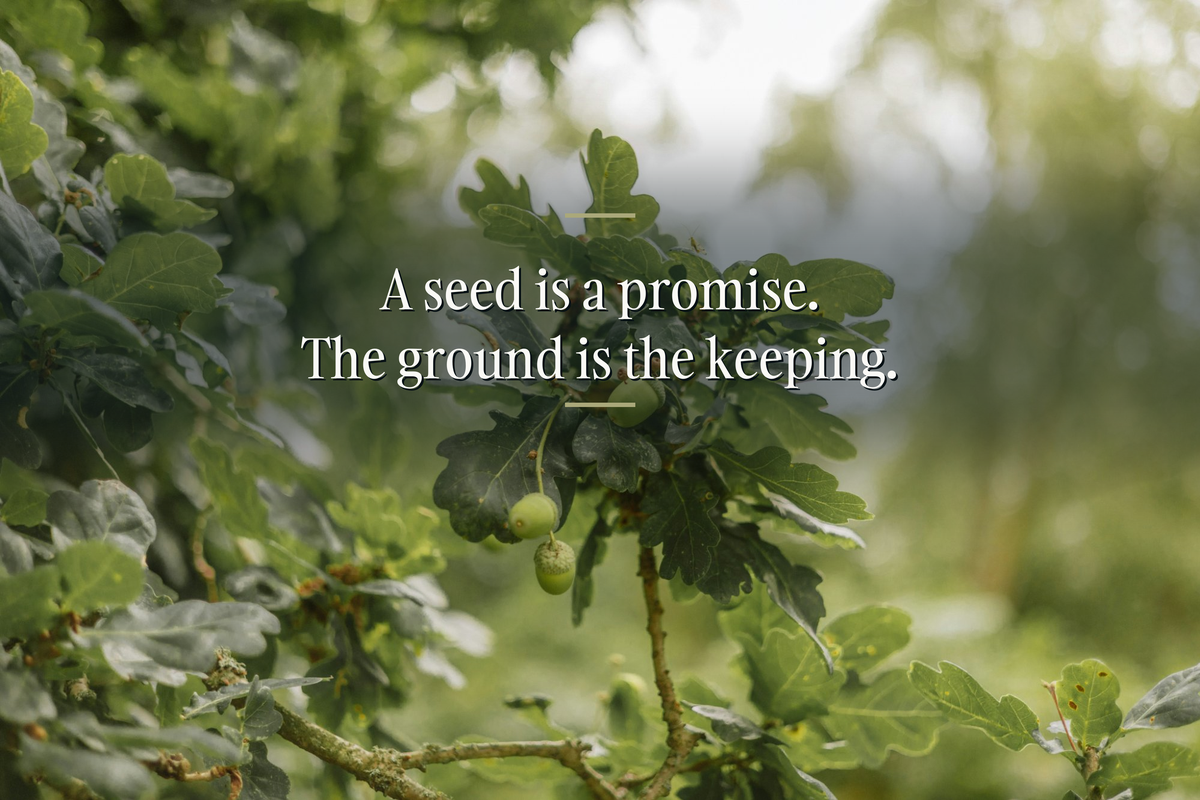
A tree stakes no century on one acorn. Clients arrive hoping the ceremony is the acorn which lands. What remakes a life is the morning after.
Outside, the oaks kept their own appointment. In a mast year the oaks of a region fruit together, cued by a warm spring, not a committee. No minutes, no motion, and the season arrives on time. A jay buries an acorn a mile off and forgets. Eighty speakers dropped what they had in one afternoon, and the rest of us are filing in writing. Most will be eaten. A few, buried in a docket, will root.
What the jay drops, the ground keeps.
Whose Lives These Are
The decisions are about a father in one of the mental health shortage areas covering most of rural Nevada, with no clinician for a hundred miles, the spouse who drove a veteran to the airport, and a child not yet born who will need a human beside him when he sets the armor down.
I was the neighbor of such a father once, at the end of what medicine knew. I am here because a few humans stayed past the point where obligation ended. A credential proves you studied. Presence proves you stayed. No Agency can require presence. An Agency can stop leaving presence the part of care with no owner.
My own ceremonies average over ten hours, and nobody has ever asked me to leave early. The dose ends when the chemistry says. The day ends when the person does.
The sacred was ruled out of scope on a Monday in September. The sacred will be in the room on the Thursday after the first approval, whether or not a rule has learned the name.
We are not the forest. We are the mast year.
Maine, September 02026.
“Veterans should not have to be forced to choose between suffering, going underground or leaving the country and crossing international borders just for standard care.”
Before You Go
If any of this landed on a bruise, go slowly tonight. In the United States, 988.
One practice before the list. Sit with a human this week. Two minutes. Listen to the end.
The podium is closed. The file is not.
Name your chair. I am a veteran who went to Mexico.
Write two hundred words. One story, one ask.
Submit your comment by 11:59 p.m. Eastern, Sunday 5 October. Use the direct link.
Then say as much out loud to one reader who would not have written.
Two minutes spoken, two hundred words filed. The Notice weighs them the same.
The next blogpost is about a cottonwood limb coming down beside a creek while I was praying.
Most of my work lives in the stretch this letter keeps pointing at: the weeks and years after the ceremony. A reader standing there can start with living the insight, and with the integration work where I spend my days. No docket governs a single hour of either.
If this named the room you work in, send the letter to whoever was told to leave the country to be healed, and to whoever drove them to the airport.
Questions to Sit With
If you had two minutes in front of the ones deciding, who would you speak for?
Where have you mistaken being processed for being cared for?
Whose two minutes could you stay for this week, without fixing, charming, or explaining?
From my Heart to yours,
Yeshua Adonai
Psychedelic Guide
Yeshua is a trauma-informed psychedelic guide, integration coach, and writer. A Marine Corps combat veteran, former diplomat, and mental health executive, he serves sacred mushroom and MDMA ceremonies, integrates ketamine treatment in clinics, supports clinical trials, advises policymakers and organizations, and mentors new guides while building technology for the field. He lives in Scottsdale, Arizona, keeps an office in Gilbert, and travels the country, including monthly to communities around Portland, Maine. Most of his work is remote. He counts himself a fellow traveler, still learning to trust his own experience. Posts arrive every other Monday at aboutyeshua.com.
Frequently Asked Questions
The letter carries the argument. What follows carries the mechanics, the evidence, the record of who spoke, and the letter I filed. Skip to what you need.
-
to be added shortly…
Blog Archive
explore the growing library
-
After the War
- Nov 17, 2025 05 | 11.11: War After War A Veteran’s Battle to Heal
-
Consciousness
- Aug 24, 2026 35 | Beholding: How the Chapel of Sacred Mirrors Returns Your Gaze
- Jun 1, 2026 29 | Leary's Eight Circuits: A Map of Consciousness That Both Frees and Binds
- May 18, 2026 28 | Cancer: The Other Healer in the Room
- Apr 20, 2026 26 | Harvard's Last Psychedelic Intersections Conference: A Practitioner's Review
- Mar 30, 2026 24 | Nonlocal Consciousness: What The Secret of Secrets Reveals About the Nature of Mind
- Mar 23, 2026 23 | Self-Remembering: When the Self Sees Itself
- Mar 16, 2026 22 | Hyparxis: The Dimension Where Real Change Becomes Possible
- Mar 9, 2026 21 | Thresholds: A Psychedelic Guide to Falling Apart on Purpose
-
Finding Purpose
- Jul 13, 2026 32 | Vows: How a Tree Learns to Love the Wind
- Apr 6, 2026 25 | Reset: What Becomes Available When You Choose to Dissolve
- Jan 26, 2026 15 | Beyond Belief: Psychedelics and the Post-Religious Spiritual Path
- Jan 5, 2026 12 | Beginning Again: The Practice of Presence Over Performance
- Dec 1, 2025 07 | Finding Purpose in Midlife: How to Regain Meaning
- Nov 24, 2025 06 | Unlock Leadership Potential With Psychedelic Coaching
-
Psychedelic Path
- Sep 21, 2026 37 | FDA public hearing: The Day the Sacred Was Ruled “Out of Scope”
- Aug 10, 2026 34 | Kaleidoscope: What Is Actually Happening Inside a Mushroom Journey
- Jun 29, 2026 31 | MDMA: Heart Medicine and the Oldest Name for God
- Jun 15, 2026 30 | Ketamine: The Mirror Molecule That Was Always Asking for a Witness
- Jan 19, 2026 14 | Microdosing Magic Mushrooms: A Guide to What Actually Works
- Dec 22, 2025 10 | From Darkness Into Light: Living the Insight
- Nov 3, 2025 03 | Ketamine Therapy Near Me: A Legal Pathway for Psychedelics
- Oct 27, 2025 02 | Arizona’s Psychedelic Awakening: Where Science Meets Soul
- Oct 20, 2025 01 | My Psychedelic Journey: A Path Through the Fog of Depression
-
Sacred Ceremony
- May 4, 2026 27 | Seekers Circle 25-26': Where Preparation Becomes Integration
- Feb 2, 2026 16 | Choosing a Psychedelic Guide: Questions Your Life Depends On
- Jan 12, 2026 13 | Psychedelic Preparation: The Work That Begins Before Ceremony
- Nov 10, 2025 04 | Magic Mushrooms: Remembering the Sacred Intelligence of Nature
-
Shadow Work
- Jul 27, 2026 33 | Bend: A Reckoning with the Feminine
- Mar 2, 2026 20 | The Shame Addiction: What the Body Learns (Part 3 of 3)
- Feb 23, 2026 19 | The Shame Addiction: What the Body Hides (Part 2 of 3)
- Feb 16, 2026 18 | The Shame Addiction: What the Body Carries (Part 1 of 3)
- Feb 9, 2026 17 | Stop Trying to Forgive: What Psilocybin and Grief Teach About Letting Go
- Dec 15, 2025 09 | Grief and the Path Back to Ourselves (part 2 of 2)
- Dec 8, 2025 08 | Grief and the Path Back to Ourselves (part 1 of 2)
- Tools for Integration
trending topics
- psilocybin
- psychedelic integration
- psychedelic guide
- harm reduction
- Arizona
- psychedelics
- integration
- transformation
- Fourth Way
- PTSD
- integration coaching
- letting go
- mental health
- nature
- neuroplasticity
- presence
- psychedelic preparation
- recovery
- self-awareness
- veterans healing
- Gurdjieff
- Long Now
- addiction
- alternative treatment
- becoming
- burnout
- combat veteran
- consciousness
- default mode network
- depression
- emotional healing
- ethics
- grief
- guide selection
- ketamine therapy
- legal
- loss
- magic mushrooms
- masculine and feminine
- mindfulness
- mushroom ceremony
- mystical experience
- personal growth
- plant medicine
- psychedelic healing
- red flags
- relationship healing
- relationships
- rites of passage
- sacred ceremony