
30 | Ketamine: The Mirror Molecule That Was Always Asking for a Witness
A few words before we begin. I do not prescribe, administer, or supervise the medical use of ketamine. The clinics named here, including partners at Mind Body Centers in Gilbert, Arizona, are pointed to as part of a wider field worth knowing. Whether ketamine belongs in your care is a medical question to be answered between you and a qualified physician. Nothing in this post is medical advice, and nothing in it should be read as a recommendation to start, stop, delay, or replace any clinical treatment. With that said…
~15 MINS READ
A TINAJA IN THE DESERT TEACHES WHAT REFLECTION ACTUALLY IS. KETAMINE IS A MOLECULE WHOSE OWN CHEMISTRY IS A MIRROR. ITS REFINED HALF, ESKETAMINE, BECAME THE FIRST TRULY NEW-MECHANISM ANTIDEPRESSANT THE FDA APPROVED IN A GENERATION. FROM ITS BATTLEFIELD HISTORY AS THE BUDDY DRUG, GIVEN BY ANOTHER HUMAN WHO STAYED. IT WAS NEVER MEANT TO BE TAKEN ALONE. THIS POST IS ABOUT WHAT INTEGRATION ACTUALLY IS, WHAT HAPPENS WHEN A KETAMINE CLINIC LISTENS AS WELL AS IT TREATS, AND ABOUT THE NEW PARTNERSHIP WITH KEVIN NICHOLSON AND THE TEAM AT MIND BODY CENTERS IN GILBERT, ARIZONA. AND A WIDER INVITATION: INTEGRATION COACHING, DELIVERED DIGITALLY, FOR ANYONE READING THIS ANYWHERE IN THE WORLD, WORKING WITH ANY MEDICINE OR NONE.
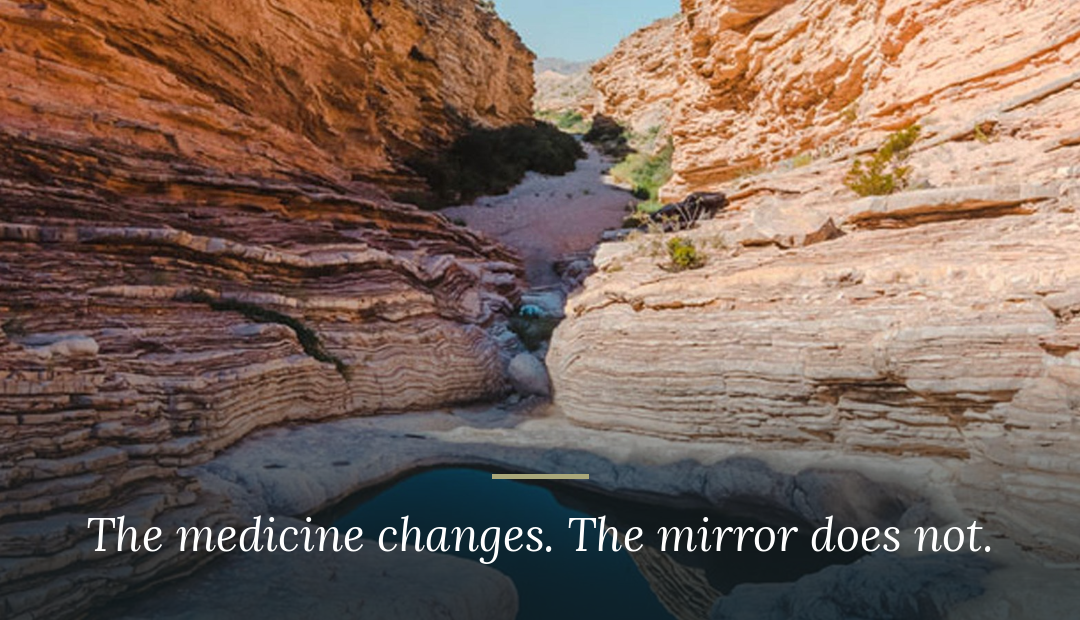
Tinaja. Water finds the low place. Patience carves the rock. Stillness makes a mirror. Someone stays beside it. Something holds what was seen. Image by the National Park Service.
If you are short on time, the first half of this post covers what integration coaching is and the partnership with MBC. The second half holds the wider context and my own story.
The Tinaja
I was walking a trail in the Superstition Mountains east of Gilbert, Arizona this week, the same mountains that rose on the horizon of my childhood, when I came upon a tinaja.
“Tinaja” is Spanish for large earthen jar. In the Sonoran desert, it is the word the old Mexican families used for a natural rock basin, carved over centuries by rain and runoff into a low place in the stone where water gathers and stays. The Hohokam, who lived here for a thousand years before any of us did, knew the tinajas by heart. The vaqueros, a Spanish term for a cowboy, after them. The Boy Scouts after them. Anyone walking long enough in this country eventually comes to one.
I crouched beside it. The water was very still.
The face that looked back at me from inside the basin was older than the one I had expected.
What I had forgotten, as a boy looking out at these mountains, is that the tinaja itself was made by water. Not by one rain. By tens of thousands of rains, returning to the same low place in the rock across seasons and centuries. The vessel and what fills it are the same thing, slowed down.
The reflection becomes possible only because of the patience that made the bowl.
That is the post. The medicine is the rain. The stillness is the rest. What you came to see is your own face waiting in the water.
The Mirror in the Medicine
One fact about ketamine that almost nobody mentions when they describe it.
The molecule is chiral. It exists in two mirror-image forms, like a left hand and a right hand, that cannot be laid on top of each other. The ketamine being infused at most clinics is a fifty-fifty mixture of both forms. Spravato, the FDA-approved nasal spray for treatment-resistant depression, is one of those two mirror forms alone. Same molecule. One hand instead of both.
The molecule is, literally, two-faced. The two faces do different things.
The same is true of the experience itself. The same hour, looked at from one angle, is a flood of images and feelings during the infusion. Looked at from the other angle, is a life rearranging itself in the weeks afterward.
The medicine cannot do both halves on its own.
The first half belongs to the molecule and to the clinical team. The second half belongs to you, and to whoever is willing to sit beside you while you find your way back into your own life. I wrote about the first half, ketamine's legal pathway and medical introduction, in Ketamine Therapy Near Me. This post picks up where that one ended.
The medicine that is two-faced wants a face turned toward it that is not its own.
The Buddy Drug
A piece of history almost no patient hears.
The medicine was FDA-approved in 1970. Soon after, it was being carried in field medic kits in Vietnam. Soldiers learned to administer it to each other on the battlefield because, unlike opiates, it did not suppress breathing. It became known as the buddy drug. From the very beginning, ketamine was given by another human, who stayed.
That detail haunts me.
Fifty years later, we built an industry around delivering this same medicine in private rooms, with patients lying alone in reclining chairs. The IV runs. The patient gets up and heads home. But only the molecule did its work.
As a Marine, I know what it means to have your buddy in the room when the worst arrives. It is the difference between a wound that becomes a wound and a wound that becomes a story. The buddy drug forgot it had a buddy. A few of us are remembering.
What Integration Is
If you have heard the word “integration” thrown around psychedelic medicine, let me give you an image you can hold onto.
A psychedelic experience is a jigsaw puzzle that someone has just shaken hard. The picture that had been locked into a stuck arrangement for years is suddenly loose on the table. Pieces you had forgotten you owned have surfaced. Pieces you thought were edge pieces turn out to be middle ones.
Integration is what you do with the pieces while they are loose.
It is the slow, patient work of placing them into a truer arrangement. The parts of yourself that had been split off. The emotions you had been deferring. The witness to your inner life you had kept muted because the muted version was easier to live with.
In practice: realizations land in the body, not only in the head. Feeling returns. Relationships soften, starting inside your own skin. You become a reliable witness to your own inner life. Choices become real, in the half-second before the old reflex fires.
A great deal of what gets called depression, in the conventional diagnostic system, is grief that has not been allowed to grieve. Or shame the body has been carrying without language. Or trauma that has not been allowed to thaw. The honest question is not only “what condition do I have,” but “what part of me have I been refusing to feel.”
Integration is where that question gets answered, slowly, across weeks and continuously deepening over seasons. Not in the reclining chair. After it.
This work is not a replacement for therapy. It is something different, something adjacent. Most psychotherapists in this country have had little or no formal training in psychedelic states. With clients in active therapy, I encourage shared sessions so we are holding the same arc. Therapy holds the chronic patterns and the medication management; integration coaching holds the neuroplastic window and the reflection-capture practices the medicine specifically calls for.
The mirror does not heal. The mirror lets you see. “What you do with the seeing is what heals.”
“Until you make the unconscious conscious, it will direct your life and you will call it fate.”
Meeting Mind Body Centers
There is a ketamine clinic in Gilbert, Arizona, near where I rode my bicycle as a boy.
I grew up here. Mind Body Centers sits in that same town, long before it became the East Valley. Earlier this year, their CEO, Kevin Nicholson, called me about a partnership. There is a returning quality to this collaboration that the calendar did not plan and I did not arrange.
Their team has, in many cases, been doing this work for over a decade.
Dr. Mark Murphy, the medical director and board-certified anesthesiologist, has personally supervised more than twenty thousand ketamine infusions. Dr. Ellen R. Diamond, Chief Psychologist and co-founder, holds three decades of mental health experience. Linda Basurto, the clinical administrator in Gilbert, brings ten years of ICU and ER nursing into the room every morning. Katie Peeples adds dietetics. Barbara Black, brings clinical hypnotherapy practice into the room, with more than four hundred hours of formal training. Ashley Johnson runs the sister clinic in Burnsville, Minnesota. Each of them, in different parts of the room, doing the same work.
Listening.
That is what’s needed. That is what most of healthcare has stopped making time for. The mental health crisis we are living through is, in part, a crisis of unwitnessed lives. The U.S. Surgeon General has named our era an epidemic of loneliness and isolation. Medicine cannot solve a problem that is, at root, about who is willing to look at us. A clinic that listens is a small repair of a much larger absence. That is why I said yes to the partnership.
Kevin knows this terrain. Before MBC, he and his partner Julie, had built one of the largest ketamine clinic networks in the country, which closed in 2023 during industry-wide consolidation. They rebuilt smaller, with the people they trusted most, and named it for the integration of mind and body the previous decade had taught them was the actual point. I wrote about choosing to dissolve what is no longer serving in Reset.
Kevin has said to me, more than once, that he does not want MBC to be only a ketamine clinic. The infusion is the medicine, but the clinic has two levers it can adjust: dose and duration. Two levers can do real work. Two levers cannot reach every patient. Many have responded beautifully to the treatment, and then quietly plateaued. The way past a plateau is rarely a higher dose. The way past is reflection that has somewhere to go.
This is the team I am honored to walk alongside. Years ago, in an announcement, Kevin had already said the thing the rest of the field is still catching up to:
“Many patients overlook the importance of supportive therapy to truly maximize the outcomes of ketamine treatment.”
The Witness in the Chair
A man I will call M. came to me last autumn after a series of ketamine infusions. His life had stopped feeling like his own. The infusions had given him something he could not name. Walking out each time, something had shifted in a direction his daily self could neither see nor use.
M. is one of many. I work with clients across the country, after in-clinic infusions and at-home telehealth treatments alike, all looking to make meaning of what the medicine showed them. That is where most clients arrive at integration coaching. They have seen something. They cannot yet say what. Or they say it once, on the drive home, and then it slips through their hands by morning.
The window the medicine opens, of roughly one to four weeks of unusual neuroplasticity, is real and well-documented. It closes whether you have done anything with it or not.
The work is to follow what surfaced, not push it toward where you wanted it to land. Forgiveness is one of the most common directions clients try to push toward. It rarely arrives that way.
What integration coaching does in that window: translate the insight before it fades, build bespoke practices that hold across the days, hold the witness when the daily self cannot, translate insight into changed daily mechanics, and stay long enough for the work to set. Weeks, not minutes. Sometimes seasons.
To witness is one of the oldest roles humans have gifted each other. The medicine that asks for a witness is asking us to remember what we once knew.
M. and I worked together for several months. He wrote afterward that one of the sentences he had found in our work was a sentence he had said but had not remembered saying.
“The voice you cannot hear in the room is the voice the witness saves for later.”
Linda Basurto, who has held this work at MBC Gilbert for more than a decade, summarized the point as simply as it can be said:
“Processing those emotions. Learning how to cope with them.”
Coming Home to Yourself
Most ketamine clinics offer an infusion and a handout. MBC is built differently. Kevin uses the word “home” for what they want to achieve, and means it.
What I add to the partnership is the architecture of reflection that runs alongside and beyond the reclining chair.
The work runs through Homecoming, a HIPAA-compliant platform built for psychedelic care, where every session and emerging pattern lives in one place you can return to. After each session, I write an Inner Snapshot, your own words returned to you in a polished structured reflection, sometimes with a custom infographic that compresses weeks into a single image, sometimes with a short meditation in my voice for a walk. I also build an integration plan calibrated to what surfaced during our session(s). Not a generic worksheet. A bespoke set of practices and reflections to integrate into your everyday life.
Sessions are recorded with your consent, so the Inner Snapshot reflects what was actually said. AI assists in pattern recognition between sessions, never during them, always reviewed by me before anything reaches you. The technical care behind this work lives in the FAQs.
The tinaja was made by water returning to the same place, season after season. The platform, the Inner Snapshots, the plans, are that same patience slowed and held.
All of this work happens digitally. Sessions are by Zoom. Plans and Snapshots arrive through Homecoming. Whether you live in Gilbert or Burnsville, in Phoenix, Scottsdale, or Boston or somewhere abroad, geography is not a barrier. The medicine changes. The mirror does not. The shorter version of all of this lives at aboutyeshua.com/ketamine, the page the MBC postcard sends readers to, where you or someone you would like to share this work with can see it at a glance.
“A vessel is patience that learned to hold.”
The Field That Is Being Built
The same Hohokam who knew the tinajas also built the canal system that made the Sonoran desert livable for a thousand years. Infrastructure that arrived a long time before anyone wrote down what it was for.
The psychedelic field is in its canal-digging years. What is not yet built is the integration layer. Most clinics designed to deliver these medicines have been built for throughput, not for the weeks of reflection that turn a treatment into a transformation. The medicine without the witness is the canal without the water. The wider regulatory picture, including the April 2026 federal executive order and state-program landscape, lives in the FAQs.
Mind Body Centers is one of the clinics building the other half early. The medical infrastructure Dr. Murphy supervises holds the molecule with rigor. The integration infrastructure I bring sits downstream of the treatment chair. Together we are building a node the next generation of substances will need.
“The work of an era is to build what the next era will inherit.”
Sister Sacraments and the Wider Path
My work did not begin with ketamine, and it does not end with it.
As a psychedelic guide, I work primarily with psilocybin, and with MDMA in support for clients moving through trauma and relational wounds when the legal and personal conditions allow. Several hundred guided ceremonies behind me. Thousands of integration sessions facilitated for individuals, couples, and groups. My training in the psychedelic sacraments, the ceremonial plant medicines used by various traditions for generations, runs through the Mazatec tradition, the plant teachers of the Amazon, and the desert traditions of the Andes.
What brought me into ketamine was the call. Enough clinics doing serious infusion work have asked for integration support that the gap is no longer hypothetical. The infusion is delivered, the patient walks out, and the work of meaning-making has nowhere professional to land. I am building infrastructure so other guides can step into that gap alongside me. The bridge between clinic and craft is what the field needs next.
Each medicine has its own window and its own terrain. They are not competitors. They are neighbors on a longer continuum. For most patients in this country, ketamine is simply the door the existing medical system can actually point them toward. For some, it becomes the only door they need. For others, it becomes the threshold through which they later walk into deeper ceremonial work. The longer answer on mechanism and complementarity lives in the FAQs below.
If you are reading this and already working with another path, the integration craft can travel with you. The MBC partnership is the formal expression of work I have done across modalities for nearly a decade and a half. The medicine you walk with is yours. The witness is what I bring.
“Medicine is a pathway. The craft of integration is a lineage. Both are larger than any one room.”
Who This Path Tends to Serve
Ketamine has done its strongest work for people carrying treatment-resistant depression, severe anxiety, trauma, midlife reckoning, chronic pain, persistent suicidal thinking, or the weight of helping professions. Integration coaching at the depth I offer serves the patient who is curious about themselves and the structure of the human psyche, not only about symptom relief. The fuller picture of fit, contraindications, and what the path tends to ask of you lives in the FAQs. If something in that description recognizes you, the free Discovery Call is the cleanest next step.
“The mirror waits patiently. It does not insist on being looked into.”
“Attention is the beginning of devotion.”
A Word About How I Got Here
What brought me to this work was a wound I could not put down.
I came home from combat in Iraq, where I served as a U.S. Marine in 2003–2011, and then the U.S. State Department years overseas in Russia, Germany, and Cyprus, carrying complex PTSD. The recovery took years, and the path was the one this post is describing. Ceremonies. Breakdowns. Contemplative practice. Witnesses who held what I could not. What I know about reflection, I learned by needing it myself.
It would not be honest to write this post without acknowledging that I have personally received ketamine many times across my own ceremonial practice, often as a booster within longer journeys. I know its character from the inside. What I had not yet known was this container. What I had not yet received was care in this register. I wanted to meet MBC from the chair, not from the partner's side of the line. I wanted to be the one with the IV for a change.
The day I returned to the chair was a Monday morning in Gilbert. Miguel met me in the lobby. He handed me a tablet with intake questions, and when I had finished, walked me back to the treatment room and set my IV with the steadiness of someone who has done this many hundreds of times. Linda came in with the dose calibrated to my body. She watched my vitals through the session and held a line of contact with the supervising physician overhead. Several pairs of trained hands at the work of holding one room. The lights came down. The chair held me. The blanket was soft. They asked what music I wanted in the air, and I brought a playlist I have used in other ceremonies that have crossed me into other rooms over the years. The right music in a session like this is not background. It is part of the medicine. From the moment I sat down I felt the care, the knowledge, and the safety of the team. It felt like home.
Linda began the infusion at sixty-three milligrams calibrated to my body weight, delivered through the pump at a steady rate across the hour. Around the midpoint of the session she added more ketamine to the syringe, bringing the total dose to ninety-three milligrams by the end. The first sensation was a tingling at the edges, then a heaviness through the chest and limbs, then a kind of floating that softened the wall between body and room. Heavy and light at once. The medicine found its depth around the half-hour mark and held there another thirty minutes before slowly settling back.
I followed my breath into the experience. Over a hundred guided psychedelic journeys across nearly fifteen years have taught me what attention can do when it rests on the breath, and how the breath itself becomes the guide through whatever rises.
I died. Pure bliss. Connection with all that lives. I navigated topics I have been carrying inside me, and each one moved a little further along its arc. Inside the hour I had what felt like countless therapy sessions, a whole life lived inside a single breath.
Ketamine has a character all its own. Psilocybin moves through body and imagination across six or eight hours of unfolding. MDMA moves through the heart on warmth and trust. Ketamine moves through a quieter door. An hour rather than an afternoon. A different mechanism in the brain, a different shape of journey, but the unity that opens inside it is unmistakable. I went where the other medicines have taken me, and I went somewhere only this one can.
When the session was complete I rested in the chair another hour as the body found its way back. Linda then walked me out of the treatment room and to my ride at the curb. The Arizona sun was waiting at the threshold; ketamine leaves the eyes sensitive for some time, and the light outside was a lot. Nausea rose with the brightness. She returned with a small dose of oral Zofran that dissolved under my tongue, and the wave passed. The team's care reached all the way to the curb.
What stayed with me through the rest of the afternoon was ungoverned and simple. Life is good. I cannot believe this is legal. I want more of this. The body inhabited the day in a different register, lighter under the weight of being alive.
I went home and rested. A nap. A slow meal. More water than usual. I wrote what was still moving. I let prayer carry the deeper layers. When I saw family later that day, the hugs held longer than usual. Gratitude in the simple fact that they were alive and so was I. With them I kept the deeper material light; the body did the speaking. The next morning Linda called for a check-in. That day I gave to nature, and to a slower rhythm of being than the days before. I called my coach. I called a mentor. I had a few conversations with peer practitioners I trust. Integration is not one conversation but a string of small returnings across the hours and days, with the right witness for each layer. The clinical container did not end when the IV came out.
“The guide who does not return to the chair is not a guide.”
What the Tinaja Returns
I went back to the tinaja before I sat down to write this. The water was still there. In the late light, the reflection held the full moon. In the morning, I had only seen my face. The moon had been there all along. The desert had not asked anything of me. The desert had simply waited.
That, in the end, is what the medicine asks of you and what the witness offers. Not effort. Patience. The willingness to keep returning to the same low place in the rock until the rock has been carved into a vessel deep enough to hold what you came for. The Cappadocian desert fathers and the forest monks of the East both knew this. “Mastery is patience that has lasted long enough to look like skill.”
Ketamine, at its best, is a tinaja made medicine. The infusion stills the wind. The reflection becomes possible. Your face is what you came to see. And what becomes visible in the days and weeks afterward, if the witness is there and the quiet is there, is more than you came in for.
The witness is you and the people who choose to stay beside you while the water settles.
The architecture of these thresholds has remained consistent across cultures and centuries, which I write about in Thresholds.
Integration coaching over time is what turns a treatment into a transformation. Mind Body Centers is a team worth pointing a loved one toward. And if you are not their patient, or not a ketamine patient at all, this work can come with you wherever you are.
“I would be honored to walk a season with you.”
Questions to Sit With
Where in your life is the wind still moving over the surface?
What would change if you protected the days after a treatment as carefully as you protect the treatment itself?
Who in your life is willing to return your own voice to you across the weeks that follow a difficult truth?
If you could replay, in your own words, what you said about yourself when the defenses were down, what would you want to do with that view?
What might become visible if you stayed long enough for the reflection to settle and deepen?
If anything in this post is calling to you, the next step is a free Discovery Call. Thirty minutes, by Zoom, no expectation. Wherever you are in the world, and whatever medicine you are or are not working with, I would be honored to meet you. The shorter overview lives at aboutyeshua.com/ketamine if you would like to share it with someone considering this path.
If this post may help someone you know who is considering ketamine or working through a treatment course right now, I would be grateful if you shared it. The conversation about ketamine care belongs out in the open.
From my Heart to yours,
Yeshua Adonai
Psychedelic Guide
Yeshua is a traveling psychedelic guide currently based in Scottsdale, Arizona. USMC combat veteran, former diplomat, ordained minister, and serial social entrepreneur devoted to mental health innovation, he has spent decades exploring contemplative traditions worldwide and learning to trust his own experience along the way. He is the founder of Hyparxis LLC, the integration coaching partner of Mind Body Centers in Gilbert, Arizona, and an incoming participant in Harvard Medical School's executive program on AI in health care. Posts arrive every other Monday. Learn more at aboutyeshua.com.
Frequently Asked Questions
-
That ketamine, at its best, is a pathway into a state in which reflection becomes possible, and that reflection is the medicine inside the medicine. The molecule stills the wind. What heals is what becomes visible in the stillness, and what you and the people around you do with what you see. The post is also a description of the new partnership between my integration coaching practice and the team at Mind Body Centers in Gilbert, Arizona.
-
Ketamine is a medicine originally synthesized in 1962 as a surgical anesthetic, approved by the FDA in 1970, and used in operating rooms and battlefield medic kits since. In the past twenty-five years, researchers discovered that much lower doses, far below anesthetic doses, can produce rapid relief from depression in patients who have not responded to other treatments. In 2019, the FDA approved Spravato, the S-enantiomer of ketamine, specifically for treatment-resistant depression. According to the American Psychiatric Association at the time of approval, it was the first novel-mechanism antidepressant approved by the FDA since Prozac in 1987.
-
Ketamine was synthesized in 1962 by a chemist named Calvin Stevens at Parke-Davis Laboratories in Detroit, Michigan. Two years later, the first humans received it in a study led by Dr. Edward Domino at the University of Michigan. The volunteers reported the feeling of being disconnected from their bodies, of watching themselves from outside. Dr. Domino's wife, Toni, coined the term that has defined the medicine ever since: “dissociative anesthetic.” The medicine was FDA-approved in 1970. Soon after, it was being carried in field medic kits in Vietnam, where soldiers learned to administer it to each other on the battlefield because, unlike opiates, it did not suppress breathing. It became known as the “buddy drug.” From the very beginning, ketamine was given by another human, who stuck around.
Why is it legal today when psilocybin and MDMA are not? History, not pharmacology. Ketamine entered medicine in the 1960s as an anesthetic and was already established as clinical medicine before its recreational misuse became a concern. By the time the DEA acted in 1999, the regulatory option was to place ketamine in Schedule III, which preserves medical use while restricting diversion. Psilocybin, LSD, and MDMA entered Western awareness through the 1960s counterculture and were placed in Schedule I before they could establish medical use, which has functionally locked them out of the medical system for decades.
-
Four things:
Legality. Ketamine is the only psychedelic-class medicine legally available for medical use at the federal level in the United States, as a Schedule III controlled substance.
Clinical container. A ketamine infusion is about an hour, with dosing that can be calibrated to the body treatment by treatment, in a medical setting. A psilocybin journey lasts near six hours; an ayahuasca ceremony can last all night.
Scale of existing infrastructure. More than seven thousand Spravato-certified centers and several hundred intravenous ketamine practices operate in this country, with more than a dozen in the Phoenix metropolitan area alone.
First-door function. For many patients, ketamine becomes the legal medical door through which they walk into deeper work, with or without later moving into ceremonial lineages. The fuller framing lives in Arizona's Psychedelic Awakening.
-
The two medicines do related work through different neurochemistry. Ketamine acts as an NMDA receptor antagonist, triggering a glutamate release cascade that rapidly increases neuroplasticity. Psilocybin, in the body, converts to psilocin and acts primarily on the 5-HT2A serotonin receptor, reducing activity in the default mode network and inducing structural growth of dendritic spines in the prefrontal cortex. Recent research has shown that both medicines, despite their different starting points, converge on similar downstream effects through TrkB and BDNF pathways. They are doing related work through related biology, by different doors.
The acute experiences are quite different. A ketamine infusion runs roughly an hour; the full session, one to two hours. A psilocybin journey is six to eight hours, with a longer arc of feeling, imagery, and emotion. A ketamine dose can be calibrated treatment by treatment in a clinical setting like Mind Body Centers in a way that a single high-dose psilocybin journey cannot. The legal status is also different. Ketamine is Schedule III and legal off-label nationwide. Psilocybin remains Schedule I federally, with state-licensed therapeutic services in Oregon since 2023 and Colorado since 2024, decriminalization in several cities, and a $5 million Arizona research investment for clinical trials. For most patients in this country today, ketamine is simply the medicine they can actually access without leaving the medical system or traveling out of state.
Can ketamine and psilocybin complement each other? In sequence, possibly. There is biologically grounded but still speculative reasoning that ketamine-induced plasticity may prepare the nervous system for later work with other medicines, and many of my clients have walked that arc over time. Concurrent administration is not standard practice and should not be attempted outside research settings.
Practically, for patients receiving ketamine at MBC, my suggestion is to be fully present with the medicine you are already receiving and with the continuum MBC has built around it. Integration coaching with me brings an essential layer of reflection in the days and weeks after each treatment without asking you to look elsewhere. If, after a season of ketamine work, your nervous system tells you it is ready for ceremonial work with psilocybin or other plant teachers, that is a separate path I can hold with you in jurisdictions where the work is legal and in containers that honor the lineages those medicines come from. Most clients of mine who walk that path do so after months or years of ketamine work, not in place of it.
-
Two questions come up most often, sometimes from patients themselves and more often from family members watching from the side.
“Can you overdose on ketamine?” Yes, in principle, but the safety profile inside a clinical setting with vital sign monitoring is wide. Ketamine does not suppress breathing the way opioids do, which is why battlefield medics chose it. In medical settings with proper screening, dosing, and monitoring, the overdose risk is essentially negligible. The serious risk profile attaches to unsupervised at-home dosing, combinations with other sedatives such as alcohol or benzodiazepines, and non-FDA-approved sources. If you are receiving ketamine at a clinic like Mind Body Centers in Gilbert, AZ, where a board-certified anesthesiologist is the medical director and your vitals are continuously monitored, the dose-related risk is far lower than what most patients carry into a routine dental procedure.
“Is ketamine habit-forming?” In the clinical setting, the doses and intervals used for depression treatment are calibrated to avoid the patterns that lead to misuse. A typical course is a series of treatments over a defined window, not daily use. Recreational ketamine use, particularly heavy at-home dosing outside any medical container, is a different conversation. There is documented evidence of bladder toxicity, cognitive effects, and dependence at the doses some recreational users reach. The medicine, like nearly every effective intervention, has a therapeutic window. Inside that window, with a clinic supervising, the safety profile is well established. Outside it, it is not. If you are worried about a loved one, or worried about yourself, that worry is part of why I think this work deserves an integration coach. The witness in the room is also the witness to whether use is staying inside the therapeutic window. The full medical-screening process is described on MBC's Getting Started page.
-
For most patients, ketamine is given alongside an existing regimen of SSRIs, SNRIs, or other psychiatric medications without modification. The medical screening at Mind Body Centers asks hundreds of questions to review your full medication list and identifies anything that needs attention. The most common interaction concern is with benzodiazepines, which appear to blunt some of ketamine's antidepressant effect; some protocols ask patients to hold benzos on treatment days. The anticonvulsant Lamotrigine can also reduce ketamine's dissociative experience. Lithium is generally compatible but worth flagging. None of this is medical advice for your particular case; the only honest answer to your medication question lives in a conversation with a physician who has your full chart in front of them. The MBC team handles this conversation as part of standard intake. If you are considering ketamine, this is not a question to leave for the morning of your first appointment.
-
A real and important question, and one I want to answer with care because the answer is often "yes, but the path matters." Many trauma survivors do remarkably well with ketamine. The dissociative quality the medicine produces can feel paradoxically safer than other psychedelic experiences for some trauma-aware nervous systems, because the consciousness has somewhere quiet to land while the body unwinds. Others find the dissociation activating, especially if dissociation has already been a survival strategy. The right path depends on your particular history, the kind of trauma, where it lives in the body, and what support you already have. The MBC team has worked with many trauma survivors, including combat veterans and first responders. Integration coaching is particularly important here. The window after a treatment is when trauma material can surface in unexpected ways, and a witness in those weeks is part of what makes the work safe. If you are considering ketamine and trauma as part of your history, the Discovery Call is a good place to begin the conversation about whether and how.
-
For roughly one to four weeks after a ketamine treatment, the brain is more capable of forming new patterns than it has been in years. This is the neuroplasticity window. The clearest published evidence that integration matters during this window comes from Wilkinson's 2021 randomized trial at Yale, which found promising evidence that ketamine plus structured psychotherapy may sustain antidepressant effects longer than ketamine alone. A broader 2023 systematic review by Kew and colleagues, covering nineteen studies and over a thousand patients, found outcomes largely positive for the addition of psychotherapy to ketamine treatment across depression, PTSD, and substance use disorders. Integration coaching is one approach within this broader category of structured support around the medicine.
The earliest evidence that low-dose ketamine could rapidly reduce depression came from Berman, Krystal, and colleagues at Yale in 2000. The conceptual framework for what psychedelic medicines open in the brain is described in Carhart-Harris's 2014 entropic brain paper. The metaphor of the snow globe, developed in that work and popularized by Michael Pollan in How to Change Your Mind, captures the idea well: the medicine shakes the globe, and the work is what happens while the snow is still settling. The Britannica entry is a clean starting point for the broader history of the molecule.
-
Kevin Nicholson, the CEO, has spent more than two decades in healthcare and previously built Ketamine Wellness Centers into one of the largest networks of its kind in the country. Dr. Mark Murphy, the medical director of MBC, is a board-certified anesthesiologist who has personally supervised more than twenty thousand ketamine infusions. Dr. Ellen R. Diamond, Chief Psychologist and co-founder, holds three decades of mental health experience. Linda Basurto, the clinical administrator, brings ten years of ICU and ER nursing onto the floor of the Gilbert clinic. Katie Peeples is the Lifestyle Wellness Coach, with degrees in both nursing and dietetics. Barbara Black brings clinical hypnotherapy practice into the room, with more than four hundred hours of formal training. Ashley Johnson, a registered nurse and certified health coach, runs the Burnsville, Minnesota location. The full team is on the MBC about page.
What makes MBC different from other ketamine clinics? I have spent the past decade visiting and working alongside ketamine clinics across the country. Most are clinical-only spaces, calibrated for throughput, where the medicine is delivered competently and the conversation ends at the IV. MBC is somewhat different. The first thing you notice when you walk in is that it feels like a home. Kevin and Linda have spoken about deliberately designing the environment so the medicine works in a body that is not bracing against fluorescent lights and stainless steel. Multiple modalities live under one roof: ketamine infusions, psychological care, nutrition counseling, clinical hypnotherapy, and nursing care from a decade of ICU and ER experience. The clinical bar is high. The human bar is higher. That is why I said yes to the partnership.
-
Mind Body Centers is at 2451 East Baseline Road, Suite 300, Gilbert, Arizona 85234. The clinic itself is set up to feel less like a medical office and more like a place you would want to spend a quiet hour. Comfortable infusion rooms, careful lighting, staff who remembers your name, and the deliberate absence of the cold institutional feel that most clinics inherit by default. Kevin and Linda speak about this design choice openly: the medicine works better in a body that is not bracing against the environment around it. The clinic serves patients across the East Valley, including Mesa, Chandler, Tempe, Queen Creek, Apache Junction, and the wider Phoenix metropolitan area. Mind Body Centers also operates a second location in Burnsville, Minnesota. For the Getting Started process, see the MBC website.
-
For ketamine itself, the medicine has done its strongest work for patients with treatment-resistant depression, severe anxiety, PTSD, chronic pain, and persistent suicidal ideation that other treatments have not been able to interrupt. The medical screening at a clinic like Mind Body Centers will assess whether ketamine is appropriate for your particular history; certain conditions, including active psychosis, untreated cardiac instability, and pregnancy, make it not the right starting place. For integration coaching at the depth I offer, the best fit is the patient who is curious about themselves and the structure of the human psyche, and not only about symptom relief, who has the interest to sit with emotion when something difficult surfaces, who has at least one or two protected hours a week, who has a few honest people around them, and who is willing to do something with what they discover.
Do you need a coach to benefit from ketamine? No. Many patients do meaningful work in the quiet of their own lives. What I would ask, if you are not working with a coach, is that you protect the days after a treatment with care. Reduce input. Take walks. Write. Sit. Tell the people around you that you need quiet hours. Reflection begins where the input stops. If, at some point, the quiet stops being enough, that is when a witness becomes useful. The deeper philosophy of becoming your own witness lives in Self-Remembering. If you are uncertain whether you fit either path, a free Discovery Call is the cleanest way to find out.
-
A typical coaching session with me is sixty minutes, by Zoom or phone, with your written consent for recording. We begin where you are: what surfaced in the last infusion, what is alive in the days since, what the daily self has been doing with it. We move through what wants to be named, what wants to be heard, and what wants to be practiced before next week. The conversation is not a therapy session and is not a check-in. It is a structured reflection on the specific material the medicine is moving through you, calibrated to the phase of treatment you are in. After the session, I sit with the recording, write the Inner Snapshot followup in your own words, and build a small integration plan for the days ahead. The plan arrives in Homecoming within a few days. Between sessions, the platform stays open for messages and reflection.
The arc across treatment: most clients meet me already in ketamine treatment, so coaching builds around the infusions rather than ahead of them. Preparation is available if you find this work before starting, mapping your hopes, fears, history, and the patterns you want to meet across one to three sessions before the first infusion. The "stabilization phase" wraps the initial induction, the first two to three weeks when infusions are happening close together. We meet a couple times a week across that window, between infusions, to process what the medicine is moving while the neuroplastic window is most open. In the "maintenance phase," most clients settle into ketamine treatments every four to six weeks. The coaching rhythm anchors to each treatment: one session within 24–72 hours after, and another about two weeks later. The rule I recommend is to not let more than a couple weeks pass between sessions during this phase. The rhythm protects what was opened. Some clients begin with a single one-off session to get a taste of the work before committing to a season. Cadence is customized to what fits a client's actual life. Some continue for years as the seasons of their work change. The arc is described in more detail on the coaching page.
-
The Inner Snapshot is the process I have developed over the past few years for returning a client's own voice to them after an integration session or ceremony. It is a comprehensive follow-up message with actionable tasks, accompanied by a custom infographic or a short audio in my voice, that captures what surfaced, organized in a way you can return to over weeks, months, or years. It is housed in Homecoming, the HIPAA-compliant electronic health record platform built for psychedelic care that I wrote about in Technology as a Mirror.
The Inner Snapshot is one part of a larger architecture. The "four layers of reflection" is a simple way to think about how integration deepens.
The first layer is the clinic that listens, which begins before the IV ever goes in.
The second is the quiet you protect for yourself in the days after a treatment.
The third is the witness who returns your own voice to you after treatments, which is the core of what I do.
The fourth is the careful use of technology, like Homecoming, that lets the voice persist across time.
Each layer makes the next one more available. You can begin with one. You do not need all four at once. The deeper philosophy of the neuroplastic moment lives in Hyparxis.
-
“Recording.” Yes, with written consent. Consent can be given, withheld, or withdrawn at any time. Sessions are recorded through Homecoming, the HIPAA-compliant platform built for psychedelic care, with Fathom, the notetaker, providing HIPAA-aligned encrypted transcription. Recordings are accessible only to you and me, and you can request access, review, or deletion at any time. Without them, the work would depend entirely on what I could remember, and the work is too important to be limited by our memory. Clients who do not consent to recording are still welcome; we simply work without it.
“AI.” I use AI as a careful pattern-recognition assistant in the preparation and post-processing layers of integration work, never during a psychedelic session, never as a facilitator, and never as a substitute for human presence. AI helps me surface through-lines across our conversations, draft initial reflection prompts which I then rewrite in my own voice, and remember everything you have previously shared. Every plan, prompt, infographic, audio, and word that reaches you is developed, reviewed, and custom-tailored by me before delivery. I work alongside a mental health ethics review that scrutinizes the methodology, and I am beginning a Harvard Medical School executive program in “AI in health care” this year. The MIT Technology Review has written the clearest public warning about AI being used to sit with people during the psychedelic experience itself, and I agree with that warning. My approach explicitly keeps AI in the supervised, human-led layer.
“Privacy.” The fuller framing of how your story is held, including retention, deletion, and your sovereignty over your own data, lives on the privacy page.
-
Integration coaching is different from therapy, and alongside it. The clearest way I have found to explain the difference is the rear-view mirror and the windshield. Therapy spends most of its time in the rear-view mirror: the chronic patterns, the family of origin, the relational landscape, the medication management, the long history of what brought you here. That looking-back is essential. You cannot drive safely without knowing what is behind you. Coaching spends most of its time looking through the windshield: what is surfacing now, what wants to be practiced this week, what the neuroplastic window is asking you to build toward. Both orientations show up in both roles, inevitably. A good therapist looks forward sometimes. A good coach looks back sometimes. The lean is what differs, and the lean is what makes each useful.
Most psychotherapists in the United States have had little or no formal training in psychedelic states; even those with training tend to have knowledge of the territory rather than mastery of the practice, which takes hundreds of hours of sitting with people in altered states and which the licensing pathways do not yet make space for. With clients who are in active therapy, I encourage shared sessions where their therapist and I sit together around what is moving in the work, with the client's permission, so the continuity of care can hold the patient across the same arc rather than running parallel and unaware.
In summary, therapy holds what therapy is built to hold: the look back, the chronic patterns, the relational landscape, the medication management. Integration coaching holds what therapy is rarely built to hold: the look forward, the specific neuroplastic window, the reflection-capture practices, the body of skill that grew up around altered states. The two are complementary, and most clients benefit from both. Reach out through a Discovery Call if you want to talk through how this might work alongside your current therapy.
-
A difficult prior experience is one of the most common reasons people walk into integration coaching. Sometimes, a ceremony surfaced material that has not been metabolized in the years since. Sometimes a ketamine treatment session left a person feeling more dysregulated than when they began. Sometimes a recreational experience cracked open something that nobody helped close. These are not signs that you should never do this work again. They are signs that the work was not held the way it needed to be held. Integration coaching can begin in this place, with what came up then and never settled, before any new medicine enters the picture. Several of my clients have started exactly here, and have eventually returned to treatment in a container that knew how to hold them. If this describes you, the conversation can begin without any commitment to do anything new. We start by tending what is still unfinished.
-
Five practices that travel well across modalities and across people.
Slow down, deliberately, in the days after any altered-state experience; less driving, less scheduling, less input.
Return to the breath when the mind begins to spiral; the breath is the part of the nervous system that is both voluntary and automatic, which is why every contemplative tradition begins there.
Soften the gaze when looking at something difficult; the eyes are where the body's holding tends to start, and softening them softens everything downstream.
Listen more than you speak for a few days; insight gets clearer when the room is not filled with your own words.
Write or speak out loud what surfaced, in your own words, before the daily filter comes back online.
These practices cost nothing. I wrote about preparation in this spirit in Psychedelic Preparation.
-
You do not need to be. Integration coaching, as I practice it, is grounded in clinical research on the neuroplastic window, embodied practice, and the discipline of reflection. The contemplative language a reader may find in my writing reflects the lineages I have been trained in, but the work itself does not require belief in anything outside your own nervous system. Many of my clients are skeptics, atheists, doctors, scientists, engineers, lifelong agnostics. The discipline of returning to your own attention is older than any religion and belongs to no faith in particular. You bring your own meaning. The work meets you there.
-
Treatment Integration Coaching is $175 for a single session. The Seasonal Integration Coaching package is $1,000 for six sessions. Every engagement begins with a free thirty-minute Integration Coaching Discovery Call, where we talk through fit before any commitment.
Mind Body Centers offers a Hero Discount for veterans, active military, and first responders. As a Marine Corps combat veteran myself, I extend a parallel discount on integration coaching for the same group. I wrote about veterans and psychedelic healing in War After War. The work belongs to those who need it, not only those who can pay the full rate. If cost is the only thing standing between you and the work, mention it on the Discovery Call. We will find a path.
-
“Geography.” Integration coaching is delivered digitally. Sessions happen by video conferencing (Zoom) or phone, scheduled through your own calendar. The Inner Snapshot, the integration plan, and the secure messaging between sessions all live in Homecoming, the HIPAA-compliant platform built for psychedelic care, which you access from any browser or a mobile app on your phone. Geography is not a barrier, here in the States or elsewhere in the world. I work with MBC patients in Gilbert and at the Burnsville, Minnesota location, with MBC patients who travel for treatment or live abroad, and with patients of other ketamine clinics across the United States. For Gilbert-area clients who want occasional in-person work, I can sometimes meet at the clinic or another local setting, but the core architecture is digital by design.
“MBC patient status.” No, you do not have to be a Mind Body Centers patient to work with me. For years I have worked with patients of various ketamine clinics across the country, on a referral basis, and that work continues. If your clinic is in the East Valley, in Phoenix, or anywhere else, integration coaching can travel with you regardless of where the infusions happen. The MBC partnership is formal because their clinical team and I coordinate care directly, with patient consent. The broader psychedelic integration coaching is open to anyone.
“Other medicines, or none.” I work with clients receiving psilocybin in legal state programs in Oregon and Colorado, or in emerging territories, as well with MDMA in clinical trials and authorized programs where legal, ayahuasca and other plant teachers in retreat settings, at-home telehealth ketamine, microdosing protocols, and with clients walking through what surfaced in earlier psychedelic experiences they are still metabolizing months or years later. I also work with clients who are not using any psychedelic medicine and never plan to, who simply want a witness during a major life threshold: grief, midlife, professional dissolution, diagnosis or challenging end-of-life issues, or the slow recovery from a long stretch of survival mode. The mirror does not require a substance. Reach out through the Discovery Call and we can talk about fit.
-
The shape of what comes next is becoming legible. On April 18, 2026, a federal executive order directed federal agencies to accelerate research, clinical trials, and Right-to-Try access for psilocybin, MDMA, ibogaine, and related medicines, with veterans as the priority target population. Within days, the FDA issued priority vouchers to Compass Pathways' synthetic psilocybin, Usona Institute's psilocybin, and Transcend Therapeutics' methylone for PTSD. State programs in Oregon (since 2023) and Colorado (since 2024) are already operational. Ibogaine and ayahuasca sit further out on the horizon, still mostly held by lineages older than any agency. The clinics that build genuine integration capacity now will be the ones best positioned for what comes next. The harm of medicine delivered without infrastructure shows up later, in disappointment, fragmentation, dropout, and occasionally worse.
-
This post is written primarily for the patients and community of Mind Body Centers and for anyone else considering ketamine as a path. That said, a number of clinic owners, therapists, and guides have asked me whether the model I am building with MBC is replicable. The short answer is yes, and the longer answer is in the work itself. Most ketamine clinics in this country offer little or no integration coaching, and those that do tend to stop at intake calls and handouts. Partnering with an external integration practice, rather than building it in-house, lets a clinic offer this layer of care without taking on the staffing, supervision, and continuity overhead. The 2026 presidential executive order on psychedelic-assisted therapies accelerated a trajectory the field has been on for decades, and clinics that build genuine integration capacity now will be the ones best positioned for what comes next. If you would like to talk through how this might work for your operation, reach out through my contact page or send me an email at email@aboutyeshua.com.
Blog Archive
explore the growing library
-
After the War
- Nov 17, 2025 05 | 11.11: War After War A Veteran’s Battle to Heal
-
Consciousness
- Aug 24, 2026 35 | Beholding: How the Chapel of Sacred Mirrors Returns Your Gaze
- Jun 1, 2026 29 | Leary's Eight Circuits: A Map of Consciousness That Both Frees and Binds
- May 18, 2026 28 | Cancer: The Other Healer in the Room
- Apr 20, 2026 26 | Harvard's Last Psychedelic Intersections Conference: A Practitioner's Review
- Mar 30, 2026 24 | Nonlocal Consciousness: What The Secret of Secrets Reveals About the Nature of Mind
- Mar 23, 2026 23 | Self-Remembering: When the Self Sees Itself
- Mar 16, 2026 22 | Hyparxis: The Dimension Where Real Change Becomes Possible
- Mar 9, 2026 21 | Thresholds: A Psychedelic Guide to Falling Apart on Purpose
-
Finding Purpose
- Jul 13, 2026 32 | Vows: How a Tree Learns to Love the Wind
- Apr 6, 2026 25 | Reset: What Becomes Available When You Choose to Dissolve
- Jan 26, 2026 15 | Beyond Belief: Psychedelics and the Post-Religious Spiritual Path
- Jan 5, 2026 12 | Beginning Again: The Practice of Presence Over Performance
- Dec 1, 2025 07 | Finding Purpose in Midlife: How to Regain Meaning
- Nov 24, 2025 06 | Unlock Leadership Potential With Psychedelic Coaching
-
Psychedelic Path
- Oct 5, 2026 38 | Vigil: A Safety Framework for Psychedelic Care
- Sep 21, 2026 37 | FDA public hearing: The Day the Sacred Was Ruled “Out of Scope”
- Aug 10, 2026 34 | Kaleidoscope: What Is Actually Happening Inside a Mushroom Journey
- Jun 29, 2026 31 | MDMA: Heart Medicine and the Oldest Name for God
- Jun 15, 2026 30 | Ketamine: The Mirror Molecule That Was Always Asking for a Witness
- Jan 19, 2026 14 | Microdosing Magic Mushrooms: A Guide to What Actually Works
- Dec 22, 2025 10 | From Darkness Into Light: Living the Insight
- Nov 3, 2025 03 | Ketamine Therapy Near Me: A Legal Pathway for Psychedelics
- Oct 27, 2025 02 | Arizona’s Psychedelic Awakening: Where Science Meets Soul
- Oct 20, 2025 01 | My Psychedelic Journey: A Path Through the Fog of Depression
-
Sacred Ceremony
- May 4, 2026 27 | Seekers Circle 25-26': Where Preparation Becomes Integration
- Feb 2, 2026 16 | Choosing a Psychedelic Guide: Questions Your Life Depends On
- Jan 12, 2026 13 | Psychedelic Preparation: The Work That Begins Before Ceremony
- Nov 10, 2025 04 | Magic Mushrooms: Remembering the Sacred Intelligence of Nature
-
Shadow Work
- Jul 27, 2026 33 | Bend: A Reckoning with the Feminine
- Mar 2, 2026 20 | The Shame Addiction: What the Body Learns (Part 3 of 3)
- Feb 23, 2026 19 | The Shame Addiction: What the Body Hides (Part 2 of 3)
- Feb 16, 2026 18 | The Shame Addiction: What the Body Carries (Part 1 of 3)
- Feb 9, 2026 17 | Stop Trying to Forgive: What Psilocybin and Grief Teach About Letting Go
- Dec 15, 2025 09 | Grief and the Path Back to Ourselves (part 2 of 2)
- Dec 8, 2025 08 | Grief and the Path Back to Ourselves (part 1 of 2)
- Tools for Integration
trending topics
- psilocybin
- psychedelic integration
- harm reduction
- psychedelic guide
- Arizona
- psychedelics
- integration
- transformation
- veterans healing
- Fourth Way
- Long Now
- PTSD
- integration coaching
- letting go
- mental health
- nature
- neuroplasticity
- presence
- psychedelic preparation
- recovery
- self-awareness
- FDA psychedelic hearing
- FDA public hearing 2026
- Gurdjieff
- MDMA-assisted therapy
- Oregon psilocybin
- REMS
- White Oak
- addiction
- alternative treatment
- becoming
- burnout
- chaplaincy
- combat veteran
- consciousness
- default mode network
- depression
- docket FDA-2026-N-7542
- emotional healing
- ethics
- grief
- guide selection
- ketamine clinics
- ketamine therapy
- legal
- loss
- magic mushrooms
- masculine and feminine
- mast year
- mindfulness