
33 | Bend: A Reckoning with the Feminine
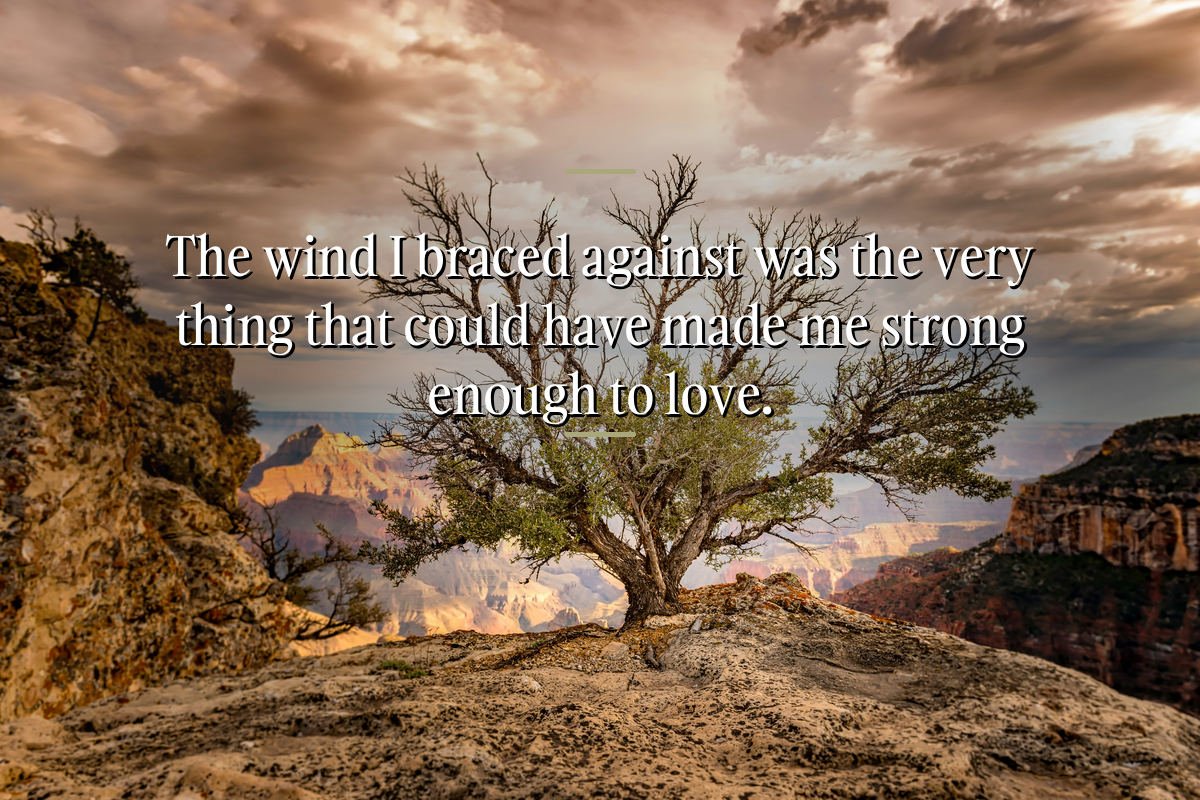
Grand Canyon National Park, Arizona. Photo by Steve Walker on Unsplash. The tree does not brace against the wind. It keeps its roots and lets the weather shape it into something that can hold.
A few words before we begin. This piece touches teenage pregnancy, an absent father, betrayal, war, addiction, the breaking of a family, and ancestral grief. Go gently with yourself. I write as a guide and a fellow traveler, not a therapist or a doctor. Nothing here is clinical advice or a substitute for the care of a professional. This work is for adults twenty-one and older, a complement to that care and never a replacement, and nothing in it supplies or encourages anything illegal. With that said…
~18 MINS READ
THE WEATHER UNDERNEATH A VOW. HOW A SEVERED FIRST BOND AND A WAR WIRED A SENTRY INTO MY CHEST. WIDE OPEN AT THE FRONT, BOLTED AT THE BACK. THE HIDDEN PAYOFF THAT KEPT ME LEAVING, THE UNFED SPRING, AND THE SHELTERED TREE THAT GREW SECRETLY BRITTLE. THE REVERENCE I SHUT OUT AND CALLED BACK. THE EARNED-SECURE ROAD, WHAT THE ELDERS WHO STAYED HALF A CENTURY KNOW, AND THE LEDGER I FINALLY TURNED RIGHT SIDE UP.
(Attachment science, polarity, ancestral work, and how I hold it live in the FAQs below.)
A man can write a beautiful vow and still be the reason it breaks. This is the reckoning underneath mine.
Phoenix, long after midnight, the dry desert wind leaning on the windows. The retreat in the high pines was weeks behind me, the vows written and spoken. I lay awake anyway. Writing a vow is the easy part. Keeping one means facing the weather inside the person who wrote it.
This is the companion to my essay on vows, Vows: How a Tree Learns to Love the Wind. That one is the tree, the shape the wind left, and a way to write your own. This one is the wind itself, why my vows took the shape they did, and why the vow to stay was the hardest of them.
A reckoning is a settling of accounts. For years I kept a ledger on the feminine, every hurt entered in her column. To reckon is to stop disputing the bill and find your own signature on the other side.
A reckoning is the day you find your own name in the ledger.
What I Mean by the Feminine
By the feminine, I do not mean women, and I do not mean gender. I mean a force, the receptive, life-giving, untamable current that runs under things, never controlled, only attended. She moves in soil and water and the liminal dark, in the great mystery, in the body's yes and its grief. She lives in the people we love, who carry her most charged human form, and in each of us, whatever our gender, in the soft feeling life.
And no woman is the feminine wearing a human face for my instruction. She is a person first, with her own hungers and limits and her own reckoning underway, and reverence begins where my symbol of her ends.
Her companion is the masculine, not her opposite, but her partner, the still point that lives in everyone too. This is the tree and the wind, two energies whose difference makes the music.
How you tend that flowing life in you sets the weather of every wind you meet. Closed to her in here, you are closed to her out there. My story runs through the women I have loved, because that is where I bled. The wind is already pressing on you, on the exact place you are least willing to bend.
“love is the best survival mechanism there is.”
How the Wind Was Wired
No one meets their inheritance empty-handed. My parents met as teenagers, and I arrived unplanned, out of wedlock, my mother barely twenty and carrying more than a child. I have been early to things ever since. The first home I ever knew was a body under that strain, learning before language that love and fear could arrive in the same heartbeat. My mother stayed and raised me. My biological father faded early, and the man she married adopted me and gave me his name, Ivanov.
In the canyon where this essay's tree keeps watch, the Little Colorado meets the Colorado, two rivers from different headwaters running side by side in one channel before they blend. That was my beginning, two currents in one small body, fed by both, loved by two good fathers, wearing a name whose headwaters I had never seen.
Like most families, mine carried an undertow between the adults, judgments unspoken that a child feels anyway. You may know that current in your own line. Follow it upstream and it does not stop at your parents. A lineage is a very long group chat, most of it sent before anyone could write, and every one of us was added without being asked, dropped mid-thread with no way to scroll up. Nobody in the chain got a manual. Everybody got a child. So I hold the whole line with more curiosity than verdict, all of them young once, improvising in rooms I will never see.
A baby does not think any of this. It records it in the body and builds a house on top. If love is a survival need, and the research on attachment says it is, confusion that early does not bruise. It wires.
Honoring the ancestors begins with the living. Somewhere down your line, you are the ancestor, practicing now. Awareness is the hinge, and every door you open in yourself opens down the line.
Then life kept teaching with bigger instruments. I went to war, and distrust became a skill that kept people alive. Hypervigilance followed me home as PTSD and plagued my relationships for most of my adult life. I know what it is to lie beside a loving presence, my chest a bolted gate an inch from her hand, aching to open and unable to, the sentry shoving away the love I starved for.
A woman I loved drank, and on the hard nights her love turned into a fist. Another's heart found someone else while mine was an ocean away. Later came years in a courtroom, a passage I will only call by its right name, which is hell.
I did not invent the danger. I built a cathedral on it.
I took a handful of true nights and raised a whole cathedral of suspicion over the feminine, and knelt in it.
The Bolted Door
A facilitator saw it before I said a word. The front of my heart was wide open, she said, to anyone hurting, and the back of it bolted shut. It is the back door, which lets a single person into the small room where I live, that I sealed long ago. To let someone that far in is the only love that can undo you. Being that close and then severed taught my body that nearness is a kind of danger.
The front of my heart never had a lock. The back of it, I threw the key away into deep water.
I have felt that door blown open by heart medicine for a night, the old fear thinned to fog, and by morning the door began to close. No substance turns that key for you. You turn it yourself, slowly, by hand. At the sunset circle where I spoke my vows, I felt it turn.
And people were not the only ones locked out of that small room. So was the boy at the back of my own heart, the soft one with no use in a war, who never quite believed he was safe. I called him ‘weakness’ and bolted him out with the rest. Now I am turning the vigilance around, toward him, tending what I left unguarded. Not every wall was a wound, though. Some held the roof up. The work is knowing which wall in the moment, not pulling them all down. Letting a beloved in and letting that boy back into my chest turned out to be one door, not two.
“when you pick a partner, you pick a story.”
The Volunteer
This is where the wind blew hardest and I bolted fastest. A map, not a verdict. There were seasons I opened wide and seasons the bolt won.
The women were extraordinary, every one. One taught me to slow-dance in a kitchen. One heard the lie in my voice before I did, and loved me enough to say so. The feminine has been tutoring me in beauty my whole life, patient as rain, and most of the tuition was free. I was not a victim of the feminine. I was a volunteer. The author can revise what the victim only suffers. The developmental word is agency.
The harder confession: I was rarely all the way available to stay with. Too often, a corner of me kept a reservation, some flaw I would find, and I called it good judgment. It was a hand on the bolt. Where have you mistaken the safety of staying guarded for the fact of being safe? I lived in that mistake for decades.
The cruelest turn of it: the same confession I can hold all day in the work with clients, the addiction, the rage, the wound a person has never said aloud to anyone, became, in a woman I loved, my cue to reach for the door. Her bravest honesty was my signal to leave, and I called the leaving discernment.
A hunger I can only now name. In my hungriest seasons, I loved the way a hunter loves. I would win a person fully, and the moment they turned all the way toward me, the chase went quiet, and in the quiet I would begin to leave. To the one I left, that broke a trust, and they were not wrong. I would stand in the wreckage, surprised. A friend asked me lately, are you, though. A person shocked by the same ending again and again is the last to admit they are the weather.
Beneath even that: some part of me was not suffering the pattern. It was feeding on it. It had a name I did not want to hear, existential kink. You cannot set down a payoff you will not admit you are collecting.
I have been blessed by the love of women. More than once a woman opened her heart and stepped toward something deeper, and what passed between us was real. Some have told me it was among the most meaningful experiences of their lives. I believe them. I was there too.
And still, I could bring a woman to the threshold, make her feel seen and desired and met, and when the opening began to ask for a life, an old restraint tightened. Near enough for intimacy. Far enough to keep an exit.
From inside me that felt like discernment. From where she stood it may have felt like being gathered into closeness and then left alone inside it.
I know how to step close. I am learning how to meet.
The Gift That Ran One Way
I loved these women well, a devoted lover and caregiver, generous past all reason. That was real love, and I will not take it back.
But too often the love ran one way. I could pour without limit and rarely let anyone pour back. Receiving was the one direction the bolt guarded. So I played the prince who needed nothing and the martyr who gave everything. The giving was real. It was also the safest place I knew to hide. I had become a spring and forgotten that a spring is fed. And an unfed spring does not stay generous. When the level dropped, frustration seeped in and found the person nearest the well. I would pour past empty, then resent her for the emptiness, as if she had asked me to pour. The over-giving was mine. So was the bill I handed her.
The guide role was the last and best-fitting armor. I could hold anyone and never once be the man being met. And I held dating as an unfolding, two people revealed a season at a time, so a rush toward certainty had always read to me as fear asking for a guarantee. What I missed is that the opposite is also fear. Wanting to know where you stand is not a rush. It is a request for ground. The practice now is both at once, the pace of a real thing and the orientation spoken plainly as it grows.
Learning to receive has been the tenderest initiation of my life. To let myself be held. To need, out loud, and not apologize. I can even take a compliment now without treating it as an infraction.
And receiving is more than accepting tenderness. It is letting what she gives carry weight in what I choose.
Even a spring must be fed.
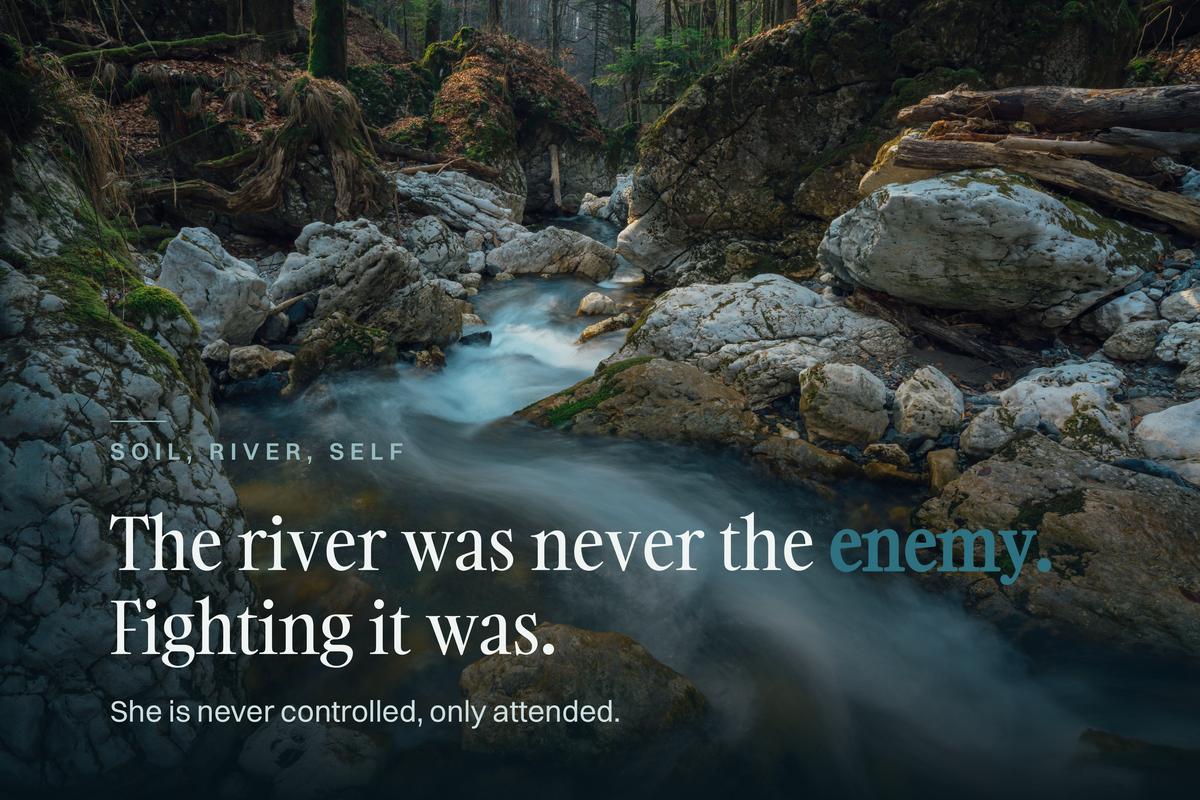
Photo by Daniel Mirlea on Unsplash. The current does not argue with the stone. It just keeps arriving.
The Same Wind, in Soil and River and Self
It was easiest to see with the women. A person can leave, and leaving makes a sound. Then I noticed the same hand on everything else.
Years before any of it had words, I had soil under my nails. I farmed organically from 2011, then apprenticed in the biodynamic gardens at Rudolf Steiner College, in rhythm with compost and moon. The earth taught me what I could not yet hear from a person. It has no face to blame. Push, and it resists. Demand, and it withholds. Charm, which worked on people, was wasted on compost.
You cannot force a garden. You can only attend it.
The grip I put on a beloved I had tried on the land, and on the river I swam against instead of letting it carry me. The feminine, in soil or water or a person or the feeling life inside, asks the thing a guarded man surrenders last: attention without control. The trust I was slow to hand a person, I now give first to the flow. Filled at the Source, what I bring to another is overflow, not need.
The river was never the enemy. Fighting it was.
I had mistaken her softness for collapse. But nothing is softer than water, and nothing wears down stone like it. The feminine does not overpower. She outlasts whatever braces, and the bracing is the only thing that breaks.
Shelter a sapling from every gust and it never grows the reaction wood a trunk lays down against the wind. I grew that way, tall, capable, secretly brittle. The wind I braced against was the very thing that could have made me strong enough to love.
“everything the power of the world does is done in a circle.”
The Two Inheritances
There is a wind older than the women in this story, and it blows down the line of the men who made me. My biological father and my mother parted when I was small, no villain, no victim, two people who were not a fit, and after that he was gone from my days, though not from all of them. The summers I had with him gave me other things, a tenderness toward animals, a love of the living earth, a zest for life, and a compassion I use in this work now without always crediting where it began.
My marriage came apart at the same age, the same parting, and my children learned my absence the way I had learned his. Then the ground came apart; I will not lay the details here. They are not only mine to tell. The parting set a stone rolling. The cost was years, the daily presence, and a grief I am still inside of.
Some hurts become the wood a vow is carved from. This one I carry without expecting it to turn beautiful.
A few years before the end, a living room in the Northwest, the kids circling the furniture, a marriage going quiet at the edges. My grandfather would not say it in front of her, so the next morning he handed me a folded square of yellow paper.
You are more married to your work than to her. She does not feel your ground. Until that changes, she will not lean back in. I answered for years with the story that an ordinary life would be the slow death of me. Underneath was a man who had made himself the provider of meaning so he would never have to be the provider of safety. She felt it as no ground, and I called her clarity judgment.
I almost served the sentence I was born into.
A pattern does not need a villain to repeat. It only needs to go unseen. Many of us may be carrying one too. Your beginning is not your sentence.
The Reverence I Shut Out
That is the paternal inheritance. The maternal one is its opposite, and for years I shut it out with everything else soft. My first teacher of the feminine was my mother. Her love came without conditions, and she showed me what devotion looks like when it does not quit. The harder truth: the anguish I named at the opening was hers, a storm in the body that was building mine. I am only beginning to hold both, her tenderness and her terror, and to give myself the compassion she gave me.
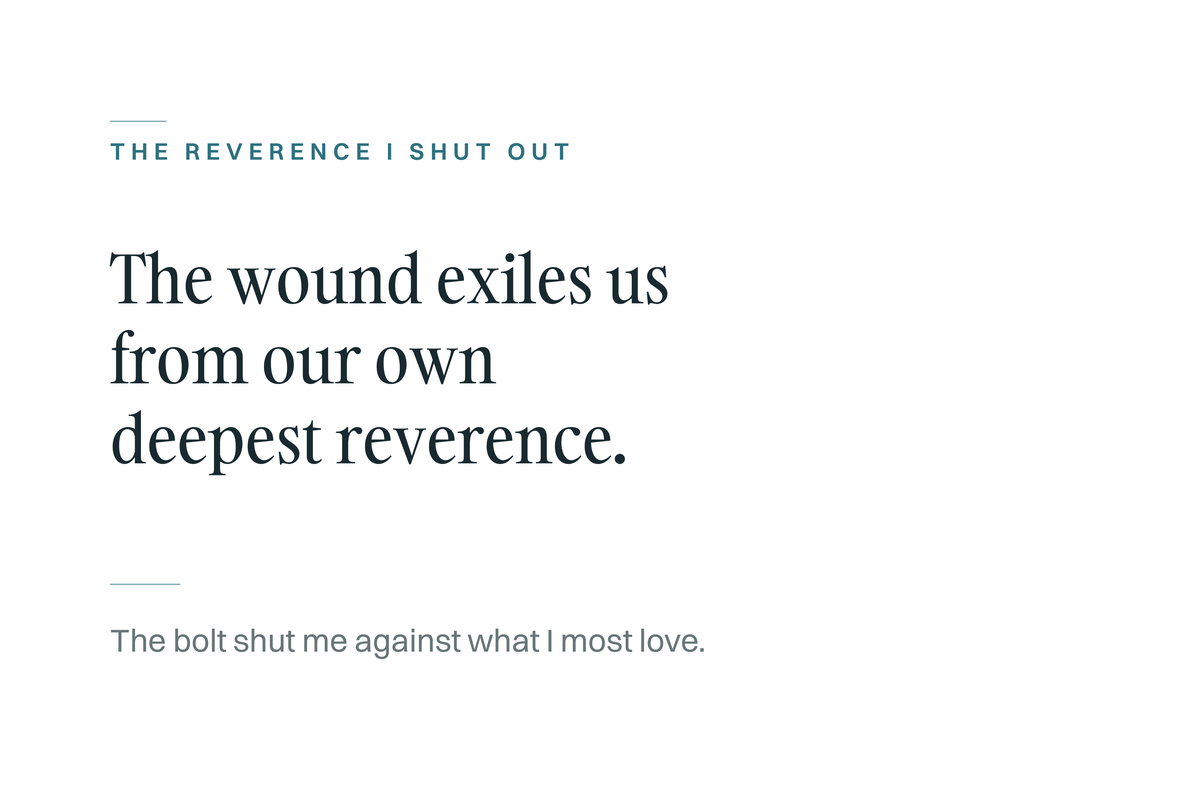
The plain truth underneath my wound: I hold the feminine as sacred. The bolt shut me against what I most love.
The wound exiles us from our own deepest reverence.
My mother's father's people were Scottish Stuarts, my mother's maiden name, and their creed names my path in three Latin words. “Virescit vulnere virtus”, courage grows strong at a wound. My mother's mother’s people were Oglala Lakota, who revere women as givers of sacred life and keepers of the center of the sacred hoop, the circle of all life. Their phrase “mitakuye oyasin”, all my relations, takes in soil, river, and wind. From both lines I carry one charge. To be a good relative.
Being a good relative, an elder therapist showed me, means reading the generational blessings and curses we carry, the family silver and the family ghosts handed down in the same breath. We are each a living story we did not write, its medicine and its heaviness in one body. To love a person is to marry the whole lineage, and I have felt unhealed inheritance reach across a family and fall on the children.
So I made a vow I have kept since: to be where an old inheritance of harm toward the feminine stops, and turns to reverence. Between the two bloodlines, the pattern and the love, I am choosing daily which one I pass on.
Learning to Bend
So I am learning a different way to meet the wind. The first vow was the hardest: I choose not to be the one who heals a partner so that they will need me. That is the savior's costume, and under it the old hunger to be indispensable. The wounded healer's real work is growing steady enough that others heal beside them, the harbor, not the rescue boat.
The more I steward the sacred as a man, the more I am asked to step back and make room for women, which I do gladly; the masculine has dominated long enough. Some circles have turned me away at the door, not for who I am or the balance I am here to grow. I honor the wound that speaks there, and I will not hide for being born a man.
Other circles open to me, and the welcome carries a weight: the grief of generations of masculine harm settles on whatever man stands nearest the altar, call it transference or weather, and I hold it without mistaking all of it for mine. Beside the weight, the blessing: I have been trusted to hold space for that very mending, in women's circles, with friends and clients of every age.
Until this work, I worshipped mostly the luminous face of the feminine. Now I am learning to honor her numinous dark, the wrath that burns away what is false. The wild feminine, whole, is embodied, contained, accountable for her own fire. Chaos borrows her clothes. I spent years courting the costume and calling it the mystery. The real one will not clap for a performance. She asks one question with her whole body: can you stay? Not fix, not charm, not explain. Stay.
Her confrontation is the initiation the soft face cannot give. A man who can stand in it without reaching for an explanation is becoming safe to love. The old reflex has not vanished, but I no longer obey it, and I let the whole person arrive before I leap. And I am learning not to open the deepest chambers in another person simply because I am able to. Depth is not a gift if I cannot stay for what it wakes.
Not long ago the old heat climbed my neck and the room tilted toward the door, and instead of overriding it I said, I need space, and stepped out. A younger me would have called that a failure of nerve. It is the whole skill. All that training, and the summit is a man leaving a room calmly. There is a difference between an exit and a desertion.
I am learning to leave facing her, naming it, the door closed by a hand and not a gust. And I watch the words I leave with now. This is not in integrity for me. I have to protect what I am here to serve. Each can be true. Each can also be the bolt's lawyer, an old flinch borrowing the language of a calling. Safety, in me, means feeling the pull, naming it, and choosing from somewhere steadier.
Is it the impulse choosing, or the chooser?
The safe masculine is not a man without fire. He is a man who tends his own.
“vulnerability is not weakness; it’s our greatest measure of courage.”
The Wind I Am Calling In
Here is where I stand. I am not searching, and not running. Even the searching was part of the wound: when I ached for a partner, the wish painted a face over the real one and I reached for the painting. So I am practicing wanting without grasping. And something harder than wanting her as a force, wanting her as real, a face across a table on a slow afternoon, neither storm nor teacher.
My pattern had a name I long resisted, avoidant, the wiring that reads closeness as danger and calls distance freedom. I resisted the label thoroughly enough to prove it. Under that wiring is a devotional heart that learned early that devotion is dangerous. Mine was. The bolt was never a lack of love. It was love guarding itself. The way out had a name, earned secure attachment, and the first bond to change is my own.
A relational wound heals in relationship, not in a cave, so I no longer treat partnership as a threat, but as the next room of the work. What I am building is secure functioning rather than the old self-sufficiency, the interdependence Stan Tatkin describes, where leaning is not collapse and standing alone is not exile. The jaw unclenching around another person. The breath dropping below the collarbone, and staying there.
My love was fierce, and the fierceness was never counterfeit. But intensity is an opening act. The truer test is time, whether love still shows up in year seven, at the tired end of an ordinary Tuesday, triggered and unthanked, entropy settling in like a stubborn tenant.
Anyone can love when it is easy. Love counts where it costs.
The elders who have stayed together and thrived for half a century look like a dying breed, and I study them like one. Their secret is rarely chemistry. It is rupture and repair, a thousand unremarkable mornings of choosing again.
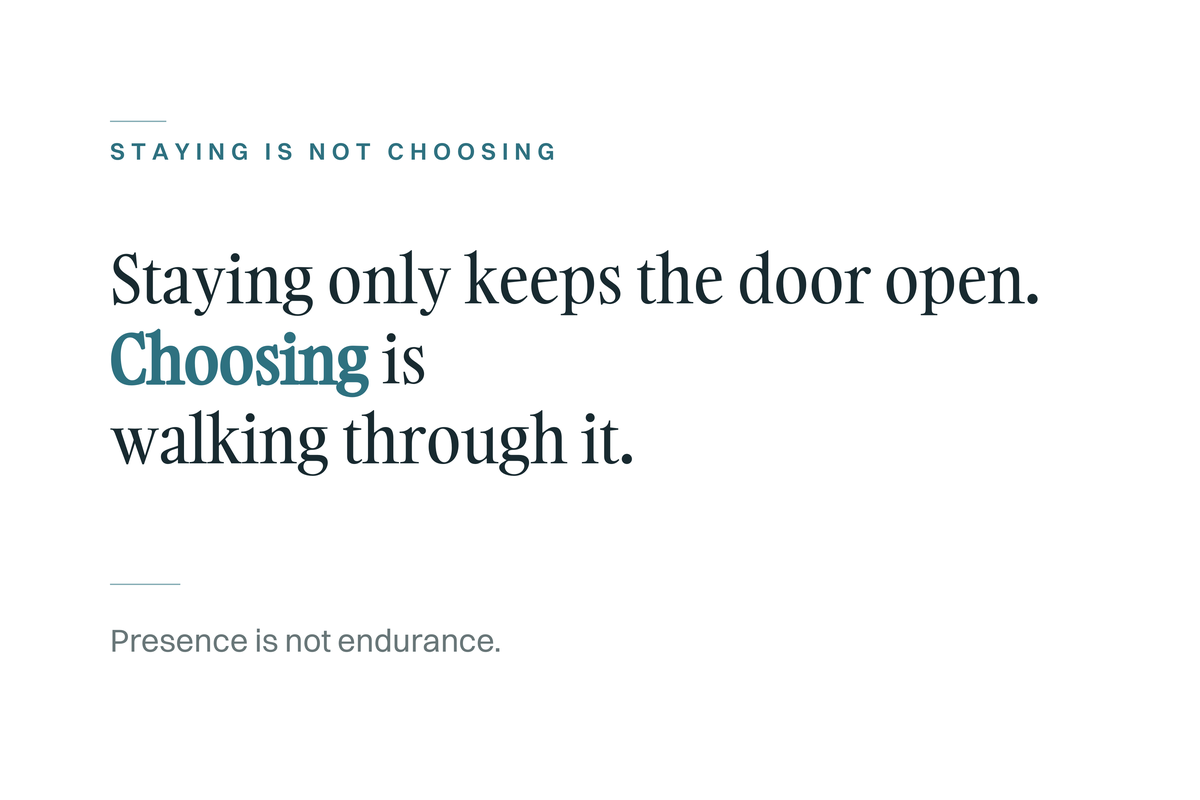
For years, I ran a private audition, is she worthy of my staying. I held the clipboard backward. The question was never whether she was worth staying for, but whether my staying was worth trusting. I had been casting a part I had not yet learned to play. And there is a sentence I have still not said with all my being, with the clipboard down and no one left to grade it. I choose you. Staying only keeps the door open. Choosing is walking through it.
I am curious about the man on the other side of that sentence. What it would be like to be loved by him. Whether the woman beside him would feel the ground under her without having to ask for it. I do not know yet. I want to find out.
What I most long for is to be seen all the way down and met with celebration, not tolerance.
A word on shape, since the vows I wrote name none, and the silence is deliberate. I was handed one picture of a finished love: two people, one roof, forever, and for years I measured myself against a frame I am not sure was ever mine. What I am learning to want is harder to draw. Depth and truth over exclusivity, a bond honest that what’s real changes with time, fierce love with no grip, the willingness to meet the actual person instead of the one my wish keeps painting over her.
I will not pretend my hands are steady on it. The same part of me that reaches for freedom is the part that once kept a hand on the bolt, and I cannot always tell yet which is speaking. So the vow binds me to how I arrive, not to the shape I arrive in.
It is less a list for the world to fill than a portrait of who I am becoming, and of a life shared with whoever will stand in that wind beside me.
Closing the Ledger
A vow points at my growth edge, and the truest thing I can say is how much I cannot yet see. Yours point at yours. Read your own vows, written or only lived, and they will show you the wound they were shaped against and who they are shaping you to become.
The seasons that burned have become the most fruitful ground I own. Now I stay in the heat on purpose, because staying is the vow. This October, I return to assist a Level 1 training with ISTA, the International School of Temple Arts, an experiential school of shamanic sexuality, healing intimacy and the body through breath, ritual, and conscious touch. To assist is to help hold the container and still be a student of it, from sovereignty rather than hunger. How I weigh it, gifts and documented risks, is in the FAQ.
And in that fire a calling has clarified. The more I sit inside this reconciliation of masculine and feminine, in myself, in circles, in the people I walk with, the more it feels like the work my life was braided for. Grateful for every season that led here, I mean to spend what remains supporting that mending, "mitakuye oyasin", we are all related.
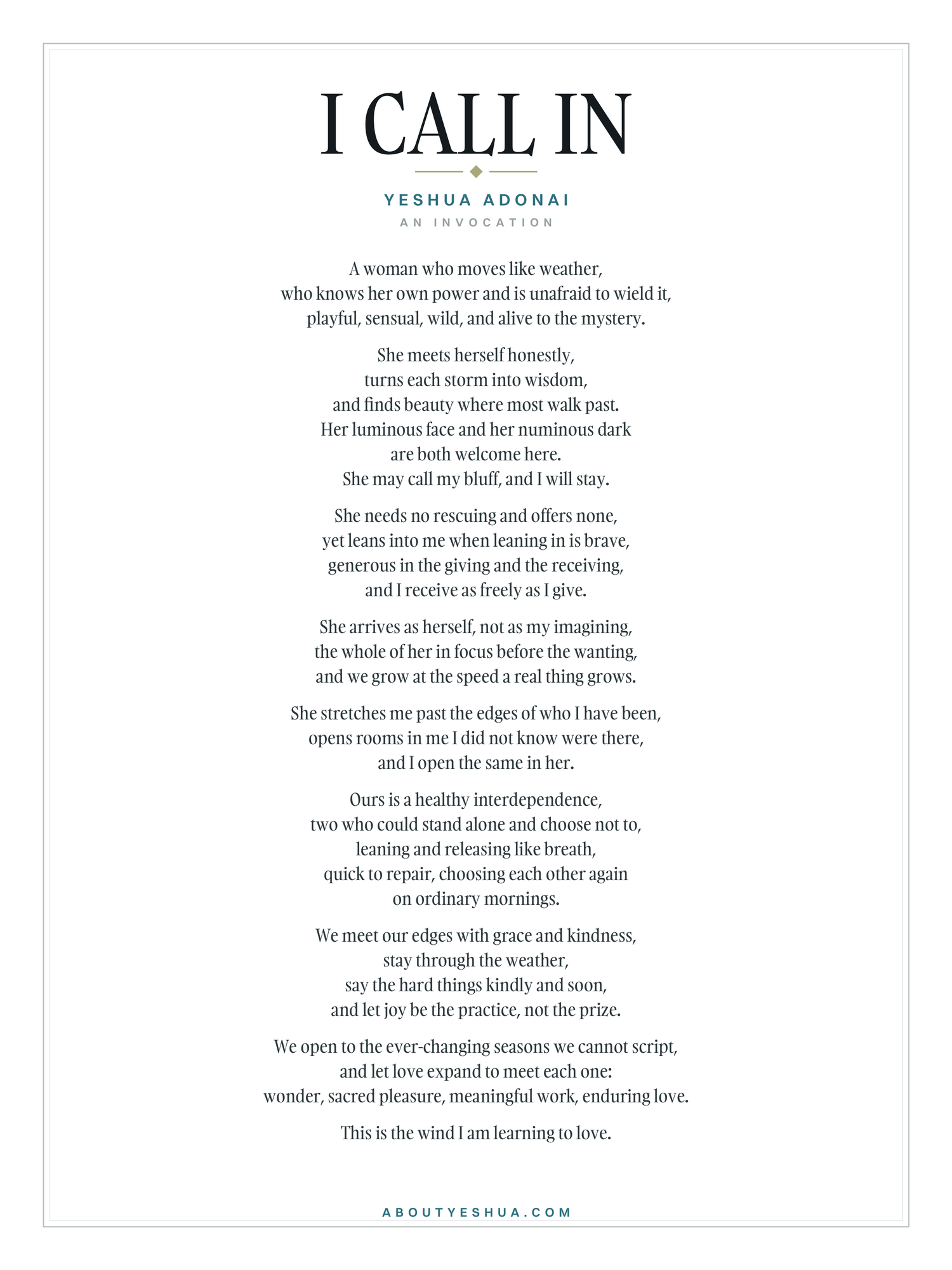
And so I come back to the ledger on the feminine. I assumed the title on its spine read 'What I Am Owed.' I had been holding it upside down. Right side up, it is a memoir, and the hand deciding the ending is mine. I am closing the accounting and keeping the story. I stopped keeping the book against her, stopped pretending I was owed, and started keeping faith.
There is a love that came to me before I had done anything to deserve it. It asked nothing and remade me anyway. That is what Grace means, and it is why the accounting could end. No ledger survives Grace.
The old verdict said women are not safe. That story is over. Women can be safe. So, it turns out, can I. In Vows I said I felt the key turn. This is the water it had to be fished from. The last entry is short. Still learning. Still here.
Whatever your gender, whoever you love, you have a wind of your own. It is leaning on the door you keep shut, in your relationships, in how you meet the earth, rest, the unknown, your unguarded body. Your reckoning will not look like mine. But somewhere a book is open in your name, and you are the one holding the pen. Hold it kindly. The author deserves the same mercy as the characters.
Even a reckoning can become a costume, the humble confessor replacing the savior. The proof was never going to be on this page. It is whether I can stay in a room where a woman is not clapping.
And some of the people I have loved may never meet the man this page describes. Repair means letting their account stand beside mine without turning it into proof that I have grown.
If you came here for a man who was finished, I can offer you one mid-sentence, and most days I choose to stay long enough to find out how the sentence ends.
The vow is not to never feel the wind. It is to stop bracing, and bend.
Questions to Sit With
What are you calling in, and how much of it already describes you?
What repeats down your line, and where are you standing in it?
Between the bolt you inherited and the love you are calling in, what would receiving ask of you this week?
The Long Work Underneath a Vow
If this gave you the reckoning underneath, its companion, the Vows essay gives you the practice above the ground and a way to write your own. The tree holds its shape. The wind is the weather. Neither makes the music alone. A vow is not kept at the altar but in the daily practice of becoming the person it describes. Weeks, not minutes. Sometimes seasons.
I work with people in two containers, and they are the heart of what I do.
Ceremony container is the full guided journey: weeks of preparation, a full day of ceremony held with screening and a sober steward, and the integration that follows, walked one-on-one across a season.
Coaching container is the ongoing season of integration: six one-on-one sessions, about every other week over three months, where insights become a changed life. The deepest and most enduring of what I do.
The first is the journey. The second is the long work of living it.
If we are a fit, that is the work I would do with you. A lighter or free first step: my Ceremony Readiness Guide, the monthly Online Integration Circle and other events, and, for those I have already walked with, the Seekers Circle, opened once a year at the fall equinox: eight returning seekers, a winter of embodiment, and an accountability partner beside you, because a relational wound heals in relationship, and no one should cross the dark stretch of a season alone.
And if we are not a fit, find your people anyway, a guide, a circle, a therapist, so you never carry alone what the dark reveals. I do not supply substances. What I offer is companionship, discernment, and steady soles for the long walk.
If this landed, share it with the one who keeps leaving the room a moment before the door opens, and might be ready to stay.
From my Heart to yours,
Yeshua Adonai
Psychedelic Guide
Yeshua is a traveling psychedelic guide currently based in Scottsdale, Arizona. A USMC combat veteran, former diplomat, and social entrepreneur working in mental health, he has spent decades exploring contemplative traditions and still counts himself a fellow traveler, learning to trust his own experience along the way.
Frequently Asked Questions
Take a breath here. What you just read was the hard part. What follows is quieter: the questions underneath the story, the science, the practical doors, for whenever you are ready. No rush. The wind will wait. A note on what follows. These go to the inner and relational questions underneath a vow, the science and the shadow both, and to how we might work together. Skip to what you need.
-
No, and the distinction matters. The feminine here is a principle, not a gender, the flowing, receptive current the post opens by describing, and it lives in everyone regardless of who they are or whom they love. Its partner is the masculine principle of structure and direction, equally present in each of us. I tell the story through women, the place my own wound showed sharpest, but the reckoning is with the whole of it, including the feminine I once exiled within myself. Further reading: the companion essay on vows.
-
The phrase comes from Carolyn Elliott, and it names what the post describes: a buried part of us can draw a secret charge from the situations we most want to end, so that we keep arranging them. It rhymes with what Freud called the repetition compulsion, the pull to recreate an old wound in the hope of finally mastering it. The point of naming it is freedom, since the payoff holds power only while it goes unseen. In my own case the arranging looked like attraction: I was drawn, over and over, to intensity, consuming intensity, often to women carrying unhealed pain, because the unhealed in them gave the healer in me a job. I accepted less than I was worth, stayed long after my body said go, and abandoned myself first, then called what followed abandonment. None of that makes those women villains. It makes the pattern mine to see, and seeing it is how the old victim story ends.
-
Both produce the same sentence: this is not going to work. The difference is what happens in the moment just before you say it. Watch yourself when someone tells you a hard truth about themselves, the addiction, the fear, the thing they have never said out loud to anyone. Discernment gets curious there. It asks one more question before it decides. The audition has already decided and is only waiting for its reason. Leaving can still be the right call, and some mismatches are real. But if another person's honesty is reliably what sends me toward the door, the wall is mine.
-
I understand the pull of that word, and I have learned not to reach for it. A diagnosis I am not licensed to make puts another person in a small box and puts me on a small throne, and both are the wrong size. Even psychiatrists bind themselves to this restraint with people they have never examined, the Goldwater rule, and I hold myself to at least their standard. Every one of us carries a selfish streak; mine spent years grading partners and calling it standards. Two unhealed people can hurt each other badly without either being a monster. So the humbler math, for me, is to take full ownership of my path, leave others the dignity of theirs, and keep the diagnosing for licensed professionals with better paperwork. Superiority is only the victim story wearing a nicer coat, and I am done wearing both.
-
You are not stuck. Attachment researchers describe earned secure attachment, the well-documented finding that people who grew up insecure can become secure in adulthood through reflection, repair, and relationships that hold. The beginning does not have to be the ending. The brain stays plastic, the nervous system can be retrained, and a vow written against your oldest pattern is one practical way to do that retraining on purpose.
-
Because the psyche is loyal to the unfinished. Harville Hendrix called it the imago, the idea that we are unconsciously drawn to partners who carry the traits of our earliest caregivers, wound and gift alike, because some deep part of us is trying to return to the original injury and finally heal it. This is not a life sentence; it is an invitation. Once you can see the pattern, you can stop casting the next person in an old role. Further reading: Hendrix's Getting the Love You Want.
-
That is not a malfunction. It is the normal architecture of a person. Internal Family Systems, developed by Richard Schwartz, holds that we are made of parts, a protector that braces for the next wound, an exile that longs to be held, a manager that keeps everyone performing, and that none of them are the enemy. The work is not to silence a part but to listen to it, thank it, and lead from a calmer center. A vow is a promise made from that center to the parts that are still afraid. Worth noting honestly: IFS is widely used and still being rigorously studied, promising rather than fully proven. I write more about parts and the witness in Self-Remembering.
-
Yes, and I write as one of you. The same vigilance that kept you alive does not have an off switch, and it walks straight into your closest relationships and stands guard. That is not weakness or damage. It is training doing its job in the wrong room. A vow shaped against that exact pattern, I vow to stay when every instinct says ‘scan for the exit’, is a way to retrain the system on purpose, slowly, with support. You learned to survive. You can learn to come home. Further reading: War After War.
-
Slowly, and never alone. The formal scaffolding, the ethics training, the peer consultation, the mentors, is laid out near the end of this FAQ, and it matters. The lived practice is smaller than any credential: a nervous-system warning named out loud instead of overridden, a no said before my body races ahead, a refractory period between forgetting myself and remembering that keeps getting shorter. Further reading: my coaching page.
-
First, compassion, because what you call sabotage is usually a nervous system doing its old job. Trauma researchers like Bessel van der Kolk and Peter Levine describe how the body keeps the score long after the mind has moved on, and how healing happens through the body, through safety, regulation, and titrated, measured, repair, more than through insight alone. A vow built against your particular pattern works best alongside real nervous-system healing, somatic work, good therapy, time. For couples specifically, Sue Johnson's Emotionally Focused Therapy is the most evidence-backed approach to rebuilding the bond.
-
This is the oldest paradox in love. Esther Perel frames it as the tension between our need for security and our need for adventure, closeness and space, the very polarity that makes the spark. David Schnarch called the deeper skill differentiation, the capacity to stay connected to a partner without losing yourself, to hold your own ground and stay close at the same time. The tree and the wind again. Desire needs two whole people, not two halves merged into one.
-
Polarity is real and it is one lens, not a law. Teachers like David Deida popularized the idea that erotic charge lives in the difference between two energies, often called masculine and feminine, that are not the same as gender and live in all of us. It can be a strong frame for why sameness dulls desire and difference sparks it. I hold it with a caveat, because some of the popular teaching slides into rigid gender essentialism, which I reject. Take the part that is alive, the dance of structure and flow, and leave the part that boxes anyone in. The honest version is this: held with respect, the difference is the dance.
-
Possibly, and here is where I stay careful with the evidence. Family constellations, in the lineage of Bert Hellinger, treat some patterns as belonging to a whole family field across generations, and many people find genuine meaning in that work. The science is thinner than the claims, so I hold it as meaningful ritual rather than proven mechanism. The related research on intergenerational trauma is more grounded, suggesting the effects of profound stress can echo across generations through how families function and possibly through biology. What I can say plainly is that naming a pattern as older than you can loosen its grip. Further reading: Mark Wolynn's It Didn't Start With You.
-
Slowness is a skill, not a temperament, and it is mostly nervous-system work. The body races toward a bond or bolts from one because an old alarm is firing, not because the present is dangerous. The practice is to feel the surge, name it out loud, and let trust build at its own honest pace, asking who is here rather than who I hoped had arrived. This is the patient, unglamorous center of integration coaching, and it is the same attention a garden asks for, where a season's worth of rain in one afternoon drowns what it meant to feed. You are not slowing down to be cold. You are slowing down so you do not hand someone the wound you are trying to heal.
-
Fair question, and I will not dodge it. I have been married, co-parented, and walked through a separation that humbled me to the floor, and I have experimented with different shapes of relating and learned their gifts and limits. I have been in my own therapy and relational work for the better part of two decades, not to perform health, but because relationship is one of the strongest medium we have for healing. I teach from the scars, not from a summit, and I will be the first to tell you so. And I refuse to do this work unsupervised. I study InnerEthics with Kylea Taylor, sit in regular peer consultation with other guides at Psychedelic Guide Network (PGN), and keep mentors who tell me the truth before I am ready to hear it, because accountability has to run in every direction at once, upward to the sacred, outward to elders and peers, inward to the self I am learning to keep faith with. Power without accountability is only a better-dressed version of harm. I am unfinished. If you want to see how I work, that is what the coaching page is for.
-
Start by not starting with each other. Each of you writes the vows you can keep, then you trade them, reading yours and asking to hear theirs. And consider not vowing forever. None of us can honestly promise it, and that knowing drains the words of power. Vow to the present instead, choose this person fully today and keep choosing, and revisit your vows together on a rhythm. Further reading: Vows: How a Tree Learns to Love the Wind.
-
Intense container work can open real transformation, and it carries real risk, and both are true at once. Schools like ISTA, the International School of Temple Arts, do potent spiritual, sexual, and shamanic work, and they have also drawn serious, documented criticism and allegations around consent, power, and harm. I have trained in this lineage and value what it made possible in me, and I take the concerns seriously and know thoughtful people who oppose it. My counsel is the same as the whole essay. Go in whole and self-possessed rather than hungry for what you hope it will fix. Write your vows first. Vet facilitators ruthlessly, ask hard questions about consent and power before you arrive, trust your body's ‘no’ in the room, and never let a container override your own discernment. This October, I serve on the assistant team for a Level 1 in Camp Verde, Arizona, a role you can step into only after moving through the training yourself. Further reading: Choosing a Psychedelic Guide: Questions Your Life Depends On.
-
Start where trust already lives: a good therapist, a men's or women's circle, one friend who will hear a vow spoken aloud and ask about it later. And for those who have already walked with me in ceremony, the Seekers Circle is built on exactly this principle: eight returning seekers, fall equinox to spring, vows tested through a winter with an accountability partner beside you, two trees, roots touching underground, each crown keeping its own sky. It opens once a year, and enrollment closes early Septembers.
-
Both. I work across Arizona from the Phoenix and Scottsdale area, including Sedona, Tempe, Mesa, Flagstaff, and Tucson, and I travel regularly to Portland, Maine and through New England. Most of the vow and integration work happens through prep and integration coaching, which I do remotely with people anywhere.
-
Begin small and real. One hour, paper, three or four vows shaped against the pattern you most want to stop repeating, read aloud to one person you trust. If you want company for the deeper, months-long work of turning a vow into a life, the free guide, the monthly circles, and coaching are all linked in the closing of the post above. Or book a free 30-mins discovery call.
Blog Archive
explore the growing library
-
After the War
- Nov 17, 2025 05 | 11.11: War After War A Veteran’s Battle to Heal
-
Consciousness
- Aug 24, 2026 35 | Beholding: How the Chapel of Sacred Mirrors Returns Your Gaze
- Jun 1, 2026 29 | Leary's Eight Circuits: A Map of Consciousness That Both Frees and Binds
- May 18, 2026 28 | Cancer: The Other Healer in the Room
- Apr 20, 2026 26 | Harvard's Last Psychedelic Intersections Conference: A Practitioner's Review
- Mar 30, 2026 24 | Nonlocal Consciousness: What The Secret of Secrets Reveals About the Nature of Mind
- Mar 23, 2026 23 | Self-Remembering: When the Self Sees Itself
- Mar 16, 2026 22 | Hyparxis: The Dimension Where Real Change Becomes Possible
- Mar 9, 2026 21 | Thresholds: A Psychedelic Guide to Falling Apart on Purpose
-
Finding Purpose
- Jul 13, 2026 32 | Vows: How a Tree Learns to Love the Wind
- Apr 6, 2026 25 | Reset: What Becomes Available When You Choose to Dissolve
- Jan 26, 2026 15 | Beyond Belief: Psychedelics and the Post-Religious Spiritual Path
- Jan 5, 2026 12 | Beginning Again: The Practice of Presence Over Performance
- Dec 1, 2025 07 | Finding Purpose in Midlife: How to Regain Meaning
- Nov 24, 2025 06 | Unlock Leadership Potential With Psychedelic Coaching
-
Psychedelic Path
- Oct 5, 2026 38 | Vigil: A Safety Framework for Psychedelic Care
- Sep 21, 2026 37 | FDA public hearing: The Day the Sacred Was Ruled “Out of Scope”
- Aug 10, 2026 34 | Kaleidoscope: What Is Actually Happening Inside a Mushroom Journey
- Jun 29, 2026 31 | MDMA: Heart Medicine and the Oldest Name for God
- Jun 15, 2026 30 | Ketamine: The Mirror Molecule That Was Always Asking for a Witness
- Jan 19, 2026 14 | Microdosing Magic Mushrooms: A Guide to What Actually Works
- Dec 22, 2025 10 | From Darkness Into Light: Living the Insight
- Nov 3, 2025 03 | Ketamine Therapy Near Me: A Legal Pathway for Psychedelics
- Oct 27, 2025 02 | Arizona’s Psychedelic Awakening: Where Science Meets Soul
- Oct 20, 2025 01 | My Psychedelic Journey: A Path Through the Fog of Depression
-
Sacred Ceremony
- May 4, 2026 27 | Seekers Circle 25-26': Where Preparation Becomes Integration
- Feb 2, 2026 16 | Choosing a Psychedelic Guide: Questions Your Life Depends On
- Jan 12, 2026 13 | Psychedelic Preparation: The Work That Begins Before Ceremony
- Nov 10, 2025 04 | Magic Mushrooms: Remembering the Sacred Intelligence of Nature
-
Shadow Work
- Jul 27, 2026 33 | Bend: A Reckoning with the Feminine
- Mar 2, 2026 20 | The Shame Addiction: What the Body Learns (Part 3 of 3)
- Feb 23, 2026 19 | The Shame Addiction: What the Body Hides (Part 2 of 3)
- Feb 16, 2026 18 | The Shame Addiction: What the Body Carries (Part 1 of 3)
- Feb 9, 2026 17 | Stop Trying to Forgive: What Psilocybin and Grief Teach About Letting Go
- Dec 15, 2025 09 | Grief and the Path Back to Ourselves (part 2 of 2)
- Dec 8, 2025 08 | Grief and the Path Back to Ourselves (part 1 of 2)
- Tools for Integration
trending topics
- psilocybin
- psychedelic integration
- harm reduction
- psychedelic guide
- Arizona
- psychedelics
- integration
- transformation
- veterans healing
- Fourth Way
- Long Now
- PTSD
- integration coaching
- letting go
- mental health
- nature
- neuroplasticity
- presence
- psychedelic preparation
- recovery
- self-awareness
- FDA psychedelic hearing
- FDA public hearing 2026
- Gurdjieff
- MDMA-assisted therapy
- Oregon psilocybin
- REMS
- White Oak
- addiction
- alternative treatment
- becoming
- burnout
- chaplaincy
- combat veteran
- consciousness
- default mode network
- depression
- docket FDA-2026-N-7542
- emotional healing
- ethics
- grief
- guide selection
- ketamine clinics
- ketamine therapy
- legal
- loss
- magic mushrooms
- masculine and feminine
- mast year
- mindfulness