
35 | Beholding: How the Chapel of Sacred Mirrors Returns Your Gaze
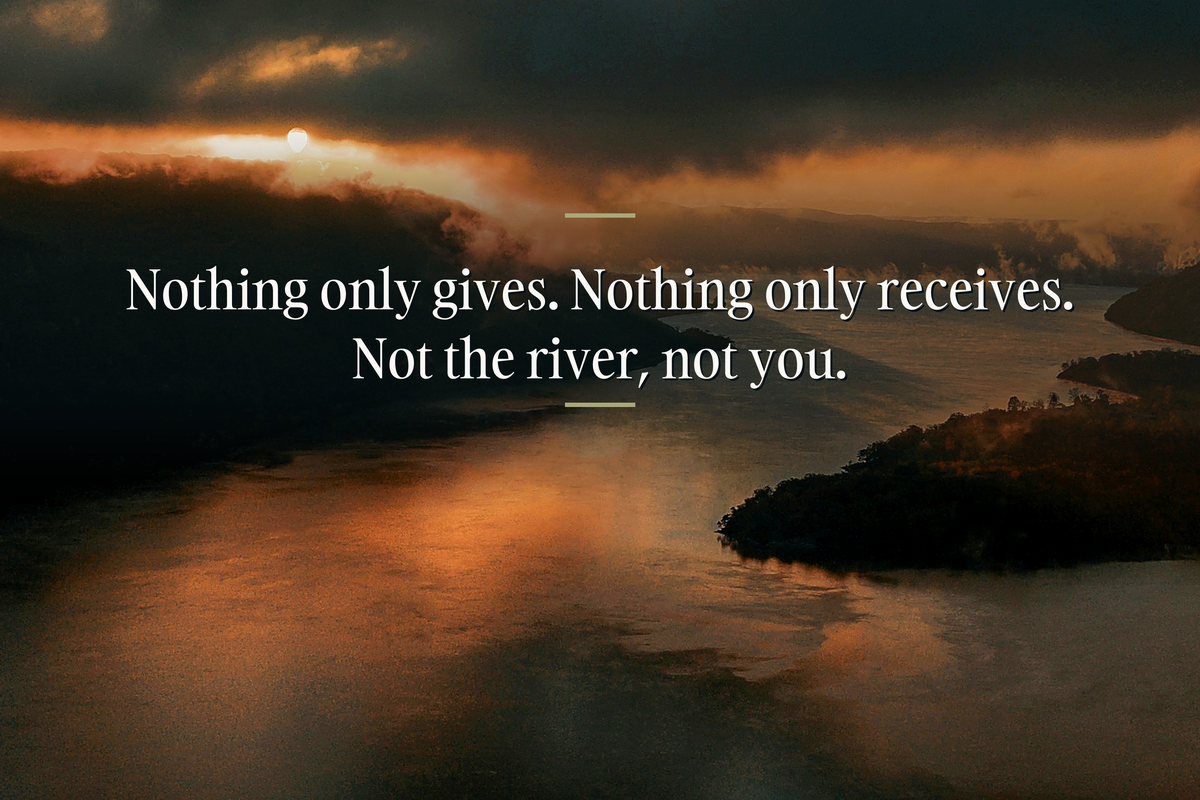
The Hudson River, low light. For a hundred and fifty-three miles it is not a river at all but an arm of the sea, running north on the flood and south on the ebb. The Chapel of Sacred Mirrors (CoSM) sits about halfway down it. Photo by Clay Banks on Unsplash, who lives and photographs in the valley.
Beholding is taking in what is in front of you and letting it change you. A gull that holds your eye. A painted figure hung at your own height. A person who hears the true thing and does not reach for the fix. I have practiced the offering for decades, the holding of the room while somebody else comes apart in it, and I have been on the other side too, with mentors and guides and therapists who were good at it. In a room above a river that runs both ways, I learned the difference between being helped and being received, and how little of the second I had ever let land.
A short word before we begin. This piece touches four generations of men who were not around much, a church that allowed only the approved songs, and a room where I stopped being able to explain myself. Go gently. My full disclaimer is in the footer. With that said…
~19 MINS READ
AN ANIMAL WITH NO EYES AND NO BRAIN DOING WHAT I DROVE ALL THAT WAY TO LEARN. A TEMPLE THAT LOOKS LIKE A CONCRETE BOX UNTIL YOU LEARN WHY. A BATHROOM THAT SENT ME SIXTEEN YEARS BACKWARD. WHY TWO PAINTERS PUT EYES ON EVERY SURFACE THEY OWN. THE SPECTACLES AND THE ASHES I COULD NOT STAY LONG ENOUGH TO EARN. AND A MAN IN HIS SIXTIES WHO LOOKED UNTIL HE WAS FINISHED LOOKING.
(The science, the seam where it stops, and how to visit are in the FAQs below.)
“for man has closed himself up, till he sees all things thro’ narrow chinks of his cavern.”
The Hole You Cannot See
Start with why anyone would need a mirror at all.
That is your physiological blind spot, one in each eye, where the optic nerve leaves and takes the real estate with it. Edme Mariotte found it in 1668, and showed it to the court of Louis XIV.
There is a test at that link that takes under a minute. Do it now if you never have. A dot will vanish, the wall behind it will fill in, and you will not catch it happening.
Now the version that costs you. Think of the last time somebody looked at you a beat longer than the conversation required. No agenda. Not waiting for their turn. Just looking, with nothing wanted.
And something in your chest moved, and you looked away.
Most of us look away, and almost nobody says so. When did that start for you? There is a gap where your eye joins your mind, and another where you join your own life, and neither can be reached from inside your own head. You need a mirror, or somebody willing to stay a few seconds past the point where you got uncomfortable.
That is beholding. Not looking harder, but being received by something that wants nothing from you, and not being the first to leave. It is also the plainest description of love I have found. The painting is not loving you back. It is only holding still, and that is enough to show you which one of you moved first.
Which is why, in a room of twenty-one figures, two of them are glass.
Eyes Closed in the Rain
I reached the room with the two mirrors in it four days into a road trip. But I have to start the night before, in the rain, a hundred and fifteen miles north of it with my father in the car and a temple at the end of the drive south.
We came out of a Dave Matthews show at Saratoga Performing Arts Center (SPAC), NY, in a downpour and my father was still dancing. Early sixties. He is my biological father. He did not raise me. Sixty-plus shows in, and this was my first, and those two numbers share a cause.
He read the set list the way a cook reads a menu, and told me this one was epic or had no flow. Then he stopped analyzing and cheered with his hands up. Eyes closed, rain coming down, nobody watching, and it would not have mattered if they were. He did not become less discerning. He set discernment down for a few hours, which is the cost of not spending the concert grading it.
I was still working. Chasing meaning. Trying to determine what the song was about, the way other people check their phone. In an airport, I have decided about a stranger before they finish a sentence. He was not doing that. He was being played. I knew the word, I have taught the word, and I was not doing it.
That is one form of it. Not looking harder at the music. Letting the music have him.
Somewhere in the second set, I understood where I stood. My father left a church at seventeen. No television, no radio, no music that had not been cleared. Hymns were fine. Everything else was a delivery mechanism. His own father was a minister, certain it was for their good, which is why there had been a record player hidden behind the hanging clothes playing exactly what they were worried about.
He goes to dozens of shows a year. I had thought of it as a hobby. Standing next to him in the rain, I understood it differently. This is where he sings, where he dances, where he lets himself be moved by something he did not make. And it is not only the music. It is the woods, the animals, the old people he sits with, the children he gets down on the floor for.
Forty-five years later, he is part of a congregation of twenty-five thousand. Outdoors, no creed, coming back to the same field for decades knowing it will not repeat.
A man raised where only the approved songs were safe built a practice out of everything they left out. Singing, dancing, animals, old people, children. He had been going for thirty years before I finally came to a service.
Two good fathers, a sentence I did not always know how to say. Go back far enough in either line and the great-grandfathers die young. Their sons worked, provided, and were gone. Their sons after that were around, mostly. Not one of them withheld anything. Each delivered love in the one container he had been handed. An imprint is not a destiny.
Whoever you are still holding it against was handed a container too. That is not amnesty. It is the difference between a man who would not and a man who could not, and forgiveness turned out to be the smaller half of the work.
Love arrives in whatever vessel the giver was handed. The work of a life is learning to recognize it there.
The Gull That Held His Eye
Then we had to find somewhere to sleep.
I called hotels the whole way. Saratoga, Troy, Kingston, Poughkeepsie. A Saturday in July. Not a room in the valley.
Somewhere past midnight I stopped calling. A problem yields to effort. A condition asks to be inhabited. Most of the suffering I have watched people carry comes from treating the second as the first, and I had spent two hours doing it.
We gave up and pulled into a Park, on the Hudson River a few minutes from the village of Wappingers Falls, no bed and no plan, and I could feel the day sitting in my jaw. The temple was one hill away. Neither of us knew. Dozens of seagulls were already there, mid-party. Second show of the night, and nobody checked our wristbands. My father got out, went through the trash cans, and came back with food for them. The gulls ate first. He did not seem to notice deciding. Kindness is decided, then repeated, then embodied.
We sat on a hill above the water and watched them. Gulls do not only fight over food. Give them enough, and they start playing, and the difference shows if you stay long enough. He stayed long enough that one broke off, planted its feet, and held his eye.
He told me that week that being fully present is a rare gift, and that he is still practicing. At seventeen he shot a deer, walked up to it, and it was still alive, and it looked at him. He has not hunted since. What sticks is rarely the reasoning. What sticks is the moment a creature looks back, and the hands know before the mind does.
Beholding begins where the wanting stops. He fed the gulls and asked nothing back, and one look came free. At seventeen he wanted everything from that deer, and its look ended the wanting for good.
The water below us was not doing what I assumed water does. The Lenape and Munsee-Mohican, who understood the intelligence of a place better than whoever renamed it, called it Muhheakantuck. The river that flows both ways. Twice a day the tide turns, and the whole river runs backward.
We talked until the sky went some lighter shade of grey, and neither of us mentioned that we had nowhere to be. Of the whole trip, that is the night I would keep.
He fed them before he philosophized, the correct order, and not the one I was trained in. Care first. Cosmology after.
And then the cosmology, because that is how it works when you take them in order.
The far end of that water once held two hundred and twenty thousand acres of oyster reef. One oyster moves fifty gallons a day and hands it back cleaner than it came. No eyes. No brain. A body built as a channel rather than a container, doing with its body what I had driven up here to learn.
Which leaves me with the part I am sitting with. Something is being taken apart by how I live, and I do not know what, because it is not in front of me and nobody sends a notice. A permaculture teacher asked me once how my environment was processing me. I had been asking the other question. It had not occurred to me that the trees were also handling my presence and adjusting to it. The room would ask me that later, in a different accent.
“the waters that are never still.”
What They Both Saw
On our drive in the morning, I read to him about the two people whose building we were going to stand in. Go back to a room in 1976. On June 3, two art students took the same dose of an entheogen, and each of them thinned out of a person and into a passage. A fountain and a drain at once, light pouring out of them and into them with no pause between, and every living being doing it too, each one a lit knot in a net running in every direction without end.
They call it the same experience. What differed was the rendering, and neither of them let their own become the right one. Neither tried to settle it in words. Each went and painted it, and neither has stopped.
Alex named his rendering the Universal Mind Lattice. Allyson painted hers as the Jewel Net of Indra, an image Buddhists have been using for centuries. Every jewel holds the reflection of the others. No jewel is the original. The arrangement I walked you through last time.
They married the year after and both took the surname. That is what happens when two people actually look at each other.
Physics already named the shape they saw. A torus. A donut. The least dignified description available for a vision of divine love.
Anything running current in a loop makes one. An electron, your heart, the earth, the sun. The mouse and the hurricane are working from the same blueprint, and neither one applied for it. Nobody was consulted about this, and every living and unliving thing complied.
And there is no storage compartment. What comes in is what goes out, which is why the people who tried to hoard love did not end up with more of it.
I had slept within a hundred feet of the Hudson River and not once recognized it. An estuary does not choose between giving and receiving. Fresh water alone would be a river. Salt water alone would be the sea. What is there is the meeting, and the meeting is where the fish spawn. Two bodies that have been trading the lead since the glaciers left, and the result is the most fertile stretch on the coast. I know couples like this. David Bohm gave his last decades to that tide, calling what we see the unfolded face of an enfolded order.
I took my own name on purpose. Not as a claim about myself, how it lands in most rooms, but as a reminder that the divine does not skip anybody, with the name or without it. Same wager, opposite method. She built Secret Writing, an alphabet of twenty letters nobody can pronounce. I chose a name that gets mispronounced weekly.
They are not two artists who married. They are one vision, rendered twice, and still unfinished.
For two days the lesson had kept arriving, each time in a different body. A man with his eyes closed in the rain. A gull that would not look away. A deer whose look ended a boy's hunting. Two painters who have spent fifty years refusing to correct each other. I could name them all. Naming is not receiving.
Where the Eye Lands
We got to the Chapel of Sacred Mirrors by noon, unwashed. Everyone calls it CoSM, and the name does triple duty. Forty acres on a hillside. A temple on the acres called Entheon. And three floors up inside the temple, one room carrying the name of the whole place. That room is the point. Everything else is the walk to it.
From the parking lot, Entheon is a concrete box. Three stories of grey block, a head on the steeple, and nothing whatsoever on the walls. I had spent the drive reading about thirty faces, angels at the corners, dragons coming off the roof, and had the whole cathedral assembled in my head before we turned in. What is there is a bunker with one head on it, waiting.
They built it from the inside out.
A decade after the first vision, blindfolded on a loft floor in Brooklyn, the Greys saw that their work was to build a temple. Nineteen years and one move later, Entheon opened on June 3, 2023, forty-seven years to the day after the vision, with the inside finished and the outside bare. They put the head on the steeple first, to honor a heavenly connection. The countenance comes after.
By their own account, the building has barely started. The inside tells a different story. The grey box breaks open like a geode. Color runs floor to ceiling, the ceilings are worked like walls and the walls the way monks worked manuscripts, and nothing on three floors is unconsidered. Outside, a rock. Inside, the reason for the rock.
The bare outside is not neglect. It is patience, and the inside proves it. The inside hangings are straight, the labels read like they were written by someone who stood where you are standing, and the glass is clean.
Reverence begins where no one is looking. We tend to build in the other order. The face first, then the body, the clothes, the sentence under our name. The interior later, if there is time, and there rarely is.
A countenance can be true. Theirs will sit on a finished sanctuary. That is what makes it honest. Walk your own front and go in behind it. See if the rooms match what is hanging on the outside.
My father read the land before I thought to look at it. There is a maturity to the place, he said. They are not little dinky trees. They have been around. That hillside took in seekers for a century before anyone roofed part of it.
“visionary mystical experiences are humanity’s most direct contact with god, and the creative source of all sacred art and wisdom traditions.”
A Door You Open With Your Body
Then I saw the doors and my feet stopped before I decided to. Bronze, seven hundred pounds, cast with Adam and Eve returning to the Garden rather than leaving it. Coming back as artists, to paint a new world and learn from the tree. You open a door that is heavy with your body, and the building has reversed the oldest story in the culture before you are through it.
Past the doors, the room is mirror facing mirror. What runs away from you into the distance is the back of your own head, a hundred of them, getting smaller. The one angle you were built without, handed over in the first few seconds, before the coat is off. Nobody asked to lower your voices. We had lowered them anyway, a step past the doors, and they stayed down for three floors. It is quiet in there the way working sanctuaries are quiet. No sign requests it. Voices drop a step past the doors and stay down for three floors.
Beyond it, the lobby floor is inlaid with her secret alphabet. I walked on her language for several moments before I saw any of it hanging, and what I felt, faintly, was read.
A plaque near the entrance names the Bronner family as benefactors whose funding helped raise Entheon. I went to find the bathroom. It turns out to be a gallery, saturated work on the walls and ceiling, in a room most buildings treat as plumbing. Peppermint hit before I had a thought about it. Hands under warm water, and I was somewhere else.
A monastery in California, 2010. A thin mat at five in the morning. A nervous system I had carried home from a war and could not switch off, and Dr. Bronner's from a washroom across the hamlet. I told you in my last letter it would come back. I have washed with that soap in stranger places. A communal shower at Burning Man, a DJ, a hundred of us naked and soaping each other down. Allyson and Alex Grey, whose building I was standing in, painting a wall of luminous skeletons while we danced. My arms stayed close to my body for the first few songs. Then they did not. Emanuel Bronner printed ALL-ONE OR NONE on every bottle he made. Nobody told me it was an instruction.
I washed my hands and sixteen years arrived.
“secret writing represents the spirit of communication irreducible to concepts.”
Eyes on Every Surface
Spend an hour in Entheon, and you notice Allyson and Alex are interested in eyes. Eyes in the paintings. Eyes rimming the frames. A roof of concentric rings of them. I read it as a signature at first. Then I learned what a retina is.
It is brain tissue. In the embryo, the forebrain pushes a small cup toward the skin; that cup becomes your eye, and it stops under the surface. The eye is the one place the nervous system comes up for air. Look into someone's eyes, and you are looking at their brain, out in the open, working. They found the single spot where the soul is visible from outside and painted it two hundred times.
Here is a thought I keep turning over, offered as a thought and not a claim. Suppose the one making and the one receiving are not two. Suppose an eye is not a device for taking in a world finished before you got here, but an aperture the world opens to look at itself, and every creature with sight is one more opening.
Then try to hold what is being seen at this second, through all of them. A great deal of it is ceilings, phones, the back of a head at the pharmacy. Several million are watching a microwave countdown. As close as our species gets to a synchronized global liturgy.
And in that second, on the one instrument, somebody is looking into the eyes of a person they have loved for forty years and finding them still in there, and somebody is crying at a sunset they could not explain to a colleague, which is love with nowhere to put itself, and somebody at a bedside is holding a hand through a last breath, and two people are looking at each other while one of them comes apart, which is a kind of being seen most of us can only survive in the dark.
All of it arrives on one lens, and I cannot find where anybody is grading it. No curator. No highlight reel. The ceiling gets the same bandwidth as the deathbed, which is either a scandal or the most generous arrangement ever devised, and I am no longer sure those are different.
Every living thing is built with its back turned to itself. Every living thing solves it by being surrounded. An eye cannot see itself. That is not a flaw. It is an argument for company.
Visionaries Who Kept Looking
The floor had been hers, so I expected the walls to be theirs too. They are not. The ground floor begins with everyone else, on a wall running back through Hildegard of Bingen and Bosch to William Blake. Their definition of visionary art is there too, and one clause stopped me. It gives form to inner experience, they say, "so communities can see themselves more clearly." Not a postcard from a country I cannot reach. A letter.
Past a gift shop is the Psychedelic Reliquary. Albert Hofmann's spectacles are in there, behind glass. I gave the room ten minutes, knew inside two that ten was an insult, and kept walking anyway.
The stairs go up. The second floor opens with Chaos, Order and Secret Writing, the alphabet I had been walking on, now hung at the height of my face and running the length of the wall. Then Progress of the Soul, a life taken in order: kissing, copulating, pregnancy, birth, nursing, and on to the last breath. I stayed there longest. Nearly everyone who looks at you wants something from you. Not a failing, just the ordinary condition of being alive among others. Paint asks nothing, so it can hold you at an intensity a person could not sustain.
Two more galleries on that floor. Gaia, where the ecological case stops being a case and becomes a body. Then the performance work, decades of rituals staged for people who had not asked for them, which is the part of an artist's life that gets no applause at the time. I have spent years of my adult life quietly funding artists I loved, so I know something about what it costs to keep making when nobody has requested it.
Standing there I wanted to say it to them directly. This is not a building about your vision. It is the vision, at scale, with a door in it. Two people's love, given a floor, a roof, and opening hours. Thank you for not waiting until it was acceptable.
Up the next flight, Cosmic Mother stands over the stairs, a sculpture holding the earth inside the almond two overlapping circles make where they cross. The oldest sign we have for the feminine. Her plaque says she blesses wayfarers ascending and descending. I have been in churches that bless only the climb.
Then the third floor and the Great Hall, where the paintings run from the floor to the ceiling and Net of Being takes a wall to itself. People slow on that floor without being asked. Strangers leave one another more room than a gallery requires, and nobody narrates. It is the etiquette of a chapel, arriving in people who were not raised with one.
There is an altarpiece there called Cosmic Christ. The carpenter was good at the looking. People kept arriving wanting to be fixed, and he met their eyes first. The accounts record as an afterthought what I suspect was most of the medicine. Alex heard words while painting it and carved them into the base.
You can never be lost. When have you ever been apart from me? You can never depart and never return, for we are continuous, indistinguishable.
In the second person. Waiting a quarter of a century for whoever needed it.
Palms Open, At Eye Level
The room the whole place is named for is through an archway at the end of the Great Hall. A latticework ceiling. Ten archangels. One body, rendered twenty-one times. Nineteen paintings and two etched mirrors, and I did not understand the mirrors until I was standing in front of one, looking like a man who had driven a long way. Each one faces forward. Arms to the side. Palms open, hung so it stands at your height. Guests enter the Chapel the way they enter cold water. A half step, a pause, then all the way in.
We learn it late, and from an object, that being looked at is not the opening move of a request.
CoSM says this on their website. "Viewers are invited to reflect on a vision of the physical body transforming into pure infinite love energy.
I have opinions about museum placards. This one does not describe the work. It gives you a job. "Mirror the image," it says. "See yourself and others as reflections of the divine." He took that from Tibetan practice, where certain images are made to work on you rather than please you.
So I did what the placard told me. Feet planted. Arms out. Palms turned up and forward. I checked, once, whether anyone was watching. My face went hot. I stayed.
Worth saying what that costs, because the instruction sounds soft and the body knows better. Arms out means nothing in front of the chest. Palms open means nothing held. We save that posture for people we have already decided are safe, and the chest knows the list before the mind does, and holding it among strangers set off an alarm that took a few breaths to stand down. The nervous system reads an open chest as unguarded.
The same alarm that fires at any real threshold, at half volume.
The body leads and the mind follows. Stand as though you were already received, and something in you catches up.
Then the breath changed on its own. Slower at the bottom. Wider through the ribs. The exhale doing more work than the inhale, which slows the heart through the vagus nerve and reads to the body as an all clear it will not accept from an argument.
You can decide to accept your life and stay braced, and nothing moves. Or you can put the body into the posture of having already accepted it, and the mind arrives a few seconds later, outvoted and willing.
The permaculture teacher's question, back, in the room's accent. Not what am I taking from this. What is it doing with me.
What arrived was not a thought. It was permission to be loved without first being improved. Whatever had been managing the encounter let go of the rope. To be one life without editing the parts that went badly, a state I have called dissolving and had not thought to call allowed. Most of us are waiting to become lovable. The room does not run on that schedule.
“the visionary artist’s mission is to make the soul perceptible.”
Until He Was Finished Looking
It widened from there. Whoever has stood in that spot and whoever will. Each client I have sat with in the dark, and the people who held me while I came apart and stayed.
Being understood is not being beheld. Understanding is an accurate account of you. Beholding is somebody staying without needing the account to come out right. Shame does not resolve under analysis. It resolves under witness.
Late in a ceremony, there is a stretch where nothing is happening, and everything is. The work is not to watch for a development. The work is to stay without one, and it is most of what I would ask a guide about. It took a painted wall and a man in his sixties to show me that skill pointed the other way.
We went back down the stairs we had climbed, past her again, blessed on the way down as we had been on the way up. Upstairs I had finally looked over at him. He was in front of one of the panels with his chin up and his weight even, rocking a little on his heels, the way a boy stands at the edge of water he has already decided to get into. His hands hung open at his sides. Nobody had given him a placard.
I waited for him to say what he made of it. He looked until he was finished looking, then moved to the next one. He has not told me what that room did to him, and I have decided not to ask. The arrangement the river had been running the whole time, a mile down the hill and out of sight.
We stopped at the Reliquary again on the way out, which is when I understood we had done the whole building in two hours because two hours was what we had. This time I read the cards. Timothy Leary's ashes. Ten more minutes, and I still cannot tell you what is in that room, only that it deserves better than a paragraph. When I have gone back and given it a day, it will get a letter of its own.
It keeps company in me with the Ludlow-Santo Domingo Library at Harvard, the largest private collection on earth documenting psychoactive drugs and the states they open, which friends at the Center for the Study of World Religions introduced me to and I have been circling back toward since. Ludlow. Santo. Domingo. Read the initials. That room is owed a letter too.
I expect to keep going back, as my father returns to one field for decades knowing the show will not repeat. I did not understand pilgrimage until I watched him do it with a lawn ticket. You do not return because the place has more to give. You return because you arrive different.
Then the doors shut behind us. We had an art class with the Greys first, and then we ate at the Mushroom Café, and my father asked me nothing about the room.
You may never drive to Wappingers Falls, NY. It is not the building that does this to you. You have carried the equipment since before you could speak. But if you carry something you have never been able to explain, go stand on that third floor for an hour. You are not the only one. Somebody painted it at your height, out of love, and left the room open.
The hole is still in your eye. It was there before Wappingers Falls, it is there tonight, and your brain is painting over it right now, on this line, while you read the word that proves it.
What changed is that I stopped trying to see it by myself. That is all beholding has ever been, and all love has ever asked, which I suspect is a similar request under different names.
Before You Go
If any of this landed on something tender, go gently tonight. In the United States you can call or text 988, any hour, and reach a person.
There is a line in my notebook from inside that building. 'The soul is restored by beholding transcendent beauty.' I do not know where I got it or why I wrote it down, and I have looked.
Here is the practice. It costs nothing and you can do it in front of a painting, a river, or a person at your kitchen table.
Put the body first. Feet flat, weight even, arms uncrossed, palms open or resting where they can be seen. Let the exhale run longer than the inhale, three times. You are not relaxing. You are removing the guard.
Stay past the finish. Look, and keep looking after the moment you have decided what you are looking at. That moment comes fast, usually inside two seconds. What you came for is on the other side of it.
Let it come back the other way. Stop asking what you are getting from this and ask what it is doing with you. Notice what changes in your chest, your breath, your jaw. That is the evidence.
Four seconds is enough to start. It is more than most people are given.
If you go, schedule nothing after. Stand before one panel longer than feels reasonable and let it be awkward. If it does something to you, I would like to hear about it.
If this named what you could not, send it to whoever is still trying to interpret their life instead of live it.
Questions to Sit With
What would you be, if you let being loved land the way you let criticism land?
What did looking away first protect, back when you learned to do it?
Where have you mistaken understanding a life for letting it move you?
Who will look at you this week, and can you stay one slow breath past the point it gets uncomfortable and let it land?
From my Heart to yours,
Yeshua Adonai
Psychedelic Guide
Yeshua is a trauma-informed psychedelic guide, integration coach, and writer. A Marine Corps combat veteran, former diplomat, and mental health executive, he serves sacred mushroom and MDMA ceremonies, integrates ketamine treatment in clinics, supports clinical trials, advises policymakers and organizations, and mentors new guides while building technology for the field. He lives in Scottsdale, Arizona, keeps an office in Gilbert, and travels the country, including monthly to communities around Portland, Maine. Most of his work is remote. He counts himself a fellow traveler, still learning to trust his own experience. Posts arrive every other Monday at aboutyeshua.com.
Frequently Asked Questions
A note on what follows. These go to the practice itself, the science and where it stops, and to how we might work together. Skip to what you need.
-
Mindfulness usually points inward, at your own breath and your own noticing. Beholding points outward, at something that is not you, and the whole event depends on staying past the moment you have finished categorizing it. You can be extremely mindful and still be running a private commentary on the person across from you. The test is not how calm you are. It is whether the other thing got to change you. Further reading: presence over performance.
-
That is common and it is information rather than a defect. For a lot of people the earliest sustained attention they received came with a demand attached, so the nervous system learned to brace when it was seen. Start with objects instead of faces. A tree, a painting, an animal, something that cannot want anything from you. The capacity builds in the direction of safety, not effort. My longer answer is in Thresholds.
-
Yes, and it is the version that changes things. Beholding is not approval and it does not require you to revise your judgment. It asks you to suspend the finished picture long enough to notice what is actually in front of you, which usually turns out to be someone doing the best available thing with what they were handed. You may still decline to spend Thanksgiving with them.
-
They overlap, and one of them is louder about it. Holding space describes what the helper provides. Beholding describes what the other one receives, and it does not require a helper at all. A gull on a hill in the Hudson Valley held my father's eye for a moment and was not holding space. It had no training and no intention and no idea it was doing anything. He was still changed by it. If a phrase makes you the subject of the sentence, it is probably not the thing.
-
Three claims in this letter are established and one is not. The blind spot and perceptual filling-in are textbook visual neuroscience. The retina developing as an outgrowth of the forebrain is standard embryology, the structure being the optic cup. The Hudson being a tidal estuary for 153 miles is measured fact. What is not established is any claim that these physical facts prove something spiritual. They rhyme with what the Greys painted. A rhyme is not a proof, and I would rather hand you the seam than paper over it.
My last letter, Kaleidoscope: What Is Actually Happening Inside a Mushroom Journey, goes further into how perception assembles what you see, and where that stops being neuroscience.
If you want to catch it yourself: take a piece of paper, draw an X on the left and a circle three inches right of it. Hold it at arm's length, close your right eye, look at the circle with your left, and bring the paper toward your face. Somewhere around a foot out the X will vanish. Not blur. Vanish, and the paper closes over the spot as though nothing had been there.
You have not once caught your brain doing that, in a lifetime of looking. That is filling-in, and the seam has never shown. We are the ones with the hole, and the ones who invented a god to explain the seamlessness.
-
David Bohm was a theoretical physicist who worked alongside Oppenheimer and corresponded with Einstein. Late in his career, he proposed that the world we see, which he called the explicate order, is the unfolding of a deeper enfolded one, the implicate order, and that the two are one motion rather than two realms. His favorite demonstration was an ink drop in glycerine: turn the handle and the drop smears away into grey, turn the handle back the same number of times and the drop reassembles exactly where it was. Mainstream physics has never adopted it, and that is worth knowing. It remains a serious idea from a serious mind about how something hidden keeps arriving into something seen.
-
Because the argument is older than the Temple. The people who named this river ate from those beds for generations and left the shells in mounds so large that the Dutch, arriving long after, named a street after them. It is called Pearl Street now. The Lenape were fed by that meeting of river and sea, and they kept it. The city that came after ate a million a day and dumped its waste in the same water. Nobody connected the two for three hundred years. Not from cruelty. From not looking. They are putting them back now, a few million at a time, which is what looking finally looks like when it arrives late.
-
HeartMath Institute was founded to find out whether we point at the chest for a reason, and their instruments say the rhythm changes when a person deliberately feels appreciation.
The measurement underneath it is heart rate variability, which is well established and not in dispute. What is contested is how far the reading carries past the person being measured. I use the breathing, I have found the free HeartMath Experience course worth the ninety minutes, and I would not hand you their wider claims as physics. Love is not only a feeling. It changes the shape of what you are broadcasting, and where that stops being measurable is exactly the seam this letter keeps pointing at.
-
Her vision came first, and it is the one people skip. In 1971, before they met, an art student named Allyson Rymland took a solo journey intending to see the white light, and found an untranslatable language of symbols moving over her body and the room. She recognized it as the communication of God, and has been making that alphabet ever since. Twenty letters, none pronounceable, which she calls Secret Writing.
Her theology comes out of the Jewish house she grew up in, where images of God are forbidden and the message travels by writing. Her life's work is a refusal to make the divine legible. The entry hall floor at CoSM is inlaid with it, so the first thing the building does is put you on top of a language you cannot read.
-
That is not quite the question. Nearly everything on those walls is an attempt to render what they saw during ceremony, and they have never been coy about that. What the paperwork asks is that you arrive without alcohol and that you actually engage with the place, which is a lower bar than most churches and a higher one than most galleries.
What they are careful about is the claim. Their own wall text on M.C. Escher calls him a visionary unattached to mysticism, drugs, or tradition, whose insight came from sustained attention. Meditation, they say, is the royal road, and psychedelics can catalyze. You can spend a whole afternoon in that building stone sober and come out rearranged, which is precisely the point they are making.
-
No. Several people I respect find the style overwhelming, and some of the art world has called it kitsch since the 1980s, a label a recent Rolling Stone feature on Entheon shows is still in circulation. The room works on a mechanism rather than a taste. Life-size figures at eye level, facing you, with open hands and no request, will do something to a nervous system whether or not the palette is to your liking. More on visionary art.
-
Because the bathroom at CoSM is a gallery, the soap in it is Dr. Bronner's, and the smell got there before any thought did.
The man who made that soap was born Emanuel Heilbronner, into a family that had made it since 1858. He got out of Germany in 1929 and begged his parents to follow. They stayed. The last word he had from his father came on a censored postcard: "You were right." All-one or none was not marketing copy. It was what he had left, printed on a bottle, in a font nobody can read without leaning in.
-
Not with a technique. Pick one conversation this week and stay four seconds past the point where you already know what they will say. Do not summarize, do not solve, do not name the pattern. Most people have never had that from anyone and it will show in their face before they can say anything about it.
If staying turns out to be difficult, that is information rather than failure, and it is workable. The ways I work with it are under How Do I Begin, below.
-
Yes. Open Friday through Sunday, twenty dollars, free the first Friday of the month, and free to walk the grounds. Allow two hours, more if you want the Wisdom Trail. There is a mushroom café, a gift shop, and rooms to stay in the Grey House. The place is well run. The people who work there are unhurried, gentle, and know the collection, and their answers have been lived with rather than memorized.
What I am planning for myself is the full moon gatherings, which happen monthly around a fire on those forty acres and have run unbroken since 2003. Next time I will stay longer than the visit requires. Slow down. Listen. Write on the grounds rather than about them. Details at cosm.org, and if you cannot go, the last section of this letter is the honest answer about what to do instead.
I have started sending clients, which I do not do lightly. Our field has clinics now, conferences, investor decks. What it does not have much of is anywhere to stand. Somewhere that holds these medicines as sacred rather than as a product to scale, made by two people who gave four decades to it and handed the keys to strangers. It has a parking lot, a café, and a twenty dollar admission. Exactly right. A cathedral you cannot park at is a cathedral for somebody else.
-
Begin with the practice above. Four seconds, one person, this week. Notice what happens in your own body when you stay.
If it goes somewhere and you want company for the longer work:
Book a Discovery Call. A conversation about where you are and whether any of this fits. No obligation.
Ceremony Readiness Guide. Free, and a good first step if a call feels like too much too soon.
Monthly Online Integration Circle. A room of people practicing exactly this, plus other events.
The ceremony container. The full guided journey, preparation through integration. Most of my ceremony work is one-to-one. I also hold couples when the relationship itself is the threshold, where heart medicine lets two people meet each other again with nothing to defend.
Integration coaching. Six sessions over three months. No ceremony required, past or planned; much of what needs integrating was opened by life rather than a substance. The deepest and most enduring of what I do.
Seekers Circle. A six-month cohort of eight returning clients, equinox to equinox, holding two group ceremony retreats, Maine in October and Sedona in January, group sessions on alternating Sundays, a weekly meditation, private sessions on demand, and an accountability partner across the arc. For those I have already walked with one to one. Opens once a year.
And if none of it is a fit, find your own people anyway. A guide, a circle, a therapist. What I offer is company, discernment, and the willingness to stay. What you see should never be the only thing in the room with you.
Blog Archive
explore the growing library
-
After the War
- Nov 17, 2025 05 | 11.11: War After War A Veteran’s Battle to Heal
-
Consciousness
- Aug 24, 2026 35 | Beholding: How the Chapel of Sacred Mirrors Returns Your Gaze
- Jun 1, 2026 29 | Leary's Eight Circuits: A Map of Consciousness That Both Frees and Binds
- May 18, 2026 28 | Cancer: The Other Healer in the Room
- Apr 20, 2026 26 | Harvard's Last Psychedelic Intersections Conference: A Practitioner's Review
- Mar 30, 2026 24 | Nonlocal Consciousness: What The Secret of Secrets Reveals About the Nature of Mind
- Mar 23, 2026 23 | Self-Remembering: When the Self Sees Itself
- Mar 16, 2026 22 | Hyparxis: The Dimension Where Real Change Becomes Possible
- Mar 9, 2026 21 | Thresholds: A Psychedelic Guide to Falling Apart on Purpose
-
Finding Purpose
- Jul 13, 2026 32 | Vows: How a Tree Learns to Love the Wind
- Apr 6, 2026 25 | Reset: What Becomes Available When You Choose to Dissolve
- Jan 26, 2026 15 | Beyond Belief: Psychedelics and the Post-Religious Spiritual Path
- Jan 5, 2026 12 | Beginning Again: The Practice of Presence Over Performance
- Dec 1, 2025 07 | Finding Purpose in Midlife: How to Regain Meaning
- Nov 24, 2025 06 | Unlock Leadership Potential With Psychedelic Coaching
-
Psychedelic Path
- Oct 5, 2026 38 | Vigil: A Safety Framework for Psychedelic Care
- Sep 21, 2026 37 | FDA public hearing: The Day the Sacred Was Ruled “Out of Scope”
- Aug 10, 2026 34 | Kaleidoscope: What Is Actually Happening Inside a Mushroom Journey
- Jun 29, 2026 31 | MDMA: Heart Medicine and the Oldest Name for God
- Jun 15, 2026 30 | Ketamine: The Mirror Molecule That Was Always Asking for a Witness
- Jan 19, 2026 14 | Microdosing Magic Mushrooms: A Guide to What Actually Works
- Dec 22, 2025 10 | From Darkness Into Light: Living the Insight
- Nov 3, 2025 03 | Ketamine Therapy Near Me: A Legal Pathway for Psychedelics
- Oct 27, 2025 02 | Arizona’s Psychedelic Awakening: Where Science Meets Soul
- Oct 20, 2025 01 | My Psychedelic Journey: A Path Through the Fog of Depression
-
Sacred Ceremony
- May 4, 2026 27 | Seekers Circle 25-26': Where Preparation Becomes Integration
- Feb 2, 2026 16 | Choosing a Psychedelic Guide: Questions Your Life Depends On
- Jan 12, 2026 13 | Psychedelic Preparation: The Work That Begins Before Ceremony
- Nov 10, 2025 04 | Magic Mushrooms: Remembering the Sacred Intelligence of Nature
-
Shadow Work
- Jul 27, 2026 33 | Bend: A Reckoning with the Feminine
- Mar 2, 2026 20 | The Shame Addiction: What the Body Learns (Part 3 of 3)
- Feb 23, 2026 19 | The Shame Addiction: What the Body Hides (Part 2 of 3)
- Feb 16, 2026 18 | The Shame Addiction: What the Body Carries (Part 1 of 3)
- Feb 9, 2026 17 | Stop Trying to Forgive: What Psilocybin and Grief Teach About Letting Go
- Dec 15, 2025 09 | Grief and the Path Back to Ourselves (part 2 of 2)
- Dec 8, 2025 08 | Grief and the Path Back to Ourselves (part 1 of 2)
- Tools for Integration
trending topics
- psilocybin
- psychedelic integration
- harm reduction
- psychedelic guide
- Arizona
- psychedelics
- integration
- transformation
- veterans healing
- Fourth Way
- Long Now
- PTSD
- integration coaching
- letting go
- mental health
- nature
- neuroplasticity
- presence
- psychedelic preparation
- recovery
- self-awareness
- FDA psychedelic hearing
- FDA public hearing 2026
- Gurdjieff
- MDMA-assisted therapy
- Oregon psilocybin
- REMS
- White Oak
- addiction
- alternative treatment
- becoming
- burnout
- chaplaincy
- combat veteran
- consciousness
- default mode network
- depression
- docket FDA-2026-N-7542
- emotional healing
- ethics
- grief
- guide selection
- ketamine clinics
- ketamine therapy
- legal
- loss
- magic mushrooms
- masculine and feminine
- mast year
- mindfulness