
32 | Vows: How a Tree Learns to Love the Wind
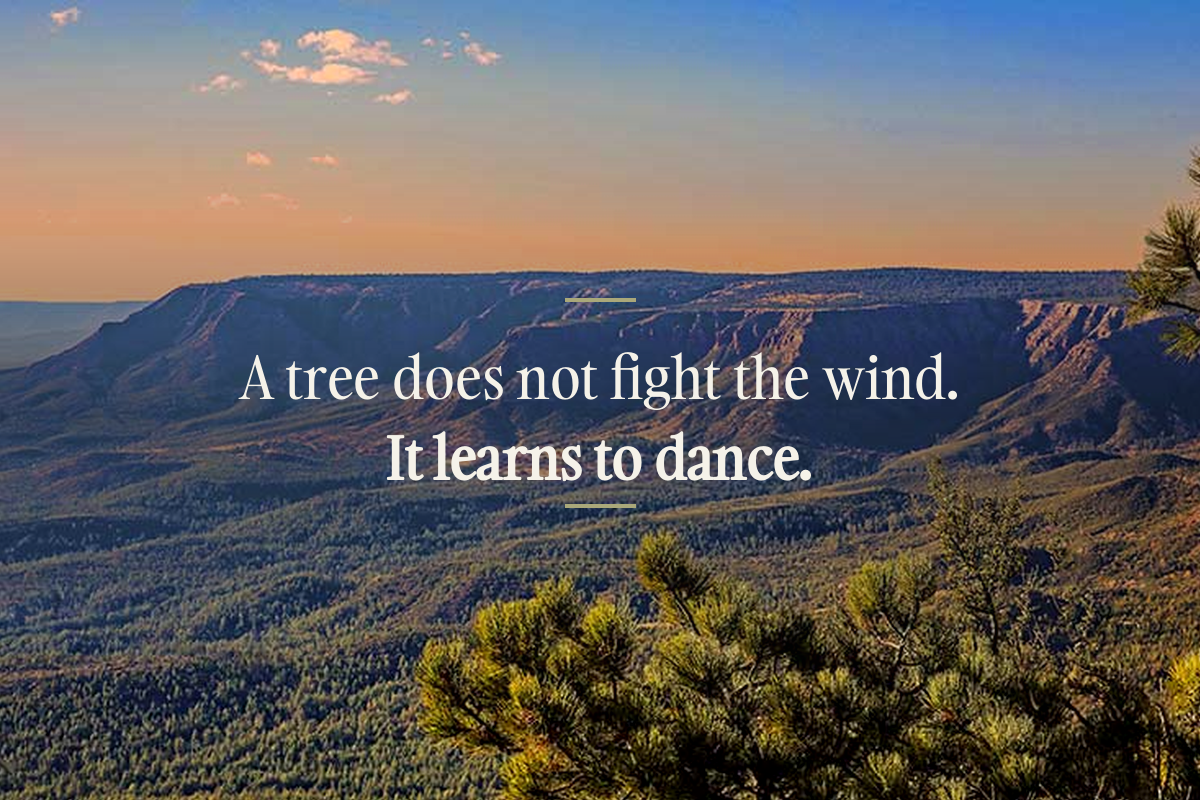
The Mogollon Rim, Payson, Arizona. The tree does not fight the wind. It keeps its roots and learns to move with the life that moves it.
A few words before we begin. This piece touches betrayal, loss, and grief. Go gently with yourself as you read. I write as a guide and a fellow traveler, not a therapist or a doctor. Nothing here is clinical advice or a substitute for the care of a professional. With that said…
~16 MINS READ
WHY YOUR WORDS ARE SPELLS. THE PAINTING THAT HANDED ME POLARITY BEFORE I HAD LANGUAGE FOR IT. THE ROOTING THE MEN PRACTICED WHILE THE WOMEN BROUGHT THE WIND. WHAT A SCATTER OF ELK BONES IN THE PINES TURNED OUT TO BE SAYING. THE FIELD OF ANCESTORS STANDING BEHIND A SINGLE PROMISE. AND HOW A VOW, UNLIKE AN INTENTION, CAN BECOME SO EMBODIED YOU NO LONGER HAVE TO REMEMBER IT.
(The history of vows, the difference between a vow and an intention, the lineages this draws from, how to write and keep your own, and how I hold this work, are all answered in the FAQs below.)
A vow is not a cage you build around love. It is the heartwood you grow, the rings a tree lays down by leaning into the wind, so that one day you can stand in real weather and not break.
High country. Payson, Arizona, on the Mogollon Rim, inside the largest unbroken ponderosa pine forest on earth. The sun had just dropped behind the rim, leaving a low orange pulse along the horizon, and I was barefoot on a flagstone still warm from the day, listening to a circle of people breathe, and the wind moving through two and a half million acres of pine.
It was the second night of a relationship reset weekend held by Flora and Michael, a couple who build these containers for a living. The centerpiece was vows. Not wedding vows. Each of us, coupled or single, would write the promises we were willing to be held to, and before we left the mountain, speak them aloud. Flora and Michael held the whole container. I had come to help carry the men's work, and another teacher would carry the women's. The work, with no incidence on job titles, also came to carry me.
Betrayal and heartbreak had taught me to guard the gate, and I had spent years outside of partnership on purpose, tending the wounds instead of handing them to someone new. Now I could feel a threshold coming, intimacy welcome again, and I wanted to cross it awake rather than armored. So when the pen went around, I did not pass it.
One of the participants had found a set of elk bones in the trees, a scatter of weathered skeleton, carried in and set among us like an offering. I kept looking at them across the weekend, not yet knowing what they were telling me.
This is the story of those vows, the inside of a decision.
The vow is the work. Not the wedding. The writing.
The Tree and the Wind
The night before I led the men, I could not sleep, so I went out under the pines to listen. A grown man, barefoot in the dark, taking notes from a tree. The tree did not find this strange, which made one of us. A tree raised without wind grows fast and tall and weak, then falls of its own weight, because the wood that lets a tree stand is the wood it builds in answer to the wind.
I felt the masculine and the feminine in it. The masculine, whatever body it lives in, is the tree, a still point another can lean into. The feminine is the wind that asks the tree to grow strong enough to dance rather than break. Neither is whole alone, and the tension between them is not the problem. The tension is the music. What I mean by masculine and feminine, energies rather than genders, is in a FAQ below.
And then the wind did a funny thing. It brought me the painting.
Someone in that circle had found a piece by the artist Zachary Brown called "Wind Through the Trees" and carried it to me the way you carry something sacred. I had spent the night reaching for words, and the wind sent me the picture in the hands of another. You cannot grip the wind. You loosen your branches and let it move through.
In the painting, two beings face each other across a forest, one streaming like wind, the other barked like an ancient oak, and you cannot tell whether they are about to clash or to kiss. Which is the point. Standing before it, the weekend's assignment came into focus. A vow is how a tree agrees to keep facing the wind. A weekend like this one can fling every door in the chest open, and a night of heart medicine can do the same. A vow is how you keep one open by daylight, long after the glow has faded.
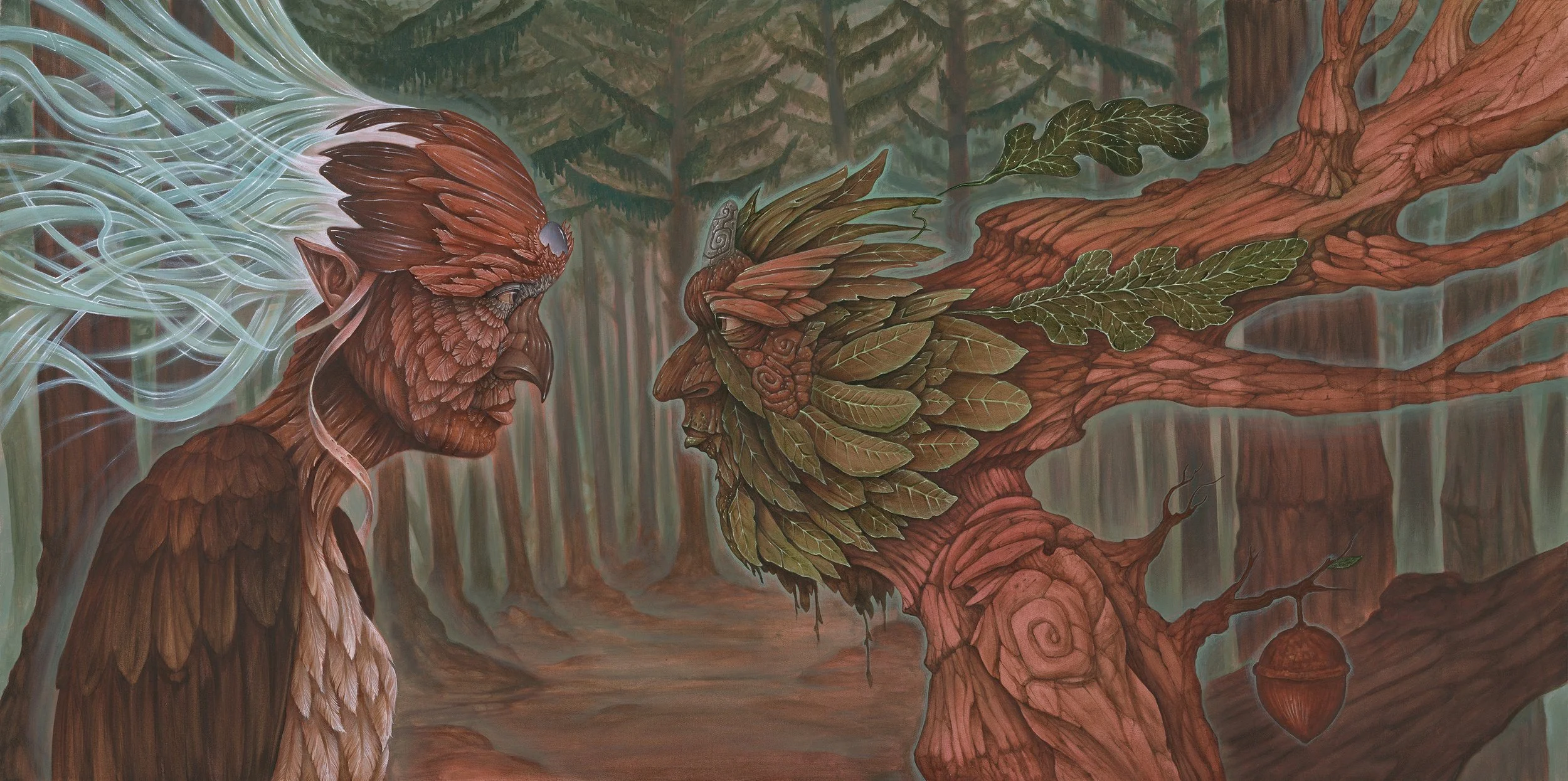
Wind Through the Trees by Zachary Brown, zacharybrownart.com.
“now I become myself. it’s taken time, many years and places.”
The Rooting
The next morning I led the men. Across the clearing, another teacher worked the women toward the opposite pole, into receptivity and the wild aliveness of the feminine. My task was simpler to say than to do. Help the men become ground.
We dropped roots and practiced staying steady while the women, on cue, brought everything the feminine can bring: seduction, distraction, emotion, chaos, play, and finally their hands, trying to knock a man off his center. Not to win, not to dominate. To stay rooted without going rigid, present without collapsing, here without fixing or fleeing. A tree that fights the wind cracks. A tree with no roots goes over in the first storm. The art is the third thing, rooted and flexible at once, so we practiced it in the body before any of us wrote a word.
Rooted is not rigid. Bending is not breaking.
Soil I Could Trust
The instruction manual was never coming, so you wrote it yourself, in pencil, one wound at a time. I did it the hard way, a double major in heartbreak, from a man still learning to open his heart who keeps count of how often he got it wrong. What I have to show for it is a handful of things, maybe five, that seem true, and the form Flora and Michael held is what let me write them down. Flora did not start us with the vows. She lit a candle, and the room dropped from head into heart. She started with a clearing, a taproot sent down from the base of the spine to the center of the earth, and asked us to forgive ourselves for every broken word. Roots first. Then we claimed the ground, fist to the chest. I am who I say I am, in thought, word, and deed. Your words are spells, she said. I have not stopped thinking about it.
Michael held the floor beneath it. Where Flora moved like weather, he was the ground she moved over, ringing the gong, holding the container, bringing us back to breath and body when the fire outran the wood. Playful, real, complementary, neither one the whole. They were not selling perfection but practicing it, honest about their own marriage, the mess and repair of it, two people doing the work without a net.
That weekend reminded me of what I had been too armored to see. That I could be held, not only the one holding, that I could put down the facilitator and be a man in a circle, weeping and undefended, and still be safe. Being held like that taught me the love I am so quick to give others is owed, first, to me.
Something lighter came back with that. I am not trying so hard to earn my place by being useful, or right. There is more plain joy in me now, the kind that does not have to be earned. That joy is not the reward for the vows. It is what they are for.
The work Flora and Michael hold draws on a deep well, attachment science, the parts work that lets us meet our protectors, the body that keeps the score. The names and studies are in the FAQs.
Forgive the broken word first. Only then is the new word clean.
“the meaning of marriage begins in the giving of words.”
The Vows Themselves
Here is what I wrote that night last June. Five vows. Not good intentions, which evaporate by Tuesday, but the architecture of a life, each shaped against a specific place I had run from. A word before you read them. The instruction was not to list goals. It was to go beneath them, past what anyone would applaud, to the essence of who we are and mean to remain, and to write from there. So these run deep, and they are sacred to the one who speaks them, which is why the page that holds mine says so.
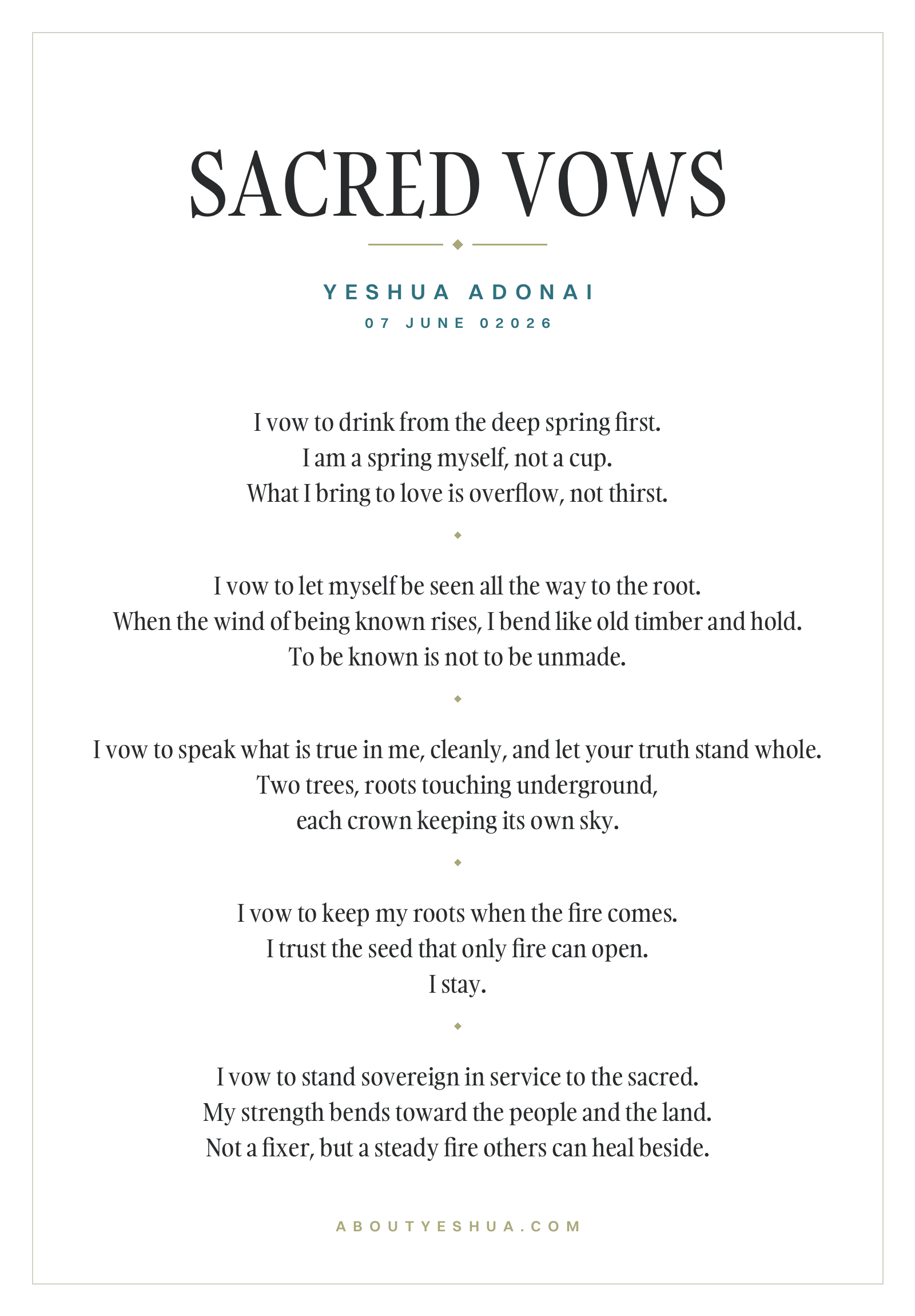
They are not abstractions. Each is the precise countermove to a place I have been wounded or have wounded. Drink from the deep spring first answers a lifetime of loving thirsty. I stay answers the hand that always reached for the doorknob. That is the secret of a vow with power. It is shaped like the wound, pointed the other way.
And if mine read as lofty, do not measure yours against them. A vow is not graded on its poetry; a plain one you keep outranks a beautiful one you only admire, and the truest vow in any circle is the one shaped like your wound, not like someone else's sentences.
The Vow That Revises Itself
A vow is not finished the day you speak it. If you stay honest, it keeps rewriting itself. The first draft of a real vow is often shaped to guard the wound while looking like it heals it. My I stay began as a promise to endure, which was secretly a promise to be the good man wronged, to suffer well and call it love. Only later did it narrow into something truer. Not I will endure anything, but I will stay in the minute after a beloved shows me the thing they were most afraid to show me, because that minute was always where I reached for the door.
So I ask each vow a hard question now. Whose interest does this serve, my growing, or my wound wearing a nobler face? I will not pretend this is done in me. There is a vow here I still catch myself doubting, whether standing in service to the sacred is my deepest devotion or the finest hiding place I have found, the one love that cannot leave me. I would rather hand you a vow I am still correcting than a finished one I am only performing.
Becoming the Right Person
My grandfather gave me the truest thing anyone ever told me about love, one sentence it took me thirty years to understand. We do not find the right person, he said. We become the right person. These sacred vows above are the blueprint for who I am becoming. A vow aimed at a partner is only a hope. A vow aimed at your own becoming is a practice, and the tending is what makes you safe to love.
This is not new ground for me. I have long worn my commitments rather than only spoken them. A small pendant hangs at my neck, a promise necklace, because the promise ring felt a little on the nose. I bought it at a Tibetan bookshop when I was houseless in San Francisco and did not love myself at all, one of the first gifts I gave myself, a bet on a man I would not, at the time, have put money on. I have worn it for over a decade, a reminder that I deserved love at the hour I was sure I did not.
And though I wrote these at what looked like a romantic threshold, a season when love was asking whether I would ever let it all the way in, they were never only about a beloved. The wind moves through every bond, the friend, the work, the morning itself, and a vow is how I keep facing it, whatever door it comes through.
“love consists in this, that two solitudes protect and border and greet each other.”
The Field Behind the Vow
One afternoon, I watched a family constellation move through the room. I will not name the one who stood at the center. I will only say the air changed. As the one holding space carried what belonged to all of us, the personal and the inherited braided into one field, and people wept for the dead they had never met.
None of our stories, it turns out, are only our own. We had all been booked into the same hour to stand in for one another's ancestors, a group project nobody signed up for and everybody, somehow, got assigned. The universe, apparently, runs an elaborate carpool, and I cannot tell you how the weaver books the room.
I only know what I saw. My mother. The father who chose me and stayed. The maternal line behind her. My own children ahead of me. Energy moving through every body in the circle like current through a grid, one person's old pain becoming another's healing balm. I sat there with tears running down my face, undone by how life orchestrates its grand design, embarrassingly moved, the way you weep at a wedding for two people you have only just met.
I had first stood in this kind of field in Cyprus with Stephen Victor back in 2009, and still it found me again, the thread pulling in my chest. And the field carried me back to the vows. A vow is shaped by far more than personal preference. We promise on behalf of those who came before us, and those who come after.
My mother was my first teacher of preverbal betrayal and unconditional love. The man who married her adopted me as his own and has cared for me across a lifetime, my first proof that a person can stay. Behind her runs a maternal line, Scottish and Oglala Lakota, carrying deep trauma and reverence I am only beginning to understand.
I am a small human holding lifetimes of stories, with only a sliver of it clear to me. My fifth vow, to stand in service to the sacred and the land, I did not invent. I am only the latest courier on a long route. That line, the wound it holds and the reverence it asks, is the weather I walk straight into the companion piece, blogpost 33.
A vow is older than the one who speaks it.
The Other Trees in the Grove
I do not want to make this only my story, because it was not. I was one tree in a grove, and the others are why my own roots went deeper. I will keep them anonymous, but no two vows looked alike, and yours will not look like mine.
A man his partner called rock solid vowed to lead with his heart. A woman who runs fast, in heels, vowed to be wildly generous in her receiving. A mother vowed to treat her own needs as sacred. One vowed to stop running from herself. Not one of them the same. There is no correct vow, only the truest one for where you keep getting stuck.
Later, around the cacao, one man said the thing I keep carrying. The longest love of his life had not been a person but a practice, a devotion he had tended for years. Love is not the person you find. Love is the devotion you practice.
The grove holds one more teaching, and I am still early in it. No tree stands alone; the ones beside us feel every shift in our weather, and a pine reads a neighbor by the light it throws and the room it leaves. Look up in an old forest and you see crown shyness, the canopy laced with clean channels of sky where the treetops stop just short of touching, each giving the others light, none of them crowding the grove into dark. That is what orientation is. Telling someone plainly where they stand with you is not a cage on freedom. It is the channel of sky you leave, the thing that lets another rest in the grove you share.
A vow is a private thing, made truer by a circle holding it.
That truth now shapes the Seekers Circle, where returning clients write vows across a winter and speak them witnessed before the circle closes.
The Circle at Sunset
On the last day, as the sun went down behind the rim, we read our vows aloud in a circle. A couple turned to face each other. A woman read hers to a beloved not in the room. Some grieved a love that had changed shape, their vows closer to elegies. Some of us were single, reaching toward a love we were not ready for, or had not yet met.
When my turn came, something released. The vows I spoke came out barer than the ones I had written, shaped by the circle and the light, and I let them. I sang a song calling in new life, and I wept while I sang it. There is a back door to my heart, the one I had bolted after betrayal and loss, and at that sunset I felt the key turn. What bolted it, and the long reckoning it took to feel the key move at last, belongs to the essay that follows in blogpost 33.
I thought again about the elk bones. What stays, when everything soft has gone back to the earth, is the frame. The bones held the animal up against the wind, and they are the last to remain. That is what a vow is. Not the muscle of a feeling, but the structure that lets a life stand when the seasons have stripped away everything that was only mood.
“love is an action, never simply a feeling.”
A Practice: How to Write Your Own Vows
The vow that changed my life was the precise countermove to my oldest pattern. Yours will work the same way. What is the shape of yours, and which way would it point? Here is the practice, the way Flora ran it. One hour, hand and paper, not a screen. Begin before the writing: slow down, move the body, sit in stillness until you drop from head into heart, so the vows rise from the body and not from the wound that is doing the thinking.
Find the pattern. Name in one plain sentence the thing that keeps repeating. I disappear when I am most wanted. I betray before I can be betrayed… If it hides, look at your last three heartbreaks, or the complaint the people who love you keep making. The pattern is usually the thing you defend.
Clear it. Forgive yourself out loud for every broken word, and where you can, those who broke theirs. Name the words as you go; a general amnesty clears nothing. An unforgiven wound hardens a vow into a demand; forgiven, it stays soft and true.
Claim your ground. Hand on your chest, said out loud: I am who I say I am, in thought, word, and deed. Say it until it lands in the body, not just the mouth. A vow written from borrowed ground will not hold.
Write your vows. Three or four. I wrote five, the overachiever and the contrarian sharing a pen, and the fifth had to argue its way in. Each the countermove to your pattern, shaped like the wound and pointed the other way. If a form helps, use the one mine took: the promise, then the image that holds it, then a short line that seals it. Focus is the active ingredient.
Speak them aloud. The voice makes real what the page cannot. Then read them to one person who knows you, an anchor for the days you drift. Choose someone who will ask about them in a month, not someone who will only applaud tonight.
Live them. Twenty-one to thirty days. Each morning, say them aloud, then carry the one your day is most likely to test. A vow does its real work in the small, unwitnessed moments, the text you want to send and do not, the room you want to leave and stay in, the reflex that meets the vow and becomes a choice. When the old pull rises, that is not the vow failing. That is the vow working. Pause, name the vow, and make the one small move it asks: stay, soften, speak, receive. At night, one line on paper. Where did a vow meet the day, and where did I drift?
Make them lived, not only spoken. Give each vow a body and a rhythm you return to, a worn token, a weekly turn outside, a standing tub time. A weekly integrity check, kept on the calendar, because integrity is the first meeting we cancel. The sacred is not above meeting you in a bathtub. And expect the vows to evolve. A life gets new chapters, and the vows should read like the person now living it wrote them. The daily practice, and the one question that saves relationships, is in the FAQs below.
And I can report from inside the first month. As this publishes, I am some thirty days from the night I wrote mine, still in the morning saying, and the changes are small and specific, which is how I trust them. I reach for the deep spring before I reach for the day. I have stayed in a hard conversation past the minute I would once have left it. I have let myself be seen mid-struggle instead of after I had it solved. And the world has been answering in kind, more truth offered, more ease in the rooms I stay in. Nothing dramatic. A vow does not change the weather. It changes what you meet it with.
And go gently. A vow is not pass or fail, but a direction, and it should stretch you, past the edge of who you already are.
So write yours. Not someday. This week, while the wanting is still warm. You do not find the right life out there. You become it, one kept promise at a time. The vow is where the becoming starts.
A vow is not proof you have arrived. It is a root you keep growing into.
Questions to Sit With
What would you vow that you do not yet know how to keep?
Which of your promises is quietly taking ground, and which has gone dead and needs new life?
What would you promise a person you have not yet met?
If a vow could become so embodied you no longer had to remember it, which one would you most want to become?
A Word on Walking This Path
Everything here is the tree, the visible shape you can write and keep. But no vow is made in a vacuum. It grows out of wounds, longing, failure, and inherited stories, and there is weather underneath this one I have not shown you. The severed first bond and the war that taught me to brace. The beloveds I could only half let in, and the honest reckoning that I was not betrayed by the feminine so much as enlisted in the story that it betrays. The slow discipline of becoming a safe man instead of a fixer. You have weather of your own. Every vow does.
Its companion blogpost, Bend: A Reckoning with the Feminine, follows two weeks behind. If this essay was the tree, that one is the wind: the reckoning underneath the promise, why a vow to stay was the hardest one I could make, and how a man learns to stop bracing against the very force that could have made him strong enough to love. It is not only about women. It is the feminine as a force of life, the wind that moves through every real bond, whatever form it takes. The tree holds its shape. The wind is the weather. Neither makes the music alone.
A vow is the tree. But the tree is grown one season at a time, and the growing, not the ceremony where you first speak it, is where a life actually changes shape.
I work with people in two containers, and they are the heart of what I do.
Ceremony container is the full guided journey: weeks of preparation, a full day of ceremony held with screening and a sober steward, and the integration that follows, walked one-on-one across a season.
Coaching container is the ongoing season of integration: six one-on-one sessions, every other week over three months, where the vow stops being words on a page and becomes the person you are growing into. The deepest and most enduring of what I do.
The first is the journey. The second is the long work of living it.
If we are a fit, that is the work I would do with you. A lighter or free first step is open too: book a 30-mins discovery call, download my Ceremony Readiness Guide, the monthly Online Integration Circle and other events, and for those who have already walked with me in ceremony, the Seekers Circle, the six-month arc I open once a year, gathers again at the fall equinox, a season where vows like these are written, tested against a winter, and spoken in circle at its close.
And if we are not a fit, find your people anyway, another guide, a circle, a therapist, so that you never carry alone what the sacrament and the dark reveal. I do not supply substances. What I offer is companionship, discernment, and steady soles for the long walk into who your vow describes.
If this landed, share it with someone ready to write a promise to themselves worth keeping.
From my Heart to yours,
Yeshua Adonai
Psychedelic Guide
Yeshua is a traveling psychedelic guide currently based in Scottsdale, Arizona. A USMC combat veteran, former diplomat, and social entrepreneur working in mental health, he has spent decades exploring contemplative traditions and still counts himself a fellow traveler, learning to trust his own experience along the way.
Frequently Asked Questions
A note on what follows. Some answer the skeptic, some give the history and the research, some speak to where you are in your own life, some are practical, and some are about working together. Skip to what you need.
-
Look at the words themselves. Vow comes from the Latin votum, a solemn promise or dedication, the same root that gives us devotion. Spell, in Old English, did not first mean magic at all. It meant a saying, a story, a thing spoken, and it is the root still hiding inside gospel, the good-spell, the good news. Only later did spell come to mean an incantation, words with the power to change what is. So when I say your words are spells, I mean it plainly. To speak a vow is to put a saying into the world and ask reality to bend around it. That is why we write them slowly, and why we do not speak them lightly.
-
There is real overlap, and that is a feature, not a bug. The difference is in the binding. A resolution is a wish about the future. A vow is a promise that reaches back and reshapes who you are now, made out loud, often witnessed. The behavioral science of "commitment devices," the work of economists like Dean Karlan, shows that a public, staked commitment changes follow-through far more than a private good intention. A vow is the oldest commitment device we have. Further reading: the platform stickK, built on that research.
-
Fair skepticism. A vow is a declared intention, and declared intention is one of the better-studied levers we have. Caryl Rusbult's research showed that commitment, built from satisfaction, investment, and the quality of one's alternatives, is what predicts whether relationships endure. In clinical terms, a vow is what Acceptance and Commitment Therapy calls values plus committed action, said out loud with a witness. The saying it aloud is closer to the active ingredient than the decoration. See the Rusbult investment model.
-
A vow is simply a promise you bind yourself to and treat as sacred, whatever sacred means to you. It does not require a church, a marriage, or a god. The philosopher Hannah Arendt argued that the human capacity to make and keep promises is what lets us build anything lasting at all, a way of setting islands of solid ground in an uncertain future. A vow to yourself, to a friendship, to a craft, to the earth, all count. The form is yours. The binding is what matters.
-
As long as we have been writing anything down. The Latin votum, a promise to a god, gives us vow; the Roman military oath, the sacramentum, gives us sacrament. Marriage vows in the familiar English form were standardized by Thomas Cranmer in the 1549 Book of Common Prayer. Soldiers, doctors, monks, and witnesses have all sworn versions for millennia. For an accessible reflection on how binding promises can free rather than trap us, see the Seen & Unseen essay Making vows.
-
More than you might expect, with honest limits. Studies on solemn oaths find they measurably reduce dishonesty; studies on staked commitment contracts find they improve follow-through on hard goals like quitting smoking. The effects are real but modest, and context dependent, and one famous "honesty pledge" study was retracted for fraud, so be wary of anyone overselling it. The durable, honest claim is narrow: a public, witnessed commitment raises the cost of breaking faith, and that nudge is often enough to change what we do.
-
Because a promise made only in your own head is the easiest one to quietly drop. Arendt held that we cannot truly bind ourselves alone, that a promise needs others to hold it real. A witness turns a private wish into a public fact, and our deep wiring for reputation and belonging does the rest. This is also why ceremony works the way it does. The circle is not decoration. The circle is the enforcement.
-
Energies, not genders. Every person carries both poles, and the charge in a relationship comes from the polarity between them, not from anyone's anatomy. The tree and the wind can live in any two people, in any pairing, in any body. David Deida, whose work on this dance has shaped my own, describes how partners move through first, second, and third stage versions of the masculine and the feminine over a life, from rigid roles, through a reactive rejection of them, into a conscious play with polarity that no longer needs to defend itself. Esther Perel maps the same paradox from the clinical side, that desire wants distance and mystery while love wants closeness and safety. It is the charge teachers of polarity say runs between two people: the masculine a still point, a tree to lean into, the feminine the wind that brings everything to life. We keep trying to smooth that polarity into sameness until the charge is gone, which is how desire goes cold. The tension was never the problem. The point is not to assign roles. It is to stay awake to the dance rather than be danced by it. I go deeper into this terrain in the companion piece, “Bend: A Reckoning with the Feminine” (blogpost 33).
-
Then this is for you most of all. The deepest vow is not to a partner. It is to your own becoming, and to whatever you hold sacred. The vows you make alone, the ones with no one to perform them for, are the ones that make you ready for everything else.
-
Write vows together, fresh ones, for who you are now and not who you were at the wedding. Read them aloud to each other and revisit them on a rhythm, once a season or once a year, asking the honest questions. Is this still true? Where are we taking ground? What has gone dead and wants rewriting? A recommitment made with your eyes open, after children and wounds and repairs, is often truer than the first vow, because now you actually know the person you are promising.
-
They can, if you aim them right. The recurring fight is usually two old patterns colliding, each one a wound reaching for its match. A vow does not fix your partner. It names your half of the loop and commits you to a different move. I vow to stay in the room when I want to flee. I vow to soften before I correct. When each person tends their own half, the fight often loses its fuel. A standing tub time, a weekly hour to ask what is mine to own before I carry it to you, does more than most arguments ever will. The Gottman Institute's research on repair and "turning toward" is a good companion here; see The Gottman Institute. Dan Siegel's interpersonal neurobiology describes the same thing one layer down, two nervous systems slowly learning to co-regulate.
-
More likely, you are protecting different sacred things, one of you guarding freedom, the other guarding clarity, and the argument is rarely about which of you is correct. Two distinctions help. Mystery invites wonder; ambiguity leaves a partner constructing the missing pieces alone, and no nervous system rests while it is doing that math. And listening to Life is a different practice from listening to how your way of moving through Life lands in the body beside you. The first is existential, the second is relational, and a relationship can starve while the first is done beautifully. Sometimes the literal answer to the literal question is the most generous thing you can offer, and mature freedom introduces itself clearly enough that the person beside you can relax without demanding certainty about the future. Stan Tatkin's work on secure functioning treats a couple as a two-person nervous system learning to keep each other safe; see the PACT Institute.
-
Forever is hard to promise honestly. A growing body of relationship research points to a more durable approach, choosing on purpose, repeatedly, rather than drifting. Scott Stanley and Galena Rhoades describe the difference between sliding and deciding, and find that partners who actively decide their commitments report more dedication and satisfaction than those who slide through the transitions of a shared life. A vow you renew out loud, on a rhythm, turns commitment from a one-time event into a living practice. A friendly overview is Stanley's sliding versus deciding.
-
Absolutely, and many couples find these vows more alive than legal ones precisely because nothing external is forcing them. A commitment freely renewed, with no paperwork holding it together, asks both people to keep actually choosing. Write them, speak them to each other, revisit them. The law is not what makes a vow sacred. Your willingness to keep meaning it is.
-
Vows are discovered at least as much as they are written, so begin by listening before drafting. Find the pattern that keeps repeating and name it in one plain sentence. Ask what values are asking to shape your life, and what commitments would still matter on the hardest day. Forgive yourself, out loud, for the times you have broken your word. Draft, refine, and sit with the words before you finalize them, making each one specific enough to actually practice. Then speak them aloud, by candle, in prayer, in nature, in meditation, or in whatever simple ritual feels true, and make the oath not only to yourself but to something larger, God, the Earth, the Universe, your soul, future generations, Life itself. Return to them often, reading, refining, and recommitting over time. The distinction that matters most: do not write vows as aspirations you hope to admire. Write vows as commitments you are willing to practice, revisit, and return to when life tests them.
-
Keep it to three or four. Focus is the active ingredient, and a few vows you can actually live will hold more than many you only admire. I wrote five, and the overachiever in me would like it on the record that I broke my own rule before the ink was dry. The fifth had a reason. My first four moved in a line, how I bring overflow instead of thirst, how I let myself be seen, how two trees stand near each other, and how I stay when it burns. Good architecture, and still the floor felt like a beam was missing. Nothing yet named the thing all of it serves, so sacred stewardship arrived as the fifth. Write the number your life actually requires, and no more.
-
A vow that stays abstract stays asleep, so give it a body and a rhythm you return to. Some wear or carry a remembrance, the way I wear a necklace. Some take a weekly turn outside, dancing or walking, to put the vow back in the body. Keep a standing tub time, a literal tub or any quiet hour at least once a week, to sit with the same few questions: How am I living my vows? Where am I out of alignment? What is mine to own before I carry it to anyone else? That last question is the one that saves relationships. Rather than negotiate every disappointment in the moment, you bring the recurring ache to your own reflection first, and if a partner sits in it with you, come as an inquirer, not a judge. This is sacred stewardship in plain clothes, the ongoing maintenance a living vow requires.
-
Because a vow does not arrive embodied. It travels through stages. First the intention, where the words run ahead of the body and every vow begins. Then the zealot, where you live it loudly, a little preachy, the new convert burning hot. Then the spokesperson, quieter, your life now backing your words. Finally the embodiment, where it has gone into the marrow and you no longer need to announce it because people feel it before you speak. Hollow usually means you are early on the road, not off it. Keep walking until the words are no longer necessary. The slow, embodied version of this is the same work I describe in the Shame Addiction series.
-
Both are a declared orientation set before a threshold, and both run on focus, not magic. The difference is direction. An intention is something you set and then surrender to the sacrament, often focused on what you hope to experience. A vow is something you keep your hand on and enact by repeated choice over time, focused on who you are committing to become. An intention may belong to a ceremony. A vow belongs to a life. Vows are worth making whether or not you ever sit in ceremony. If you are preparing for one, build the vow first, sober, set the intention for the journey itself, then return to the vow in integration to turn insight into a changed life. For the research on how intention shapes a journey, see Haijen and colleagues' prospective study, which found that the intentions and mindset a person carried in predicted both the acute experience and the well-being that followed.
-
Write them before you ever touch the sacrament, while you are clear and sober. Speak them at the threshold, in the hour before, or carry them in to be reaffirmed inside the work. If a partner is part of your life, reading your vows aloud to them before or after the work can be its own ceremony. It lets them understand what you are calling into your life, and lets them witness and support without policing. Then, in the weeks of integration after, return to them as the structure that turns what you saw into how you live. Insight fades fast once the doors close; a vow is what gives the revelation a place to stand. A vow is meant to outlast the journey, a long-term integration tool and not a one-night exercise.
-
You will, and that is built into the practice, not a disqualification from it. The work begins by forgiving yourself for every word you have already broken, because you cannot make a clean promise on a pile of old guilt. When you break one, you notice, you make repair where repair is owed, and you return. A vow is not a test you pass or fail. It is a direction you keep coming back to, and the coming back is the whole discipline.
-
The same act can serve two different masters, and the body can tell them apart even when the mind cannot. Guilt is the counterfeit twin of devotion. It moves you the way a debt collector moves you, paying down an old balance, and no amount of doing ever settles the account, because guilt does not want the behavior. It wants the punishment. Guilt is shaped like the wound and pointed back at you. A vow is shaped like the wound and pointed the other way. The test is the aftermath. Guilt leaves you drained and still owing. A kept vow leaves you more yourself, the way a tree is more tree after a season of wind. If your promises are running on guilt, go back to the practice above and repeat the second step, the clearing. Forgive every broken word out loud, because a vow written on unforgiven ground burns guilt for fuel, and that fire never goes out and never warms a thing. I map how shame and guilt operate in the body in the Shame Addiction series.
-
Daily at first, for the twenty-one to thirty days, said each morning. The popular idea that habits set in twenty-one days is a myth; research on habit formation reports in its full text it usually takes longer, a median of about two months, so be patient with the practice. After that, on a rhythm that fits your life, a turn of the season, a birthday, an anniversary, or a standing weekly tub time. A vow that has gone dead is not a failure; it is information. Tend it back to aliveness or write a truer one. The living revise. A vow you never touch again slowly becomes a fossil.
-
Yes, for those who have already walked with me. The Seekers Circle is a six-month cohort of eight returning clients, fall equinox to spring, where vows are written across the season, tested through a winter, paired with an accountability partner, and spoken aloud in circle before the close. It opens once a year, and enrollment for the 2026–27 arc closes September 8. If you are new to this work, the one-hour practice in this post is the right beginning, and a ceremony or coaching container is the door in.
-
I am based in Scottsdale, Arizona, and I work across the state, including Phoenix, Tempe, Mesa, Chandler, Gilbert, Sedona, Prescott, Tucson, and the surrounding areas. The work is not tied to a single office. I coach preparation and integration remotely with people anywhere, and I travel to clients when it serves, for retreats, immersive experiences, preparation, integration, and in-person psychedelic support. I also travel regularly to Portland, Maine and through New England. If you are wondering whether distance is a problem, it usually is not.
-
Begin small and real. One hour, paper, three or four vows shaped against the pattern you most want to stop repeating, read aloud to one person you trust. If you want company for the deeper, months-long work of turning a vow into a life, start with a free discovery call, the free guide, the monthly circles, and the coaching are all linked in the closing of the post above.
Blog Archive
explore the growing library
-
After the War
- Nov 17, 2025 05 | 11.11: War After War A Veteran’s Battle to Heal
-
Consciousness
- Aug 24, 2026 35 | Beholding: How the Chapel of Sacred Mirrors Returns Your Gaze
- Jun 1, 2026 29 | Leary's Eight Circuits: A Map of Consciousness That Both Frees and Binds
- May 18, 2026 28 | Cancer: The Other Healer in the Room
- Apr 20, 2026 26 | Harvard's Last Psychedelic Intersections Conference: A Practitioner's Review
- Mar 30, 2026 24 | Nonlocal Consciousness: What The Secret of Secrets Reveals About the Nature of Mind
- Mar 23, 2026 23 | Self-Remembering: When the Self Sees Itself
- Mar 16, 2026 22 | Hyparxis: The Dimension Where Real Change Becomes Possible
- Mar 9, 2026 21 | Thresholds: A Psychedelic Guide to Falling Apart on Purpose
-
Finding Purpose
- Jul 13, 2026 32 | Vows: How a Tree Learns to Love the Wind
- Apr 6, 2026 25 | Reset: What Becomes Available When You Choose to Dissolve
- Jan 26, 2026 15 | Beyond Belief: Psychedelics and the Post-Religious Spiritual Path
- Jan 5, 2026 12 | Beginning Again: The Practice of Presence Over Performance
- Dec 1, 2025 07 | Finding Purpose in Midlife: How to Regain Meaning
- Nov 24, 2025 06 | Unlock Leadership Potential With Psychedelic Coaching
-
Psychedelic Path
- Sep 21, 2026 37 | FDA public hearing: The Day the Sacred Was Ruled “Out of Scope”
- Aug 10, 2026 34 | Kaleidoscope: What Is Actually Happening Inside a Mushroom Journey
- Jun 29, 2026 31 | MDMA: Heart Medicine and the Oldest Name for God
- Jun 15, 2026 30 | Ketamine: The Mirror Molecule That Was Always Asking for a Witness
- Jan 19, 2026 14 | Microdosing Magic Mushrooms: A Guide to What Actually Works
- Dec 22, 2025 10 | From Darkness Into Light: Living the Insight
- Nov 3, 2025 03 | Ketamine Therapy Near Me: A Legal Pathway for Psychedelics
- Oct 27, 2025 02 | Arizona’s Psychedelic Awakening: Where Science Meets Soul
- Oct 20, 2025 01 | My Psychedelic Journey: A Path Through the Fog of Depression
-
Sacred Ceremony
- May 4, 2026 27 | Seekers Circle 25-26': Where Preparation Becomes Integration
- Feb 2, 2026 16 | Choosing a Psychedelic Guide: Questions Your Life Depends On
- Jan 12, 2026 13 | Psychedelic Preparation: The Work That Begins Before Ceremony
- Nov 10, 2025 04 | Magic Mushrooms: Remembering the Sacred Intelligence of Nature
-
Shadow Work
- Jul 27, 2026 33 | Bend: A Reckoning with the Feminine
- Mar 2, 2026 20 | The Shame Addiction: What the Body Learns (Part 3 of 3)
- Feb 23, 2026 19 | The Shame Addiction: What the Body Hides (Part 2 of 3)
- Feb 16, 2026 18 | The Shame Addiction: What the Body Carries (Part 1 of 3)
- Feb 9, 2026 17 | Stop Trying to Forgive: What Psilocybin and Grief Teach About Letting Go
- Dec 15, 2025 09 | Grief and the Path Back to Ourselves (part 2 of 2)
- Dec 8, 2025 08 | Grief and the Path Back to Ourselves (part 1 of 2)
- Tools for Integration
trending topics
- psilocybin
- psychedelic integration
- psychedelic guide
- harm reduction
- Arizona
- psychedelics
- integration
- transformation
- Fourth Way
- PTSD
- integration coaching
- letting go
- mental health
- nature
- neuroplasticity
- presence
- psychedelic preparation
- recovery
- self-awareness
- veterans healing
- Gurdjieff
- Long Now
- addiction
- alternative treatment
- becoming
- burnout
- combat veteran
- consciousness
- default mode network
- depression
- emotional healing
- ethics
- grief
- guide selection
- ketamine therapy
- legal
- loss
- magic mushrooms
- masculine and feminine
- mindfulness
- mushroom ceremony
- mystical experience
- personal growth
- plant medicine
- psychedelic healing
- red flags
- relationship healing
- relationships
- rites of passage
- sacred ceremony