
39 | New Moon: The Only Man in a Women’s Facilitator Immersion
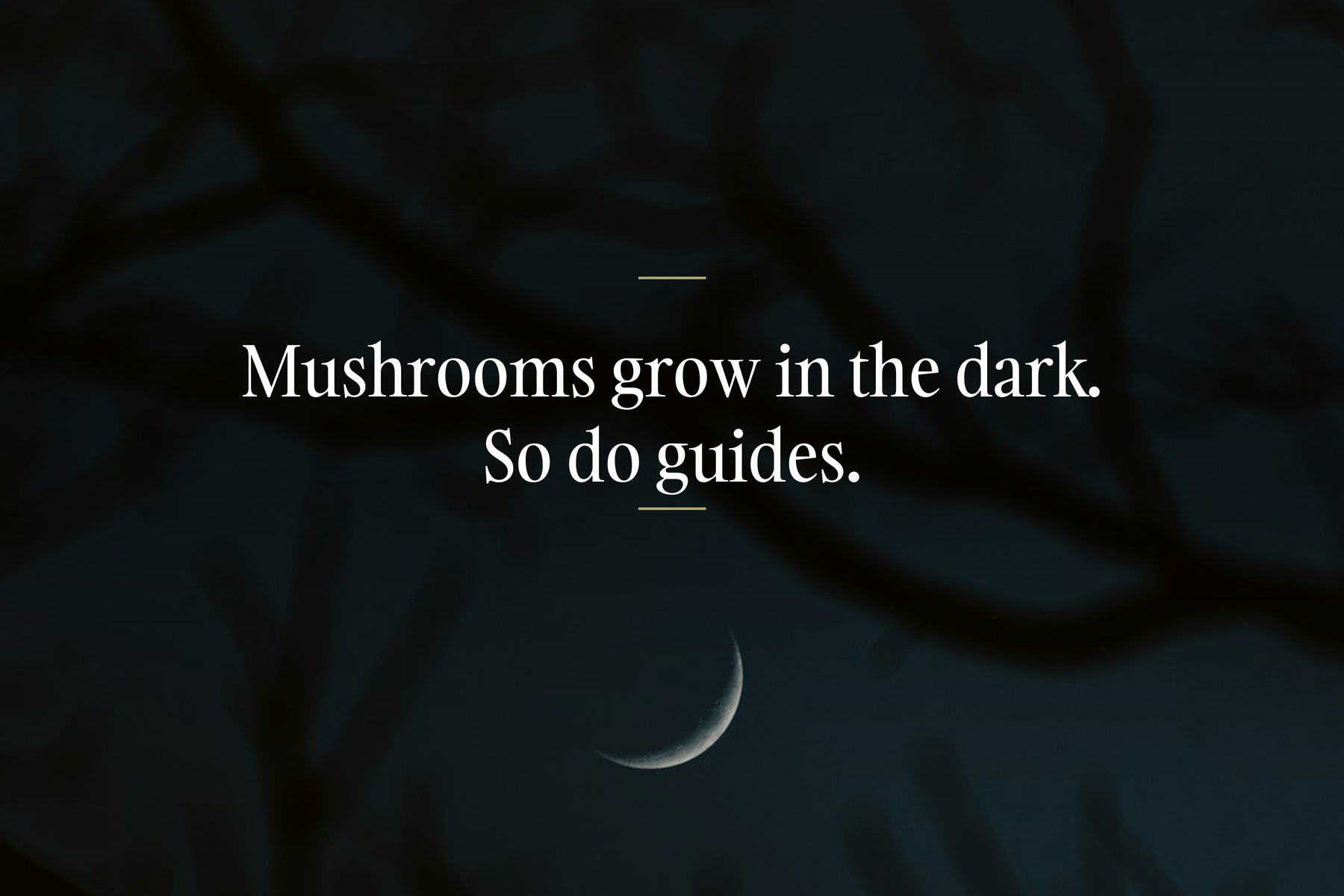
The first sliver after a new moon, through bare branches. The growing happens in the dark. The showing comes later.
The work I offer is for adults 21 and older who are walking this path by their own choice. What follows reflects my personal and professional experience. It is a complement to professional care, never a replacement for it, and nothing here encourages illegal activity. I do not supply substances. Everyone in this story but me stays unnamed, by agreement. So does the land.
~21 MINS READ
EIGHT WOMEN WHO HOLD SPACE FOR OTHERS, AS THERAPISTS AND HEALERS, MOTHERS, GRANDMOTHERS, CAREGIVERS AND FRIENDS, SPENT A SEASON PREPARING TO BE HELD. UNDER A NEW MOON IN AUTUMN, EACH JOURNEYED ONCE AND KEPT WATCH FOR HER PARTNER ONCE. I WAS THE ONLY MAN IN THE ROOM. WHY I SAID YES. WHAT THEIR TRAINING COULD NOT GIVE THEM. THE AGREEMENTS WE MADE IN DAYLIGHT, THE CANDLE, THE HANDS. WHAT THE WOMEN CARRIED, WHAT MOVED MY WAY, AND WHAT MY OWN STANDARD MISSED. THE CIRCLE, IN ITS OWN MOMENTS. AND WHY WE ARE DOING IT AGAIN IN LATE SPRING.
Mushrooms grow in the dark. So do guides.
New Moon
The moon was new that first morning, which is to say it was not there at all. Fall had turned the trees. The last sunflowers of summer stood on the altar.
Eleven of us sat in a circle in a yurt, doors closed against the cold. At the center, one candle. Around it, what each woman had carried from across the country and down through her generations: photographs, pieces of different faiths and lineages sharing one cloth. For the go-arounds we passed a talking stick a medicine man gave me in Ghana, carried as a staff of protection for generations before it reached my hands. I carry it to remember the lineages that hold this work, mine and everyone's.
Ten women. One man. Me. The arithmetic was lost on no one.
I opened with the season. Autumn is the little death, I said. Nature lets go and goes inward. The tree does not argue with its leaves.
Eight sat on the mats. Some hold space for a living, as therapists and healers. All of them hold it somewhere: as mothers and grandmothers, as partners, as caregivers for aging parents, as the friend everyone calls first. Being held is the rarer practice, for them and for me. Each would journey once with a peer keeping watch, then keep watch for that same peer. In this work the one keeping watch is called a sitter: sober, close, and awake for whatever comes. My co-facilitator sat across from me. A support woman sat near the door.
The organizer gave us the image on our first call. In rock climbing, the belayer holds the other end of the rope, feet planted below, keeping the line taut enough to catch a fall and loose enough to let the climber climb. You can learn the knots from a lecture. A lecture has yet to catch anyone. You learn what a climber weighs the day you hang from the rope yourself, and then hold it for someone else.
These women already belay others, at work and at home.
This weekend asked them to hang from the rope.
The Only Man in the Room
The call came from a woman who has worked with me as a client for a few years. She had trained as a psychedelic-assisted therapist, and she came out of that training carrying a question. Could my co-facilitator and I make a container where her classmates could practice what the training could not give them? I said yes. Absolutely, let's do it. Then she organized all of it.
A second question arrived, quieter than the first. Should a man be here at all?
Some of these women had been hurt by men, and the same women had been loved by men too, fathers and partners among them. Some had been taught, young and well, to keep the peace around one. A man at the edge of their journeys could be a comfort or a trigger, and which one would not be up to me. I said yes anyway, and tried to be a safe masculine presence in that room. Not a man without fire. A man who tends his own.
On the land I took the seat I could serve best: structure, schedule, the walls of the container, so my co-facilitator could bring her magic and the women could bring theirs. She is the feminine side of our dance and I am the masculine, and I kept to the edge of mine. When a woman asked me to stay beside her during ceremony, I stayed, hands open, for as long as she wanted. Evenings were different. A few times, around the campfire, someone asked me to stay a little longer. I said goodnight anyway and drove off the land. The boundary was not for that evening. It was for whichever night a woman needed to trust it.
Before the weekend I joked to my co-facilitator that next time I would come as a woman. The laugh was real. So was the nerve underneath it. Being the only one of my sex in a room where anger at men had every right to be spoken, and was. Walking on eggshells so carefully that I might stop being useful.
I said yes, and then I had to keep earning it.
“One does not become enlightened by imagining figures of light, but by making the darkness conscious.”
The Map and the Territory
More than half the women were alumni of a respected psychedelic-assisted therapy training. A year of lectures, research, ethics and role plays. They knew the map in fine detail. Few had walked the territory. What the program could not offer, for institutional reasons, is what no syllabus can hand you: the personal experience of journeying, with someone beside you who knows the terrain, and the professional experience of keeping watch over another person while she is in it. Word traveled, woman to woman, and others who had trained elsewhere asked to come.
I know that wish from the inside. Fifteen years in, with different sacraments, the mushroom among them, I still lie down with a guide keeping watch. Sitting for others has taught me one kind of competence. Being sat for teaches another: what a hand feels like when it arrives, what a silence feels like when it lasts. A map does not get cold at three in the morning. A body on a mat does.
The stories set into this essay are theirs, written from what each woman said out loud in our circles, nothing from a screening, a check-in or the fire, each read by her first and published with her yes. No names, not even the land's. A yes can become a no, and a word from her is enough. Here is the first.
The Traveler. She left this world quickly, she told us, traveling through other times and places with a guide she could feel and could not see. Underneath it all ran one message. "We are all connected. We are here to heal ourselves and each other." Back on the mat, the woman that was her guide painted lines, which she saw as for the places and times she had been. A map of where she went. The thread through all of it, she said, was no longer out there but within. Sitting for her partner the next day, she could not stay still for long, so she moved and danced and stayed present. "That's a growing edge for me," she said: being there for someone while knowing what she needs. By Monday she named it with confidence. She feels called to this work.
In my recommendations for safe psychedelic care, filed with the FDA after its public hearing this fall, I asked that no facilitator sit for a client without significant personal experience with that particular sacrament. The inside of the altered state is the ground every other skill stands on. So this was not a training. It was a practice room, both seats. If you are choosing a guide, ask the simplest question first.
Have you been where you are offering to take me?
A Season, Not a Weekend
Ceremony has begun, as the elders tell us, long before anyone lies down. The weekend is the part everyone pictures. It was the shortest part. No one frames a photo of the screening call. The work ran over a few months, and each woman walked it twice, once as the one being cared for and once as the one caring, the same arc she will one day walk a client through.
Screening. More than a month out, my co-facilitator and I sat with each woman on a call of her own. Contraindications, sure. Mostly we looked at her: where she is in her life, what she is reaching for, what she is afraid of. Then each woman did the same for her partner, from her partner's own intake forms. The aim was not to perform expertise. It was to notice what happens inside you when another person becomes vulnerable.
Preparation. Two group calls, a month apart. On the first we read our agreements aloud and met our partners. Between them the pairs prepared each other: an intention the size of a paragraph, a signal that needs no words, what helps when grief arrives. Then a call as a three, you, your partner, your mentor, so each woman knew whose phone to ring once the weekend was over. Knowing whom to call is one skill. Letting yourself call is another.
Immersion. Three days on the land. Saturday, four women journeyed while their partners kept watch. Sunday, they traded. Monday, we gathered what we had learned and planned the way home.
Integration. A call the day after. Partners meeting inside the week to ask the two questions the weekend was for: what did I learn while receiving, and what did I learn about myself while holding someone else. A pod call with the mentor. Two more group calls inside the first twenty-eight days, one turn of the moon.
Most of what makes it last happens after the cars pull out, in the ordinary weeks when no one is watching but your own life.
The Blank Space. In the picture she described to us, "there was so much happening in the picture, except for the space where I was blank." She had come with one word, transitions, and expected the journey to point forward. It went back instead, to a weight she had not known she was carrying, and showed her she could put it down. When rain began on the roof, it felt like sorrow and grief falling from the sky and washing something clean. The day before, sober beside her partner, she had still been pulled into the peak. She goes home to find her own colors, to let others carry what is theirs, and to her morning laps, where the only focus is breath.
The weekend was three days. The ceremony was a season.
“Nothing ever goes away until it has taught us what we need to know.”
Agreements in Daylight
Weeks earlier, on our first prep call, we had read eight agreements aloud, each woman in her own voice.
Presence. Listen without fixing, rescuing or rushing to fill silence.
Consent. A yes can become a no. No response is not consent.
Confidentiality. Carry the learning, not another woman's story.
The pair. Practice without pretending to diagnose or treat.
The facilitators. Asking for help is good practice.
Spirit. No spirituality used to override a boundary.
Repair. Good intentions do not erase impact.
Stewardship. These are living practices.
The women had already watched the seventh agreement in use. On that first call, I cut my co-facilitator off mid-sentence, caught it, and said so in front of everyone: I mansplained you, and I take accountability. Weeks before anyone lay down, repair had stopped being a word on a list.
Living practices change with the season, and after this one the list reads a little differently. Consent names depth as well as touch: presence alone, a question, a hand, agreed before the door closes. Tend yourself: a depleted belayer is a risk. Integration time is part of the ceremony: start together, end together, stay together. And plan the landing like the launch: warmth, water through a straw, an arm to lean on.
Know the rules well enough to find their edge, I told them on Monday. Not to break them. To find where they end, because that is where we grow.
We agree in daylight so we can let go in the dark.

What the Candle Was For
The first morning, before anything else, we lit one candle.
Fire is a point of transformation in tradition after tradition, so I offered it the way it was offered to me. This is where we send what is no longer ours to carry, our own and some of what was handed down to us. We would light it together each morning and blow it out together each night. One breath to let it all go. One breath to come back.
Then I asked for what I call protection, and I know how that word lands on some ears. We had walked the land with salt, clockwise, four corners. Some shamans carry a mirror to send back whatever does not belong. Ours was made of words, and I asked the women to hold it with me. Whatever is not for the highest good of us here, and of all our relations, goes back where it came from. Does that feel true for each of you, I asked. It did.
Around the fire that first night, a fair question came up. Protection from what? A good share of my practice is energy work. Believe in it or not, you are exchanging more than words with the person beside you. Leaning in too far is its own kind of trespass. Withdrawing all the way is another. I have come to believe that nothing can conquer love. Nothing. So when I am confused or afraid in that room, and I was, the work is one breath to clear, and one breath to return to love, and let it lead.
The Chains Thrown Off. She came looking for freedom, and the journey took her down to find it. From the outside she was so still, so self-contained, that you would not have guessed anything was moving. Sunday morning she told us what was. "I felt the chains being thrown off, and I felt that freedom." Small fierce faces came and went, and she watched them without fear. "I got my strength, and I have a boundary." Then a cliffside, and on it her own people. Freedom, it turned out, had roots. The next day she sat right beside her partner and kept watch. On Monday she turned a longing for community into a practice: "a daily prayer in my future, starting today."
The candle was also a place to return to. A sitter running low could leave her partner in good hands for five minutes, sit at the altar, speak in whatever way was real for her, and come back full. The field asked no one to borrow another's.
At the center, a flame. Around it, a promise to keep returning.
“Everything the Power of the World does is done in a circle.”
Hands Raised
Before anyone journeyed, I asked for a show of hands. Who carries even a glimmer of worry about disturbing the others with sound or tears? Almost every hand went up. Two stayed down, and I gave their owners a look. Let's just be real, I said. It is a human worry, not a woman's, and it still visits me. Spontaneous sound and movement were welcome, and, as my co-facilitator added, one woman letting go might be the very gift the group was waiting for.
By the afternoon the room had taken us up on it: tears, loud sound, women up and moving.
The Big Housekeeping. "A big housekeeping event." That is what she called the first half of her journey, a broom coming through and sweeping it all up and out while her body shook loose what it had been holding. She had come for release, and to reclaim parts of herself she believed were well hidden. They turned out to be in plain sight. Later she felt a heartbeat under everything. What felt cut off, she saw, had only been kept at a distance by fear. "It's not a one and done for me," she told the circle. Her jaw, she said, feels like it holds a key, and she means to turn it a little every day. She was journaling early in the morning.
The Light. The circle sang her first song before she had played a note. She told us she had always wanted to be a musician, "even if it's just for me," and that a small instrument had been waiting a couple of years for her to pick it up. Once, she said, asking what her gift was, she heard the answer: you are the light. So one of the women asked that her first song be "This Little Light of Mine," and they all sang it to her, right there in the yurt. "That never would have happened before, for me to do that." Sitting for her partner the next day, she gave her one word: willing.
Then we talked about touch, and my hands went up a different way. Agree ahead of time. If you want me near, invite me and ask. Then my hands are raised, palms open. You place your hand on mine, and you take it away whenever you want. In the go-around, each woman named her own map. Hands, yes. Feet, yes. Nothing toward the face. One said: still ask, even though I hold hands all the time. Saying a no out loud, in a full room, is a practice too. Consent, I told them, is the point of contact of relationship.
Consent can be withdrawn at any time. It cannot be added on to once the journey begins.
Two Seats, One Rope
I knew the design. I did not know how intimate it would be.
The sitter who saw her partner cry, shake, laugh and go silent for an hour lies down the next day while that same partner keeps watch. What she learned about giving care becomes, overnight, what she hopes to receive. One sober sitter felt the peak arrive in her own body. All of us are in this altered space together, I had told them, whether you are taking substances or not. Here the power kept circling, like a thread passed hand to hand until it became a web. You are gentler with someone's vulnerability when yours is next.
Four journeying a day, a sober sitter at every mat, a support woman within reach, two of us floating: the one facilitator for every three I proposed to the FDA, with a trained peer in the second seat. Eleven of us. No one alone.
Ask a first-time sitter what crosses her mind around hour three. How do I do this well? By Sunday night each of them had found her own way of keeping watch. One prayed. One danced. One called it play, two children on an adventure. None of them was wrong.
The Waiting Room. Her journey began in a waiting room. "I felt like my mind was keeping my physical body in a waiting room," she told us Sunday morning. She had come to crack her heart open. For a long time, nothing cracked. After a few tries she saw the waiting would not end on its own, and she asked for help, not knowing what kind. The presence of a witness. And weight, it turned out. The biggest sitting cushion pressed to her chest, then tears. "My heart gave birth to myself, and I had a baby in my hands." The next day she sat for her partner and called it play, two children on an adventure. "Crying and laughing are two really close sisters." She carries home a fierce protectiveness for that new self, and a wish to let her be daring too.
The Unguarded Moment. For a long while the journey seemed not to come. Then it did, and she said it better than I can. "The mushrooms hadn't given up on me. They were waiting for an unguarded moment." The day before, she had sat for her partner and watched her move from confusion into pure joy. What she took from that seat was simple. "Every time I looked at her, she was smiling." In the closing circle she named the vow she had carried in, to lay down her arms and her armor, and said she had felt safe enough this weekend to lean into it. She asked for a nudge now and then to keep her daily practice. Several women answered at once. I'll do it with you.
Sunday morning, before the roles reversed, my co-facilitator led a limpia, a cleansing. Each woman bound a broom of herbs and swept away the role she had carried the day before: the importance of having been needed, the urge to keep carrying another woman's process. The herbs went to the fire, not the compost.
Autumn knows this practice by heart.
“Mitakuye oyasin. All my relations.”
Ten Feet Away
A sitter who wanted badly to warm her shivering partner held back a long time, afraid of interrupting. When she finally asked whether her partner was warm enough, it landed as relief.
Oregon's licensed program asks facilitators to be non-directive outside of safety, and I share most of that. Imposing meaning on someone's journey can be harmful. So can leaving her alone in a hard passage. Choosing when and how to intervene is itself the competence.
On Saturday morning I drew it as a spectrum. At one end, hands open, here to watch: I see you, I will catch you if you fall. At the other, the guide who leans in, asks a question, offers a hand. In practice I start about ten feet away and read from there, a step at a time. Which step a moment calls for cannot be decided in advance. The permission can.
On Saturday I misread a step. A sitter waved me over, and I pulled up a chair and offered more than presence, a question, a nudge, when the journeyer's consent had been to be sat with. She told me so that evening, and I was blindsided. Here is the part I would rather leave out. My first move was not to listen. It was to explain. She asked whether I was willing to sit with that, and it took my co-facilitator stepping in before I stopped talking and sat with it.
The next morning I went back, thanked her, said sorry for what had felt like crossing her boundary, and asked how I could practice being more attuned. On Monday my co-facilitator said it plainly: I came in as a teacher when the moment wanted a human. Part of me still wanted the journeyer to have said no sooner. Deep in a journey, the women reminded us, the voice does not always come. The lesson was mine. Hear sooner. Our consent agreement now names depth as well as touch because of that hour, and my old opener, can I have a moment, has become a question with a no built in: would you like a reflection right now?
Drug, set and setting, Norman Zinberg called it. The sacrament was the medicine, and so was the sitter's steadiness, the cold, the candle, the agreements made in daylight, and the trees standing over us. The Fourth Way calls it self-remembering: the sitter stays awake to herself while she watches.
Who stays awake is part of the medicine.
What They Carried
Over three days we listened as their facilitators, and I listened as a man. What follows are patterns, not anyone's story.
Tending. These women give for a living and for love: clients, children, aging parents, partners, friends, entire households. One journeyer apologized for needing to lie down longer, as if her rest were slowing the group down. And a harder lesson, in one woman's words: some of it is theirs to carry, and doing it all for them is a disservice.
Asking. An old voice ran under journey after journey: don't be too much, don't ask, handle it. Help came after someone said the hardest sentence in the room. I need help, and I don't know what kind.
Voice. Some said their voice goes quiet in altered states. Some found it again on the mat. Some found it the next morning, sober.
Armor. Built young and built well, by girls who figured out how to stay safe.
Lineage. The weight the women before them carried and handed down.
Worth. The long trance of not enough.
Desire. Wanting, for no one's sake but her own, and going looking for it again.
Opposites. Gentle and fierce. Crying and laughing. Learning that they can live in the same body.
Belonging. Under all of it, a longing for the ones who would still be there long after the weekend ended.
Node to Node. By Monday afternoon, she was asking the whole circle to honor the dark. "Seeds grow in the dark and mushrooms grow in the dark and babies develop in the dark." She had come to walk in beauty, and the journey kept faith with it. She moved through the people she loves. "It was like going node to node almost." Each one, she said, a node of loveliness and love. A long wave of grief came too, and she let it come and go until rest arrived. The day before, sitting beside an utterly still partner, she waited, and when her partner surfaced and began to speak, she wrote it all down. She carries home a question: how gentleness and fierceness can live in the same place.
Her invitation gave this essay its first line.
Do you recognize any of them in yourself? I recognize a few in me. On Monday, I told them what I tell myself when the trance of not enough comes back. Remember you are enough when you forget, a thousand times, ten thousand. Remember, and come back. This moment is enough.
Choose love. It is never done.
“Remember yourself always and everywhere.”
What Moved My Way
As a man, I cannot know most of these from the inside, and one or two I know too well. What I can know is my part in the story they push against. Men taught more than a few of these lessons, for generations, sometimes on purpose and sometimes by not noticing. My work in that room was smaller and harder than fixing any of it. Stay steady. Hold the frame. Be one man who would not take up the space they were reclaiming.
And I know a piece of it from my own life. I have known abuse. I know how it teaches a body to read a room before entering it, and how long it can take to trust a hand again. For years now I have been looking for right relationship between the masculine and the feminine, first within myself, then between me and the ones I love.
What surprised me was the healing that moved in my direction. I watched women work with the men in their lives, fathers and partners and the ones who did harm, while one man sat nearby, trying to do no harm, and once getting it wrong. More than one said afterward that a man in the room changed it, that some of what they touched they could not have touched without one there. They chose to include me. I did not expect how much that would mean, or how far it would reach into the part of me that once needed the same. In Bend, I wrote that after all that training, the summit is a man leaving a room calmly. My reckoning with the feminine began on that page.
This weekend was its practice room.
What the Leaves Let Go
The trees around us were doing what we were trying to learn.
What held was the pairing, and the season around it. And the small promises. Several left with a daily practice named out loud, and a woman or two who promised to ask about it. Some left feeling called to this work. Others left to care for their families with steadier hands.
What bent was time. On Monday the world started pulling, and the closer the end came, the more the room renegotiated. My co-facilitator bends for a real need, and she is right. You cannot refuse one. I protect the container, because when integration time slips, we teach that it matters until it is inconvenient. When the last car had gone, the first thing I told my co-facilitator was that I wanted to keep creating with her. The second was a question: where had I been off? We have a good groove, she and I, and it survives the question.
The Music. My co-facilitator held the room through sound. She played live, reading each woman through the speaker, and chose songs for some of them, a lineage here, an intention there. She brought the herbs and led the limpia, the sweeping that let each woman set down the role she had carried. On Monday she shared a reflection I keep returning to. Breaking bread on the first night, she thought of the single grain of wheat in it, the seed's long lineage, the sun and the hands that tended it, and how it got to become her. "What a wonderful journey for that piece of grain to get to become you." For a woman who has given a great deal, it was a quiet act of receiving.
I came in tired, and I said so in circle on Monday, because a guide who hides his fatigue teaches the room to hide theirs. A guide is not someone without mistakes but someone who tends them. This weekend handed me a few to tend.
What my standard missed was the sitter: the woman who journeyed yesterday and keeps vigil today, still tender, now responsible for someone else. The limpia did that work here. A standard should name her, and name the support team, who carry their own weather. Our support woman out-served me all weekend, and the standard has no line for her.
The Floater. She said she had never done anything like this. She told the closing circle she had been "super nervous" just to come, even without journeying, and that a warm welcome in our group thread steadied her. Then she spent the weekend steadying everyone else. Tea and water, blankets and heaters, the cold walk to the outhouse, the hundred small things a circle needs and never sees. Her own moment came when the women had surfaced and moved to the table to eat. With the room held and nothing left to carry, the space was finally hers, and she dropped into tears and let it all move through her. No sacrament, no mat. The same release the journeyers had found, arriving through the back door of service. And on Sunday night, at the dishes, she practiced the other half: this is a lot, would you help?
It is thin on the landing too: whoever keeps vigil stays until the one in their care can stand without them.
Come autumn, drop what was necessary all summer. Keep the roots.
“No mud, no lotus.”
Full Moon
On the last morning I told them my cup was overflowing. Before the cars pulled out, the question came more than once. When are we doing this again?
That evening, alone at the cold fire pit, I watched the crows gather as the light went. They had no notes.
The weekend was the fruiting. Integration is where the spores land. The spores, it turns out, have a group chat. The women's Signal thread became a daily one almost overnight. When one of them asks for help, it arrives faster than most clinics return a call. Partners and pods meet on their own terms, with no facilitator in sight. That longing for community they named in circle found its way home before they did. We did not build it. We made room for it to grow.
The Land. The hosts welcomed us by asking us to see the land as part of the ceremony, not the backdrop. They fed us from it: bread baked that afternoon, passed hand to hand, smelled and thanked, a piece offered back to the forest. On the last evening we sat together and asked how to come to a place like this in a good way. We all agreed that even with offerings it can still feel a bit extractive. People arrive, have their experience and leave. So we dreamed out loud. A trail down to the water, so a journeyer could walk to the brook, say a prayer and climb back. A work party, the kind where attention itself is the practice, so the next circle leaves a little more than it took.
If you were in that yurt, here is my one nudge, offered with hands open. Give your integration a season, not a week, and give it company. Bring your sitter. She already knows where you keep the blankets.
I am still learning to lead a gathering like this one, and still learning the dance it asks of a man. I lean in when a moment wants me still. I overbook. I protect the ending by standing firm while my co-facilitator protects the people by bending, and the room needs both of us. If you see where I got it wrong, tell me.
The moon was new when we lit the candle. It filled while I was writing this, and it is thinning again as I finish, a week from dark. Our last group call of the season lands the night before it goes new.
What we planted in the dark will have had time to stir.
The Next New Moon
Late spring. That is my answer to the question at the cars, and my co-facilitator's too. We sat with it through the fall. What we are building is a longer arc than this one. Two extended weekends on the land instead of one, inside four or five months of support sessions around them, with the practicum at the center. Open to men as well, unless the women ask otherwise. We have no wish to repeat what the guide trainings already teach well. We mean to fill what they leave out.
A good training hands you the map: pharmacology, ethics, research, role plays. Then it stops at a line it did not draw. A program that answers to a licensing board, or lives on government grants and their oversight, cannot put a practitioner on the mat with the sacrament, or beside a peer who is on it, and it cannot stay for the months after. So graduates meet their first real altered state as the one responsible for it. My recommendations to the FDA ask for the opposite: no one sits for a client without first-person experience of that sacrament, and the day and the care around it are one offering. A standard like that creates a need the institutions cannot meet. Practitioners meeting it for one another is how the field closes its own gap.
Who it is for has widened. Therapists and social workers whose training could not offer the practice. Nurses, chaplains, somatic practitioners and grief workers who already sit at thresholds for a living. Psychedelic facilitators and guides, wherever they practice, who want a circle of peers and a mentor's eye. And the ones building a practice, calling and training in hand, with no one yet to show them how to do it in integrity. I have mentored that walk for years, one guide at a time. A circle does it better. If you work inside a system with a line you cannot cross, you know where it runs better than I do, and I will not ask you to cross it.
The rope is ready. Come hang from it.
Questions to Sit With
Where in your life are you the only one of your kind in the room, and what does it ask of you?
What is your autumn asking you to let go of, and what is the root that stays?
What would you need agreed in daylight before you let yourself be held?
A Word on Walking This Path
If any of this landed on a bruise, go slowly tonight. If you are in crisis in the United States, call or text 988.
The belayer and the climber need each other. So do the one who opens in an altered state and the one who stays steady beside her. The peak is a single day. What changes a life is the support around it, before and after, over weeks and sometimes seasons.
If you want company for that part, here is how to walk with me:
Integration coaching: a season of one-on-one sessions every other week, renewable. This is the heart of my work.
Ceremony: the full guided journey, with weeks of preparation, a full-day ceremony with screening and a sober steward, and integration one-on-one across a season.
Circles: the monthly integration circles I hold in Arizona, New England and online, and, for existing clients, the Seekers Circle, a six-month cohort that walks together.
The free Ceremony Readiness Guide, if you are earlier on the path.
If you are a guide, therapist, nurse or chaplain looking for practice in the other seat, or building a practice of your own, write to me. The late-spring circle is forming now.
If we are a fit, that is the work. If not, find your people: a guide, a circle, a therapist. I offer companionship, discernment and the willingness to listen and stay.
Next letter, a different room altogether. A week where nothing is ingested, and the curriculum is the body, consent, sex, and the sacred.
If this essay found you, share it with the friend who holds everyone and has not been held in years.
From my Heart to yours,
Yeshua Adonai
Psychedelic Guide
Yeshua is a trauma-informed psychedelic guide, integration coach, and writer. A Marine Corps combat veteran, former diplomat, and mental health executive, he serves sacred mushroom and MDMA ceremonies, integrates ketamine treatment in clinics, supports clinical trials, advises policymakers and organizations, and mentors new guides while building technology for the field. He lives in Scottsdale, Arizona, keeps an office in Gilbert, and travels the country, including monthly to communities around Portland, Maine. Most of his work is remote. He counts himself a fellow traveler, still learning to trust his own experience. Posts arrive every other Monday at aboutyeshua.com.
Frequently Asked Questions
The essay carries the story. These answers hold the practical detail and the sources, and they can be read in any order.
-
Because the inside of the experience teaches what no lecture can. Time bends. A small kindness can feel enormous, and a hand arriving unannounced can feel like a wall falling. A guide who has been held knows from her own body what helped and what intruded, and she will sit differently because of it. I wrote about the terrain itself in Kaleidoscope. You would not hire a river guide who had only read about rapids. At the fire that first night, I put it the way I put it to everyone. You can eat all the berries at once and poison yourself. You can avoid the bush for the rest of your life. Or you can find a way to get tuned.
-
Most offer excellent theory, ethics and research, and some add breathwork or role play. Few can offer supervised sessions with the sacrament, for legal and institutional reasons, so graduates often finish without having sat for anyone in a real altered state. That is a limit of where the programs live more than a failure of the people teaching in them. One review of firsthand experience of non-ordinary states in therapist training argues that it supports trainees' comfort and confidence, in a field with few guidelines for developing competence. Peer practice and mentorship close some of that gap.
-
It is a practicum, not a training. No one left with a certificate, and no one was graded. Eight women formed four pairs. Each journeyed once with her partner keeping watch, then sat for that same partner the next day, while my co-facilitator and I led the whole group with a support woman beside us. The weekend sat inside a few months of work: screening, peer screening, prep calls and mentor calls before, and a month of integration after, the same way I describe preparation for any ceremony. A weekend like this gives a first taste. A certificate gives permission. Neither is competence. In the traditions I trust, no one leads ceremony for others without first being held in it, again and again, and the elder sits inside the circle, not at the front of it.
-
Oregon's licensed program requires facilitators to be non-directive: warm and affirming, no advice or interpretation, with the client setting pace and direction. Its curriculum guidance allows a facilitator to become directive when safety is at stake, and it also teaches discerning when to intervene and when to step back. I share most of that, especially the refusal to impose meaning on someone's journey. Attuned intervention puts a relational spectrum inside that discernment: presence, proximity, a word, touch only as agreed, an invitation back to intention. The permission is set before the journey begins, and the step is read in the moment.
-
I asked that no facilitator sit for a client without significant personal experience with the sacrament, that the day and the care around it be treated as a single offering, and that groups stay at twelve or fewer with one trained facilitator for every three. I also proposed lighter alternatives to two facilitators in every session, such as a trained peer as the second seat and a seasoned mentor within reach. This weekend ran that model, and it showed me where my own standard was thin (the sitter who journeyed yesterday, and the landing after the peak). You can read the full recommendations for safe psychedelic care, docket included. The weekend was practice, not proof.
-
The woman who organized it, a longtime client, asked for the two of us, and the design gave each of us a clear role. My co-facilitator led the more embodied practices and stayed on the land overnight. I held structure and the container, kept my hands raised and open, and stayed beside any woman who asked during ceremony. In the evenings, I said goodnight at the fire and slept off the land, even when someone asked me to stay a little longer. More than one woman said a man's steady presence changed the room for the better, and I took that as trust to be guarded, not a compliment to keep. I wrote about my own reckoning with the feminine in Bend.
-
Before anyone journeyed, every woman named out loud which kinds of touch were welcome and which were not. Each pair also agreed how much leaning in was welcome, from presence alone to a question or a hand. During a journey, consent can be withdrawn at any moment but never expanded, and sitters still asked again in real time. As the only man present, I offered raised and open hands only, for a journeyer to take or release. It follows the minimum standard I laid out in Vigil: all consent in daylight, in plain words, and touch never sexual or suggestive.
-
No one but me is named, and the land, the women's training program and my co-facilitator stay unidentified. In a small field, profession, place and age together can point to a person, so that combination stays out too. Any story told at length about a specific woman appears only after she has read the full essay and chosen yes, yes with edits, or no, with no reason needed. Our agreements put it simply: carry the learning, not another woman's story. My Seekers Circle recap followed the same principle.
-
Start where the law and your license allow, and move slowly. Look for experienced facilitators who screen with care, write agreements with you and stay for integration, and find a mentor who has sat in both seats again and again. Learning to stay present with someone else's altered state can also begin with nothing in your own body, for example as a trained volunteer on Fireside Project's support line, which offers free peer support during and after psychedelic experiences. Keep a peer circle you answer to. And never let a container override your own discernment, including mine.
-
Fifteen years in the client's seat, with a guide beside me, across different sacraments. Hundreds of sits on the other side of the mat. And more than a hundred and fifty aspiring guides I have helped gain that personal and professional experience, then mentored as they built their practices. Most of them had read a great deal. Few had sat beside a stranger through a single long night, through the stretch when the music goes quiet, the room goes strange, and nothing in the binder applies. That stretch is the curriculum, and the only way I know to teach it is to be in the room. I keep my own teachers too: a circle of guides I meet with every other week, and the vows I answer to.
-
She asks a facilitator to cover her for five minutes, sits at the altar, and speaks to her guides or her ancestors in whatever way is real for her. One practice that works for me comes from the kriya lineage: draw the energy up the spine with the breath, hold it, and send it out through the heart. If that is not your way, find your own source of vitality and go to it before you run dry. The technique matters less than the habit. A depleted sitter is a risk to two people, and the agreement we adapted this fall says so out loud.
-
More than we gave it, so far. Our hosts asked us to treat the land as part of the ceremony, and fed us from it. On the last evening, I admitted, and our hosts agreed, that even with offerings, arriving at a place, having an experience and leaving can still feel extractive. So we dreamed out loud about next time: a trail to the water so a journeyer can walk to the brook and pray, and a work party where attention itself is the practice. A standard of care might one day ask the same of all of us: reciprocity with the ground that holds the work, the way I asked for it in Vigil.
-
I work between Arizona (Scottsdale, Phoenix, Mesa, Gilbert, Sedona) and New England, and online. The next practitioner immersion is in planning with my co-facilitator for late spring in New England: two extended weekends on the land rather than one, inside a longer arc of support sessions, four to five months as we see it now, with the practicum at the center. It is open to men as well as women unless the women ask otherwise, and it will not repeat what the guide trainings already teach well. Places go by invitation or existing relationship, so I would rather hear from you early than announce a date to strangers. Integration happens online wherever you live, through integration coaching. If you are a guide or therapist looking for practice in the other seat, book a discovery call and tell me where you are on the path.
-
Many of the women in this circle carry a license, and the question of what it allows was in the room from the first call. I cannot answer it for you, and I will not ask anyone to cross a line her board or her funder has drawn. What I can say is what we offer and how: a container made by practitioners for practitioners, for adults choosing it freely, with nothing supplied, screening before anything else, consent agreed in daylight, and integration held for a season after. Confidentiality runs through all of it, from the tools we use to the way this essay was written. Some of what you are looking for can be practiced with nothing in your body at all, as the sitter, the support woman, or the one who screens and prepares a peer, and that practice counts. Read my recommendations for safe psychedelic care, talk with your own counsel, then book a call and tell me where you stand.
-
Screening went further than is this safe. Intention, fears, boundaries, touch, who is at home, prior experience, relevant health, and what would need a senior eye, asked the way a facilitator asks, without turning curiosity into interrogation or peer practice into diagnosis. Preparation distilled the intention until it fit in a written paragraph, then learned the person: how she journeys, a signal that needs no words, what helps when fear or grief arrives, music louder to feel held or softer to feel free, water through a straw, eye shades, and what would tell either partner it was time to bring a facilitator in. The packing list was part of consent too: cold nights, rustic showers, an empty stomach the morning you journey. The mentor call as a three came last, so that consultation was practiced before anyone needed it. The free Ceremony Readiness Guide holds the questions I ask when I screen and prepare anyone, and the pairs borrowed from it.
Blog Archive
explore the growing library
-
After the War
- Nov 17, 2025 05 | 11.11: War After War A Veteran’s Battle to Heal
-
Consciousness
- Aug 24, 2026 35 | Beholding: How the Chapel of Sacred Mirrors Returns Your Gaze
- Jun 1, 2026 29 | Leary's Eight Circuits: A Map of Consciousness That Both Frees and Binds
- May 18, 2026 28 | Cancer: The Other Healer in the Room
- Apr 20, 2026 26 | Harvard's Last Psychedelic Intersections Conference: A Practitioner's Review
- Mar 30, 2026 24 | Nonlocal Consciousness: What The Secret of Secrets Reveals About the Nature of Mind
- Mar 23, 2026 23 | Self-Remembering: When the Self Sees Itself
- Mar 16, 2026 22 | Hyparxis: The Dimension Where Real Change Becomes Possible
- Mar 9, 2026 21 | Thresholds: A Psychedelic Guide to Falling Apart on Purpose
-
Finding Purpose
- Jul 13, 2026 32 | Vows: How a Tree Learns to Love the Wind
- Apr 6, 2026 25 | Reset: What Becomes Available When You Choose to Dissolve
- Jan 26, 2026 15 | Beyond Belief: Psychedelics and the Post-Religious Spiritual Path
- Jan 5, 2026 12 | Beginning Again: The Practice of Presence Over Performance
- Dec 1, 2025 07 | Finding Purpose in Midlife: How to Regain Meaning
- Nov 24, 2025 06 | Unlock Leadership Potential With Psychedelic Coaching
-
Psychedelic Path
- Oct 5, 2026 38 | Vigil: A Safety Framework for Psychedelic Care
- Sep 21, 2026 37 | FDA public hearing: The Day the Sacred Was Ruled “Out of Scope”
- Aug 10, 2026 34 | Kaleidoscope: What Is Actually Happening Inside a Mushroom Journey
- Jun 29, 2026 31 | MDMA: Heart Medicine and the Oldest Name for God
- Jun 15, 2026 30 | Ketamine: The Mirror Molecule That Was Always Asking for a Witness
- Jan 19, 2026 14 | Microdosing Magic Mushrooms: A Guide to What Actually Works
- Dec 22, 2025 10 | From Darkness Into Light: Living the Insight
- Nov 3, 2025 03 | Ketamine Therapy Near Me: A Legal Pathway for Psychedelics
- Oct 27, 2025 02 | Arizona’s Psychedelic Awakening: Where Science Meets Soul
- Oct 20, 2025 01 | My Psychedelic Journey: A Path Through the Fog of Depression
-
Sacred Ceremony
- Nov 3, 2026 39 | New Moon: The Only Man in a Women’s Facilitator Immersion
- May 4, 2026 27 | Seekers Circle 25-26': Where Preparation Becomes Integration
- Feb 2, 2026 16 | Choosing a Psychedelic Guide: Questions Your Life Depends On
- Jan 12, 2026 13 | Psychedelic Preparation: The Work That Begins Before Ceremony
- Nov 10, 2025 04 | Magic Mushrooms: Remembering the Sacred Intelligence of Nature
-
Shadow Work
- Jul 27, 2026 33 | Bend: A Reckoning with the Feminine
- Mar 2, 2026 20 | The Shame Addiction: What the Body Learns (Part 3 of 3)
- Feb 23, 2026 19 | The Shame Addiction: What the Body Hides (Part 2 of 3)
- Feb 16, 2026 18 | The Shame Addiction: What the Body Carries (Part 1 of 3)
- Feb 9, 2026 17 | Stop Trying to Forgive: What Psilocybin and Grief Teach About Letting Go
- Dec 15, 2025 09 | Grief and the Path Back to Ourselves (part 2 of 2)
- Dec 8, 2025 08 | Grief and the Path Back to Ourselves (part 1 of 2)
- Tools for Integration
trending topics
- psilocybin
- psychedelic integration
- harm reduction
- psychedelic guide
- Arizona
- psychedelics
- integration
- integration coaching
- transformation
- veterans healing
- FDA psychedelic hearing
- Fourth Way
- Gurdjieff
- Long Now
- Oregon psilocybin
- PTSD
- letting go
- masculine and feminine
- mental health
- nature
- neuroplasticity
- presence
- psychedelic preparation
- recovery
- self-awareness
- FDA public hearing 2026
- MDMA-assisted therapy
- REMS
- Seekers Circle
- White Oak
- addiction
- alternative treatment
- becoming
- burnout
- chaplaincy
- combat veteran
- consciousness
- consent
- default mode network
- depression
- docket FDA-2026-N-7542
- emotional healing
- ethics
- grief
- guide selection
- ketamine clinics
- ketamine therapy
- legal
- loss
- magic mushrooms